「Real World」と一致するもの

ISSUGI - ele-king

 ISSUGIが2022年にリリースした9枚目『366247』。そのデラックス盤が完全限定プレスのアナログ盤でリリースされることになった。デラックス盤には、デジタルのみで配信されていた“366247 Remix ft JJJ”が追加収録される。
 また、これに合わせ、ISSUGI & GRADIS NICEによる『Day’N’Nite 2』のアナログ盤も数量限定でリプレスが決定している。合わせてチェックしておきたい。

ISSUGIの2022年リリース作『366247』へ"366247 Remix" ft JJJを新たに収録したデラックス・エディションが完全限定プレスのアナログ盤でリリース! また、即完売していたISSUGI & GRADIS NICE『Day’N’Nite 2』のリプレスも決定!

東京Dogear RecordsをRepresentするラッパー、ISSUGIが2022年にリリースした9thアルバム『366247』。完全限定プレスでリリースされたアナログ盤は早々完売して入手困難な状況が続いていたが、デジタル限定でリリースされた"366247 Remix" ft JJJを新たに収録した『366247 (Deluxe Edition)』として完全限定プレスのアナログ盤が待望のリリース。
また、同時に2024年にDogear RecordsよりリリースされたISSUGI & GRADIS NICEのジョイントアルバム第二弾『Day’N’Nite 2』のアナログ盤も数量限定でリプレス決定。こちらも昨年リリースされ、早々完売して入手困難になっておりリプレスが待たれてたタイトルなだけに待望のリリースと言えるはず。
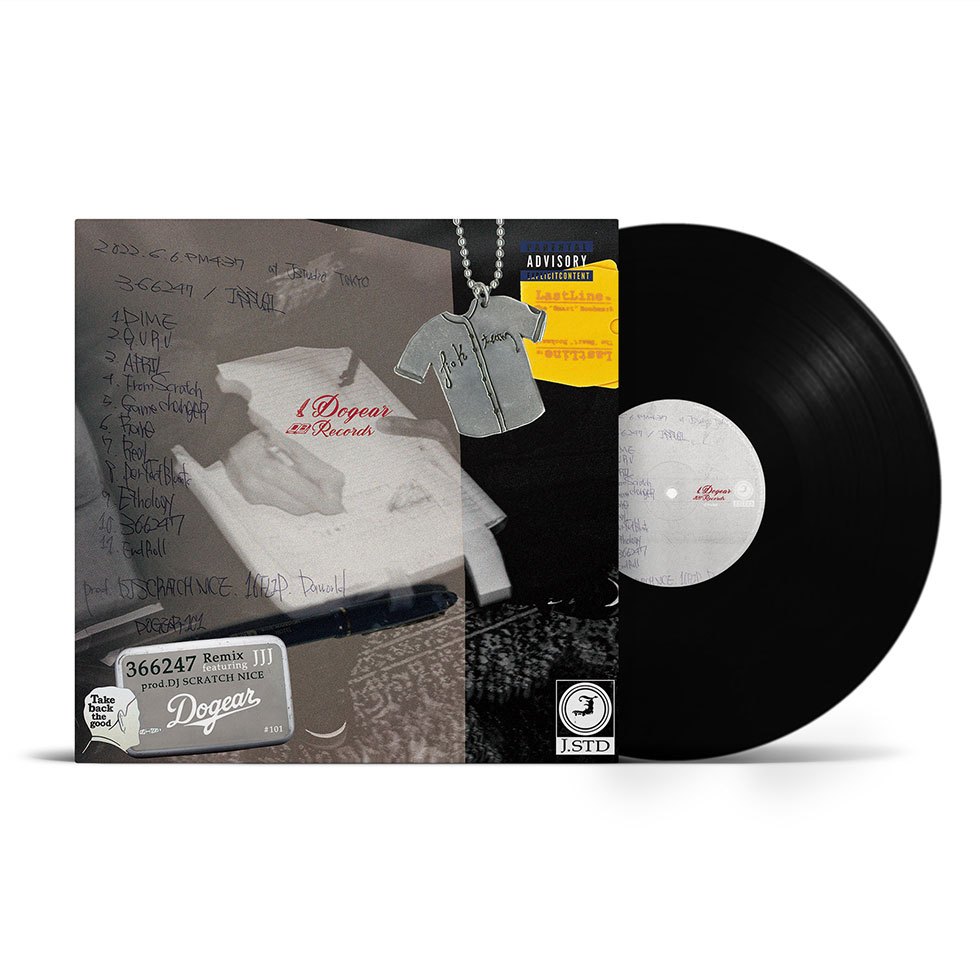
「366247 (Deluxe Edition)」概要
アーティスト:ISSUGI
タイトル:366247 (Deluxe Edition)
レーベル:P-VINE, Inc. / Dogear Records
仕様:LP (完全限定プレス)
発売日:2026年6月24日(水)
品番:PLP-8351
定価:4,950円(税抜4,500円)
*「366247」Stream/Download/Purchase:
https://p-vine.lnk.to/hBxqgO
*P-VINE SHOPにて予約受付中!
https://anywherestore.p-vine.jp/products/plp-8351

*ISSUGI - 366247 Remix ft JJJ / prod DJ SCRATCH NICE (Official Video)
https://www.youtube.com/watch?v=l-gi2XmuzbU

*ISSUGI - from Scratch / prod DJ SCRATCH NICE (Official Video)
https://www.youtube.com/watch?v=FP-HIFVLieA

トラックリスト
SIDE A
1. Dime
 prod DJ SCRATCH NICE 
 Scratch by DJ SCRATCH NICE
2. G.U.R.U. ft Mr.PUG
 prod DJ SCRATCH NICE
 Scratch by DJ SHOE
3. April ft Eujin KAWI, KID FRESINO, BES
 prod DJ SCRATCH NICE
4. from Scratch
 prod DJ SCRATCH NICE
5. Game Changer
 prod DJ SCRATCH NICE
SIDE B
1. Rare ft VANY
 prod DJ SCRATCH NICE 
 Scratch by DJ SCRATCH NICE, DJ K-FLASH
2. Real ft SPARTA
 prod DJ SCRATCH NICE
3. Perfect blunts
 prod 16FLIP
4. Ethology ft stz, 仙人掌
 prod DJ SCRATCH NICE
5. 366247 Remix ft JJJ
 prod DJ SCRATCH NICE
6. End roll
 prod Daworld

『Day'N'Nite 2』情報
アーティスト:ISSUGI & GRADIS NICE
タイトル:Day'N'Nite 2
レーベル:Dogear Records
仕様:LP(完全限定プレス)
発売日:2026年6月24日(水)
品番:DERLP-077
定価:4,620円(税抜4,200円)
*Stream/Download:
https://linkco.re/qcG8uVT6
*P-VINE SHOPにて予約受付中!
https://anywherestore.p-vine.jp/products/derlp-077

トラックリスト
SIDE A
1. BK Suede 
2. YingYang ft. Epic,Eujin 
3. Step My Game Up ft. Sadajyo
4. I Am… 
5. Me & My Musik ft. JJJ 
6. XL  
SIDE B
1. Ichi ft. Sparta 
2. Janomichi ft. 5lack 
3. Da Two ft. 仙人掌 
4. Chef Banga ft. BES 
5. Wizards ft. 5lack 
6. Day’N’Nite 2  

Daniel Lopatin - ele-king

 最新作『Tranquilizer』が評判のワンオートリックス・ポイント・ネヴァーことダニエル・ロパティン。彼が映画『マーティ・シュプリーム 世界をつかめ』(日本公開は3月13日)のサウンドトラックを手がけていることはすでに報じられているが、めでたくもその日本盤がリリースされることとなった。発売は2月27日。映画音楽作家としても着々と地位を固めているロパティン、その最新の成果に注目だ。

MARTY SUPREME
ORIGINAL SOUNDTRACK
BY DANIEL LOPATIN

★ クリティクス・チョイス・アワードでノミネート
★ 英国アカデミー賞でロングリスト入り
★ アカデミー賞でショートリスト入り

注目映画『マーティ・シュプリーム 世界をつかめ』の
サウンドトラック・アルバムが国内盤CDとLPでリリース決定!
購入者特典として先着でオリジナル・ピンポン玉をプレゼント

BEST NEW MUSIC - Pitchfork
緻密かつ雄弁。まるで“第二の脚本”のように機能する - IndieWire
ジョン・ヒューズ作品的な高揚感、宇宙的神秘主義、
そしてジョン・カーペンター的な不穏さが同居するサウンド - Empire
すべてに鮮烈でスリリングなオーラを与えている - Slash Film
ダニエル・ロパティンの予測不能な脈動のスコア。ボリュームは11まで引き上げられている - Variety

本作を語るうえで重要な話題のひとつになるのは、
ダニエル・ロパティンによるきらめくオーケストラルなスコアを中心とした
大胆な音楽の使い方だ
- The Hollywood Reporter

作曲家ダニエル・ロパティンは、マーティの鼓動と、卓球ボールが跳ね返るリズムの両方を、
推進力に満ちたスコアの中で見事に表現している
- AP News

アカデミー賞前哨戦と言われるゴールデングローブ賞にて、主演のティモシー・シャラメがミュージカル・コメディ部門の主演男優賞を受賞し、日本での公開も3月13日に決定している話題映画『マーティ・シュプリーム 世界をつかめ (原題:Marty Supreme)』。
現在までに映画賞の213部門にノミネート、うち25部門を受賞し、賞レースのトップランナーに躍り出ている本作のオリジナル・スコアを手がけたのは、ワンオートリックス・ポイント・ネヴァー (以下OPN) ことダニエル・ロパティン。昨年OPN名義で最新アルバム『Tranquilizer』をリリースし、4月には待望の来日ツアーも決定している。

本作『Marty Supreme (Original Soundtrack)』は、Pitchforkにてサウンドトラック作品としては異例となる「BEST NEW MUSIC」に選出され、アカデミー賞でもショートリスト入りするなど、音楽単体としても極めて高い評価を獲得。現在デジタル配信中の本作が、2月27日に国内盤CDおよび2枚組LPでリリースされることが決定した。

ロパティンが手がけた23曲のスコアは、ネオクラシカルなオーケストレーション、広がりのあるシンセサウンド、80年代ハードウェアの有機的な質感を融合し、献身的でありながら陶酔感に満ちた未来的な音世界を描く。ララージの神秘的な演奏、ワイズ・ブラッド の幽玄なボーカルもフィーチャーされ、作品にスピリチュアルな煌めきと揺れ動く感情を一層引き立てている。

本作は現在好評デジタル配信中。
2月27日には、国内盤CDおよび2枚組LP(ブラック&クリア・ヴァイナル)でも発売される。アートワークには映画のビジュアルが採用され、国内盤CDには解説書と両面ポスターを封入。LPはゲートフォールド仕様となり、同じく両面ポスターが付属する。またアルバム購入者は先着で映画にも登場する『マーティ・シュプリーム』オリジナル・ピンポン玉がもらえる。

先着特典:
『マーティ・シュプリーム』
オリジナル・ピンポン玉

封入特典:
両面ポスター

本作は、2025年の年間ベストにも数多く挙げられている、ワンオートリックス・ポイント・ネヴァー名義の最新作『Tranquilizer』に続くリリースでもある。同作で示された感情表現の透明度と音響テクスチャーの革新性を、映画音楽というフォーマットにおいてさらに拡張。オーケストラのドラマとデジタルの幻影がせめぎ合い、常に変化し続けるロパティンならではの緊張感が全編にわたって描き出されている。

この音楽は、リズムや浮遊感、そして“動き”への強い執着から形になっていった。マーティの変幻自在でスピード感に満ちた、躍動的な性質--まるで卓球のボールそのもののような存在--を表現するために、何百種類ものマレットやベルの音を集めたんだ。このスコアは、伝統と革新のあいだに存在するものにしたかった。ネオクラシカルな要素は、ルールや制約、プレッシャーといった現実の中で彼が生きる現実世界を支え、電子的なテクスチャーは、彼が思い描く未来へと傾いていく。その二つの力が、やがて互いにせめぎ合い始める。
- Daniel Lopatin

ジョシュ・サフディが監督を務め、ティモシー・シャラメが主演。共演には、アカデミー賞受賞俳優グウィネス・パルトローをはじめ、オデッサ・アジオン、ケビン・オレアリー、タイラー・ザ・クリエイターことタイラー・オコンマ、アベル・フェラーラ、フラン・ドレシャーらが名を連ねる。
ロパティンによる音楽は、本作の“神経系”として機能し、ネオンに彩られたマキシマリズムと、結晶のように静謐な瞬間を行き来しながら、サフディが描く野心、崩壊、そして創作への執着を鮮烈に浮かび上がらせている。

label : BEAT RECORDS / A24 Music
artist : Daniel Lopatin
title : Marty Supreme (Original Soundtrack)
release:2026.2.27
商品ページ: https://www.beatink.com/products/detail.php?product_id=15596
配信: https://a24music.lnk.to/MartySupremeOriginalSoundtrack
TRACKLISTING:
01. The Call
02. Marty’s Dream
03. Endo’s Game
04. The Apple
05. Pure Joy
06. Holocaust Honey
07. The Humbling
08. Motherstone
09. The Scape
10. Tub Falls
11. Fucking Mensch
12. Rockwell Ink
13. Hoff’s
14. Seward Park
15. The Necklace
16. Vampire’s Castle
17. Back to Hoff’s
18. Shootout
19. I Love You, Tokyo
20. The Real Game
21. Endo’s Game (Reprise)
22. Force Of Life
23. End Credits (I Still Love You, Tokyo)

CD

LP

------

ニューアルバム『Tranquilizer』をひっさげ
奇才フリーカ・テットとの最新ライブセットで来日決定!

Oneohtrix Point Never
WITH FREEKA TET

大阪 2026.04.01 (Wed) Gorilla Hall
東京 2026.04.02 (Thu) Zepp DiverCity

open 18:00 / start 19:00
前売:8,800円(税込 / 別途ドリンク代)※未就学児童入場不可
info:http://www.beatink.com/
E-mail:info@beatink.com
公演詳細:https://linktr.ee/opnjapan2026

label : BEAT RECORDS / Warp Records
artist : Oneohtrix Point Never
title : Tranquilizer
release:2025.11.21
商品ページ: https://www.beatink.com/products/detail.php?product_id=15439
配信: https://warp.net/opn-tranquilizer
TRACKLISTING:
01. For Residue
02. Bumpy
03. Lifeworld
04. Measuring Ruins
05. Modern Lust
06. Fear of Symmetry
07. Vestigel
08. Cherry Blue
09. Bell Scanner
10. D.I.S.
11. Tranquilizer
12. Storm Show
13. Petro
14. Rodl Glide
15. Waterfalls
16. For Residue (Extended) *Bonus Track

CD+Tシャツセット

LP+Tシャツ

CD

LP

限定LP

interview with Kneecap (Mo Chara and Móglaí Bap) - ele-king

 政治において、言語は戦場であり法廷で争うための手段となる。その場に立つ全員が言葉の些細な言い回しを巡って議論する。そこで我々は弁護士となり、言葉の意味の違いを研ぎ澄ませて鋭利な刃物に変える兵士にもなる。その最たる現場がベルファストの政治だ。地理的にはアイルランドに位置しながら、一部はイギリスの統治下にあり、政治的・宗教的な背景によってカルチャーも分断されている。
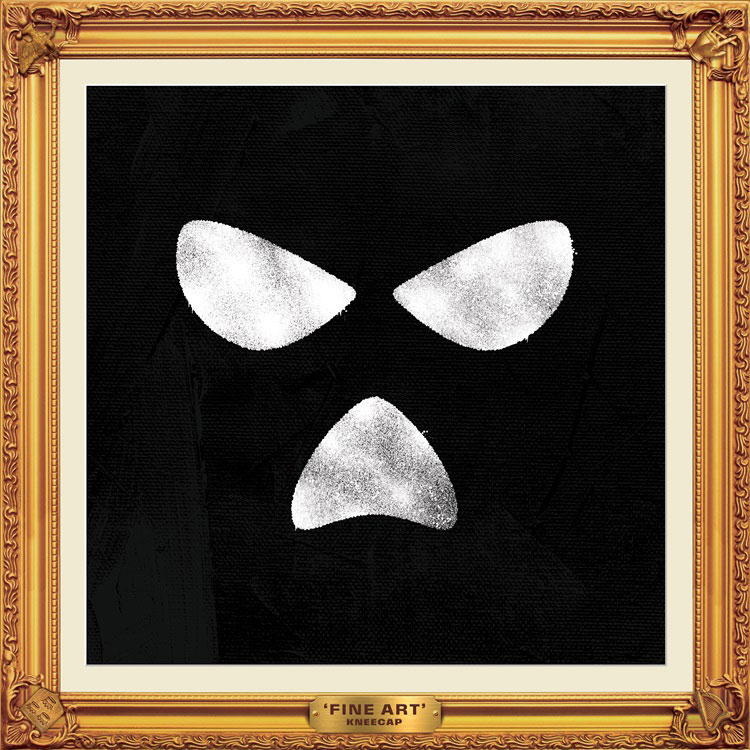
 モウグリ・バップとモ・カラのラッパーふたりとDJプロヴィからなるベルファストを拠点にするニーキャップの作品はそのような言語の宝庫であり、アイルランドの政治的風景を言葉とヴィジュアルの両方から色濃く反映している。DJプロヴィという(*「Provisional IRA(暫定IRA)」の略称から派生したスラング「Provei」が元ネタ)アーティスト名しかり、あるいはアイルランド国旗の3色の目出し帽もアイルランド共和派の武装組織IRAを示唆している。そもそもバンド名のニーキャップ自体が上記の関連団体によっておこなわれた悪名高い拷問を伴う制裁手段について言及している。つまり、あからさまに挑発している。しかし、このようなメッセージ性をライヴにおけるパーティのどんちゃん騒ぎ的なノリと合わせることによって、彼らはその背景にある恐怖や緊張感を緩和すると同時に、宗派の垣根を越えて若いファン層、とりわけ1998年の和平合意以降に育った若者が集える場を提供している。
 とはいえ、彼ら自身はゴリゴリの共和主義者であり、アイルランド語で楽曲を制作し、イギリスによる北アイルランドの統治に対して公の場で激しく抗議している。さらに労働者階級であることに誇りを持ち、保守党の元首相マーガレット・サッチャーに対していまだに根深い嫌悪感を抱き続ける姿勢は、アイルランド国内だけでなくイギリスの左派系リスナーから圧倒的な支持を受けている(筆者もまたそのひとり)。さらにパレスチナへの支持も公言しており、それが原因でイギリスの首相キア・スターマー政権から糾弾され、同政権から反テロ法を盾にモ・カラがハマスを支持しているとの理由に(いまのところ、まったくの不毛な作戦とはいえ)法的に執拗な攻撃を受けている。
 メディアや政治界などの権威からはニーキャップは無責任で無神経な危険分子のような描かれ方をしているのかもしれない。しかし、セルフ・タイトルにして彼ら自身が主演を務める映画『ニーキャップ』はときに寓話を交えながらフィクションという形で、彼ら自身が自らの目線で自らのストーリーを語る機会を提供している。さらにその特異な言語にフォーカスすることで、国家レベルから日常生活のレベルの両方から政治について多面的に映し出しながら、政治家やタブロイド紙が伝えるストーリーのカウンターとして、よりパンチとユーモアの効いた繊細な物語と同時に、いわゆる「トラブルズ」と呼ばれる北アイルランド紛争下のステレオタイプのイメージを覆す形でベルファストに暮らす人々の日常を描き出している。
 今回、モウグリ・バップとモ・カラにビデオ通話によるインタヴューで、言語およびそこに含まる細部やニュアンスが、彼らの歌詞だけでなくアイデンティティや日常生活であり、そのすべてに関わる政治においてどのような中心的役割を担っているのかについて語ってもらった。

うちのライヴについて確実に言えるのは、ものすごい多様性があるってこと。全ジェンダーが勢揃いしてる。(モ・カラ)

いまではインターネットのおかげで、フランス語だのバスク語だのカタルーニャ語だの、ありとあらゆる言語の音楽にアクセスできるようになってる。いまはもっと実のある音楽が求められてる時代になってるんだろうね。(モウグリ・バップ)

音楽を作って表現するというのは、ある種の空間なり環境を作り出してリスナーに提供するという側面もありますよね。ことライヴ・パフォーマンスでは大いにそれがあてはまると思うのですが、どのような空間を作り上げようとしていますか?

モウグリ・バップ:ニーキャップの使命のひとつとして、いまのメインストリームのラジオじゃ滅多に取り上げられることがない言語で語っていく、つまり、アイルランド語を中心にした自分たちのリアリティを反映した空間を作り上げようっていうのがあるんで。音楽を通して人びとがアイルランド語と繋がれる環境を作りたいわけさ。アイルランド語を自分自身のアイデンティティの一部として感じてもらいたい。これまでそういうことをやってる連中っていなかったんで。少なくともアイルランドのいまどきのヒップホップ・シーンにおいては。

モ・カラ:うちのライヴについて確実に言えるのは、ものすごい多様性があるってこと。全ジェンダーが勢揃いしてる。ヨーロッパというか、少なくともイギリスとアイルランドのヒップホップ・シーンってほぼ野郎に支配されてるじゃん。それがうちのバンドはカルチャー的側面も入ってきてるんでね。言語だったりとか、そこに伴うアイデンティティだったり、そこからも共感できる。毎回、ありとあらゆるジェンダーが集まってる。めっちゃエネルギーに溢れてるし、毎回モッシュピットが起きるし、モッシュするときは全員一緒、性別に関係なく、誰もケガしないようにお互いに気を遣いながら。誰にとってもめちゃくちゃ安全な場なんだよ。誰でも輪のなかに入ることができるし、そこに参加したいと願う全員にとってのオーガナイズされたカオスって感じ。

ライヴ映像を見る限りモッシュピットがライヴで重要な位置を占めているように思いますが、そこには何らかの意図があるんでしょうか。実際、あなた方もそこに注力しているように見受けられますし、その場にいるが安全に楽しめるようにすごく気を配っているようですね。

モ・カラ:若干、エネルギー過剰って説も! というか、そもそもそれ自体がエネルギーを宿してるような、うちのバンドでやってるモッシュピットってそういうものだから。みんなそれを期待してるわけで、客のほうも盛り上がりにきてるみたいな……だから、盛り上げ役としては超ラクだよね。そもそもモッシュピットのことを聞きつけた上で会場に集まってるわけで、なんなら客同士が勝手にモッシュピットをはじめて盛り上がってる。とりあえずモッシュしてる最中ってめちゃくちゃ自由に感じるじゃん、なんか知んないけどさ。モッシュの輪のなかにいると、自分も全体の一部になったみたいな感覚になるっていうか、たんにライヴに来た客のひとりじゃなくて、それよりも大きな何かに繋がった感覚になる。自分もショウの一部になるわけさ。要するに、双方向からのエネルギーの交換がおこなわれてるわけだよね。俺らも客を楽しませるし、向こうも俺らを楽しませてくれる。

モウグリ・バップ:ライヴに熱狂が生まれるのと同時に一体感も生まれる。お互い安全な状態を保ちつつ楽しむためには信頼関係がないと。それがあるからこそ、モッシュピットはうちのライヴの中心みたいな存在になってるんじゃないかな。みんなうちのライヴからそういうものを受け取ってるわけさ、その場にいる全員が仲間みたいな意識というか。

それって、あなたたちの政治的な思想にもあてはまりますよね。仲間意識であり人びとを繋いでいく力みたいな。

モウグリ・バップ:まさに。

モ・カラ:政治だって、ある意味、パーティと同じぐらい大事だからね。 政治に突っ込んでいくのだって、その先に楽しいことが待ってるって期待してるからなわけじゃん。あるいは戦いに勝利して祝福しようって気持ちがあるからなわけじゃん。パーティもライヴで自由になるのも生きるために必要不可欠なもんなんでね。

そもそも共産党って言葉自体に、パーティ(党)って言葉が入ってますもんね。

モ・カラ:マジそれな!

モウグリ・バップ:ハハハ!

モ・カラ:てか、めっちゃウケてんじゃん!

政治に突っ込んでいくのだって、その先に楽しいことが待ってるって期待してるからなわけじゃん。あるいは戦いに勝利して祝福しようって気持ちがあるからなわけじゃん。パーティもライヴで自由になるのも生きるために必要不可欠なもんなんでね。(モ・カラ)

アイルランド語なり少数言語で歌うことの何がいいって、本質的に反資本主義的であるってことで、金儲けのためじゃなくてコミュニティのために存在してるってとこだよ。(モウグリ・バップ)

以前もおっしゃっていましたが、ベルファストでもアイルランド語を話してる人口はそんなに多くないですよね。音楽という形を介すことでアイルランド語を完全に理解していなくても、その言語と繋がると思いますか。

モウグリ・バップ:とはいえ、流暢でなくてもいくつかの単語は知ってたりしるし、うちのライヴに来て一緒に歌ってアイルランドも十分堪能してもらえるんじゃないかな。流暢じゃなくても、その言葉を楽しむことはできるんだから。あともうひとつ重要なこととして、少数言語を話す環境に育った子どもって、まわりでその言語が使われてないと、その言語には価値がない、あるいは社会的に重要じゃないって自然と思い込まされるようになるんだよね。だから、俺らの映画が映画館で上映されたりラジオで曲がかかったりすることで、それまでアイルランド語に付随してた恥の部分が払拭されて、自分たちの言語でありアイデンティティに誇りが持てるように。 実際、うちのライヴに来る客のほとんどはアイルランド語を話せないけど、それでも十分楽しんでるしアイルランド語で一緒に歌って大満足してる。

モ・カラ:そりゃまあ、自分らの場合はラッキーだったっていうか、アイルランド語の学校に通わせてもらう機会に恵まれてたんで。というのも、自分たちの前の世代が国から支援もないなかでゼロから築き上げてくれたものなわけで。いまではみんな普通にウチのライヴに来て、たんに学校で勉強する科目とは別の形でアイルランド語に慣れ親しむことができる。それこそ自分たちの一世代、二世代前の世代にとってたんに学校で習うだけでそれ、それ以外で使う機会もなかったのが、いまではライヴだの映画だの学校の外でも楽しめるものになってる。

1950年代のロックンロールの誕生以来、全世界においてポップ・ミュージックも英語の曲中心でしたよね。いまの英語が母語のリスナーは、自分たちが理解できない言語の音楽も以前よりもオープンに楽しめるようになってると思いますか?

モ・カラ:いや、確実にそれはあるでしょ。いまって、みんな何かしら新しいものを求めている時代で、前例のないものだったり、これまでとは違うものを自分から探しに行くようになってる。60年代の人間に自分の知らない外国語の音楽って言っても、なかなかピンと来なかっただろうけど、いまではみんな普通に言葉なんて関係なしに音楽を聴いてる。

モウグリ・バップ:結局、英語が長いあいだ公共の電波を支配してきたのだって、昔は音楽を発表する機会が大手のラジオだのテレビだの一つ二つのメディアに絞られていたからであって。それがいまではインターネットのおかげで、フランス語だのバスク語だのカタルーニャ語だの、ありとあらゆる言語の音楽にアクセスできるようになってる。いま、うちの相方が言ってたように、いまはもっと実のある音楽が求められてる時代になってるんだろうね。

以前のように世界のポップ・カルチャーをアメリカが支配しているという構造が崩れかけてるのもあるんじゃないでしょうかね。

モ・カラ:まさに!

モウグリ・バップ:それってアメリカで植民地の支配者の銅像が撤去されていったのと同じ動きだよね。植民地とか、主要もしくは多数派言語による支配が徐々に綻びを見せてる証拠だよね。しかもいまではインターネットのおかげで、人びとが自分で聴きたい音楽を自分で選ぶ権利を取り戻してる。アイルランド語なり少数言語で歌うことの何がいいって、本質的に反資本主義的であるってことで、金儲けのためじゃなくてコミュニティのために存在してるってとこだよ。

モ・カラ:過去の歴史からも帝国が崇拝対象となるシステムになってたわけで、アートもそれに倣うような形になってたわけで。英語で歌われてきたのなんてまさにその最たる例だし。でもいまはわざわざ学校で勉強するまでもなく、誰でもインターネットにアクセスして、諸外国の歴史について知ることができるし、かつての帝国がどれだけ世界に害悪をもたらしてきたかもはや周知の事実になってるわけさ(笑)。結果として、先住民族の言語や少数民族のカルチャーが再び注目されるようになってる。

モウグリ・バップ:いま言ったのって、インターネットがもたらした最大限にポジティヴな面の一例だよね。そりゃまあ、アメリカや中東の帝国主義者の連中はフェイク・ニュースを拡散するためにインターネットを利用してるっていう側面があるとはいえ。

※このあとふたりの舌鋒はまだまだ続きます。後編は2月下旬発売予定の『別冊ele-king 音楽は世界を変える』に掲載。ぜひそちらもチェックを。


English version

interviewed by Ian F. Martin

When it comes to politics, language is both a battleground and a courtroom. It makes lawyers of us all, arguing over the finest differences in meanings between words, and it makes soldiers of us too, honing these differences down into blades. Nowhere is that more true than in the politics of Belfast. Geographically part of Ireland, ruled as part of the United Kingdom, and culturally split down the middle along political and religious grounds.

Formed by rappers Móglaí Bap and Mo Chara, along with DJ Próvaí, Belfast-based band Kneecap’s work is dense with the language, both verbal and visual, of the Irish political landscape. DJ Próvaí’s name and Irish tricolour flag balaclava are both references to the republican paramilitary group the IRA. The group’s name refers to a notorious form of torture and punishment carried out by such groups. It’s a provocation, for sure, but marrying this language to the sort of raucous party atmosphere of their shows is also a way of putting the edge of fear and danger it implies behind them and open up a shared space for young fans from both sides of the sectarian divide — especially those who grew up in the years after the 1998 peace agreement.

That said, the group are staunch republicans, writing in the Irish language and fiercely and vocally opposed to British rule over their corner of Ireland. They are proudly working class and retain a deep loathing for Conservative former Prime Minister Margaret Thatcher, which has endeared them to left-leaning listeners both at home and in Britain (I’ll admit, myself included). They have also been vocal supporters of Palestine and attracted condemnation and ongoing legal attacks from the government of British prime minister Keir Starmer, who have used anti-terrorism laws to (thus far unsuccessfully) prosecute Mo Chara on accusations of promoting Hamas.

Seen only through the lens of the media and political establishment, Kneecap come across as irresponsible, insensitive and dangerous. Their self-titled movie, which stars the group themselves in a fictionalised, often allegorical version of their origin story, was an opportunity for the group to frame their story in their own way, and in its explicit focus on language as a multilayered vehicle for politics on both a national level and in daily life, presented a powerful, funny and nuanced counter-narrative to the story the politicians and tabloid newspapers were telling, as well as a depiction of Belfast life that subverts many of the Troubles-era stereotypes of the city.

I spoke to Móglaí Bap and Mo Chara via video about how language in all its specificities and nuances is at work at the core of not just their lyrics but their identities, their everyday lives, and the politics that run through it all.

When you make music, you’re also creating a space or an environment for the listeners, especially when you think of the live performance. What kind of space are you trying to create?

Móglaí Bap (MB): A big part of Kneecap is creating this environment of reality where the Irish language is central, especially as it’s not a language that’s heard a lot on the mainstream radio. So we’re trying to create an environment where people can connect with the language through the music. They can identify with the language. And it’s not something that’s been done, really, in contemporary hip hop music in Ireland.

Mo Chara (MC): There’s also something to be said about our gigs that we have such a mix. There’s a mix of all genders. I think a lot of hip hop gigs in Europe, in England, in Ireland, it’s very male-dominated. And I think the difference with Kneecap is that we have a cultural aspect to it as well, with language and identity to it, so people relate to that. We always have a mix of genders. We have very high energy gigs, there’s always moshpits, but everyone’s moshing together, all genders, no one’s trying to injure each other. It’s a very safe space for everyone. Organised chaos for everybody who wants to be involved.

Watching videos of your live performances, the moshpit seems to have a central place in the show. Is there something special about the moshpit? Because you seem to put a lot of energy into that part of the show — organising, or taking a lot of care to make sure everybody’s safe.

MC: Maybe too much energy sometimes! But I think it took on a life of its own, the moshpits that we do, because everyone is expecting hig energy, and what happens is the crowd… we can rile them up pretty easily, but the crowd have heard about all the moshpits and so they come in and do it themselves. The thing is there’s something very freeing about it. When you’re part of a moshpit, you’re part of a collective, you’re part of a greater thing rather than just an individual at a show — you’re part of a show then. When there’s a moshpit happening, the audience are putting on a show for us. It’s kind of transactional: we entertain them, they entertain us back.

MB: It creates a sense of excitement at the gig, and also a sense of solidarity between people because you have to rely on each other to keep each other safe and have a good time. So I think that’s why it’s kind of central to our gigs, because that’s what people get from our gigs: a sense of solidarity.

Which I guess feeds into the political aspects of what you do: the sense of solidarity and everyone being in it together.

MB: Exactly.

MC: In certain scenarios, politics is just as important as partying. I mean what’s the point of chasing political memes unless you’re going to be able to enjoy yourself at the same time, or enjoy yourself after the fight’s done? So partying and the freedom that comes with gigs are just as important a part of life.

You can’t spell “Communist Party” without “party”!

MC: Exactly!

MB: Hahaha!

MC: He loves that one!

You’ve mentioned in the past about how, even in Belfast, there’s not a lot of Irish speakers, so is there a way in which, by delivering it through music, that gives people a way to connect with it even without fully understanding all of it?

MB: One aspect of it is that people who don’t speak Irish but they speak a few words, they can come to the gig and they can sing along and get that sense of fulfilment, that you don’t have to be fluent to enjoy the language. And another aspect of it is that, when you speak a minority language growing up as a kid, if it’s not heard, you feel like it’s not worthy or that society values it. So the fact that our movie was in the cinemas and our songs are on the radio, it gets rid of that shame and gives them self esteem towards their language and identity. Most people don’t speak Irish at our gigs, so the fact that they can come along, enjoy the gig and sing along in Irish, there’s a sense of fulfilment there.

MC: Obviously we were lucky enough that we had the opportunities to go to school in Irish because of the generations that came before us who had built that stuff up from scratch with no help from the state. And now people can come to our shows and it’s not just a school subject the way it was for the generation or two before us, where they were just learning it in school and they didn’t have any services or anywhere to go to enjoy it socially. Now people can go to a show or see a movie and it’s just about taking it outside of the classroom.

Since the birth of rock’n’roll in the 50s, pop music worldwide has been dominated by the English language. Do you think English speaking audiences nowadays are becoming more open to enjoying music in languages they don’t speak?

MC: Definitely. I think we’re at a time in history now where we’re seeking something different. Everybody’s seeking something new, that hasn’t been done, or branching out in some way. If you tried to explain to somebody in the 60s that you’re listening to music in a language you don7t understand, it’s probably alien to them, but now it’s become the norm.

MB: The reason that English has dominated the airwaves for so long is because there was only one or two avenues for getting your music out there through mainstream radio or TV or whatever, but now you have the internet, and there’s people singing in French or languages you’ve never even heard, Basque languages or Catalan or whatever, so now we have access to all this music and I think, as he was saying, people are looking for something with a bit more substance these days.

I wonder as well if part of it’s also this sort of slow collapse of the United States as the centre of global pop culture.

MC: Yes!

MB: I think it’s kind of reflected in, you know when they were taking down the statues in America of the former colonialists. I think that’s part of this slow degeneration of this idea of colonies, of mainstream languages, of majority languages. And with the internet, we can take back control of the avenues of listening to music. And a good thing about singing in Irish or any minority language is that it’s anti-capitalist at its core because it’s not there for profit, it’s there for the sake of community.

MC: If you go back, empires have always been looked up to, and obviously art kind of imitated that, obviously with music always being in the English language and stuff, but now you don’t have to be in a classroom to learn a certain subject, anyone can get on the internet and listen to someone talk about some historical event that happened in another country, we’ve all kind of realised that empires have (laughs) been a kind of bad thing for the world, so people are looking more towards indigenous languages and more towards minority culture again.

MB: I think that’s the most positive aspect of the internet, because of course we have imperialists in America and the Middle East, etcetera, using the internet as a means of spreading fake news.

Jay Electronica - ele-king

 ジェイ・エレクトロニカという名の「謎」が帰ってきた。しかも、実にあっけらかんとした明るい笑みを浮かべて。自分自身の宇宙のタイムスケジュールに基づき、極めて正気なやり方で、わずか5日間のうちに5つの作品をリリースしたのだ。
 多くのアーティストが望み、多くのラッパーが部屋に足を踏み入れる際に「持っている」と言い張るもの、それが「リップ(威信)」だ。しかしジェイは異種の生き物である。スワッグ(虚勢)を自慢したり、大勢のセキュリティやアシスタントを引き連れたり、単に「なんとなく」という理由だけでわずか20kmの距離をプライベートジェットで飛んだりするような人間ではない。ジェイ・エレクトロニカはそのような世界には住んでいないが、まるでドクター・ストレンジが新たな魔術やポータルを呼び出すかのように、それ以上の尊敬を勝ち得ている。
 ヒップホップ界に25年身を置き、技術的な記録としてのデビュー(MySpaceでだ!……MySpaceを覚えているだろうか?)は2007年(後にオフライン化)であったにもかかわらず、ジェイのアルバムは片手では数えきれなかった。これまでは。いまや、両手が必要だ。だが、それ以上はいらない。

 おそらく49歳の誕生日を祝うためだろうか(確証はないので引用しないでほしいが)、ジェイは5日間で1枚でも2枚でも3枚でも4枚でもなく、5つもの作品をリリースした。まずInstagramで発表され、続いてTwitter(X)のアカウント、そして〈Roc Nation〉が続いたこの衝撃的なニュースは、完全なサプライズだった。まるでエイプリルフールのジョークのようだが、それが届けられたのはどんよりとした9月だった。

 文字通り、彼が3枚目のアルバムをリリースした瞬間にこの記事を書き始めたのだが、インターネット上の噂で「19枚のアルバムを出すかもしれない」と囁かれたため、筆を止めざるを得なかった。だから、状況が落ち着くまで数日待った。この地球外生命体のような事態を百科事典的に紐解くため、少し時間をかけて整理させてほしい。まず、これを見てくれ。

  Act I: Eternal Sunshine (The Pledge) /永遠の陽光(誓約)— 2025年9月17日
  Act II: The Patents of Nobility (The Turn)/貴族の特許状(転機) — 2025年9月18日
  A Written Testimony: Leaflets /書面による証言:リーフレット— 2025年9月19日
  A Written Testimony: Power at the Rate of My Dreams /書面による証言:夢の速度で流れる力— 2025年9月19日
  A Written Testimony: Mars, The Inhabited Planet /書面による証言:火星、居住可能な惑星 — 2025年9月21日

 ジェイ・エレクトロニカという男において、「苦悩するアーティストがスタジオに引きこもり、翌年に新作を出す」という古くからの不測の事態やロマンチックなステレオタイプは当てはまらない。彼は業界を気にせず、業界だけで生きているわけでもなく、業界から自尊心を得ているわけでもない。1週間以内に5枚のアルバムをリリースするという発想は、ラップ界では前代未聞であり、業界の幹部たちからは恐れられることだ。
 しかし、主流に抗うことこそが誰よりも彼に似合っている。適切な説明をするならば、彼はメインストリームのラップ・ゲームの圏外に身を置きつつ、同時にその中心に存在している、ということだろう。少なくとも世界中で、このような空間に生息しているラップ・アーティストは他にいない。Jay-Zの親友であり、彼のレーベル〈Roc Nation〉に守られ、エリカ・バドゥの親友かつ相談相手であり、彼女の子供の一人の父親でもある。その一方で、ヒップホップ業界により意図的に深く組み込まれている数多くのプロデューサーやラッパーたちとも、電話一本でつながる距離にいるのだ。

 ジェイ・エレクトロニカという謎は、彼が最初に登場したときや、その後の『What The Fuck is a Jay Electronica?』(2012年)の頃の初期の熱狂とはまた別物だ。当初から彼は際立っていたが、スタイル的には、ケンドリック・ラマーをはじめとする多くのアーティストが好んだ「1小節に100万語を詰め込む」タイプのラップとまだ競い合っていた。しかし、リークや客演を重ね、「Exhibit A」(2009年)のようなシングルを経て、彼は独自の地位を確立し、その台座を勝ち取った。
 何年もラジオから音沙汰がなく、Instagramで難解な投稿を繰り返していても、一度ヴァースがリークされたりトラックがドロップされたりすれば、ファンは狂喜乱舞し、あらゆる単語、引用、フレーズを徹底的に解剖する。その磁力を持つ声の明快さと語彙、より正しい道へと導く父親のような言葉のジェスチャー、そして物語を語るという絶対的な意図が、単に誰にも理解できないトラックを作るために言葉を並べるだけの業界の多くの人びとから彼を隔てている。
 かつて誰かに「なぜジェイを聴くべきなのか」と聞かれたことがある。私はこう答えた。ジェイはサビ(コーラス)に辿り着くためにヴァースや節を急いで終わらせようとは決してしない、と。そもそも、彼はサビ(コーラス)を書かないことも多い。すべての言葉が重要で詩的であり、それはまるで村の人びとに歴史を語り継ぐセネガルの語り部「グリオ」のようだ。ジェイは「変な奴」として知られているが、その「変な奴」は、イスラム教の戒律への全面的な献身を軸とした難解な情報の断片を丹念に紐解き、聖書の証言、アウトサイダー的な思考、そしてモス・デフのような巧みさが絡み合う濃密なウェブを作り上げる。
 彼の言っていることは聞き取れるし、その語りに首を振りながら、その過程で何かを学ぶことができる。彼の最高のトラックを聴くことは、言葉遣い、テナー(音域)、聴衆の理解への予見が最優先される説教者の礼拝に出席するようなものだ。

 さらに重要なのは、彼が「時間」を気にしていないことだ。夏のリリースのスケジュールに間に合わせようと急ぐことなど、クソ食らえだと思っている。はっきりさせておくと、9月の5つのリリースのうち、『Act 1』と『Act 2』は新作ではない。デジタルのものは誰かのウェブサイトやハードドライブのどこかにあるはずだが、1と2はどちらも一瞬現れては消えていた。『Act 1』は、ジョン・ブリオンによる映画『エターナル・サンシャイン』のスコアをインストに使用した、2007年のムード溢れる15分のミックステープだ。MySpaceを通じて公開され、20年近くインターネット上を漂っていたが、公式なものではなかった。
 『Act 2』はリークされ、Jay-ZのTidal(※レーベルではなくストリーミングサービス)を通じてリリースされたが、同じ月(2020年)のうちに葬り去られ、5年経ってようやく再浮上した。先に述べたように、ジェイは時間を気にしない。リークの数ヶ月前に出された2020年の『A Written Testimony』の勢いがあったにもかかわらず、今年までそれを再び世に出そうとアクセルを踏むことはなかった。そして、2025年の『A Written Testimony』シリーズは形式上は新作だが、正直なところ、それらのトラックがいつ制作されたのかはわからない。録音された音楽に対するジェイの特異な性質は、彼の全アウトプットが、制作時期に関わらずいつでも貸し出し可能な彼専用のライブラリであるかのように感じさせる。時間は捉えどころがない。

 アウトプットは少なく限定的だが、熱狂的なファンにとってそれは許容範囲内だ。しかし、2020年の『A Written Testimony』と、今回の2025年の5つの新作を比較せずにはいられない。喩えるなら、2020年の『A Written Testimony』は銀座の職人が握った寿司やおにぎりのようだった。対して、2025年のリリース群(『Act 1』と 『Act 2』、そして3つのアルバム『Power at the Rate of My Dreams』『Mars, The Inhabited Planet』『Leaflets』)は、地元の祭りの屋台で手早く作られた焼きそばに近い。
 2020年の『A Written Testimony』は、心地よく調和した鋭いトラックのコレクションだった。ハードなビートから、鋭い感情、さらには部分的な信仰心まで、繰り返し読み解くことができた。一方、『Act 1』は瞑想のようであり、『Act 2』は2020年のアルバムに近い、より弾むようなトラックと流れるようなビートがある。車で仕事に向かうなら、『Life on Mars』や『Bonnie and Clyde』を再生するといい。

 2025年の3つの『A Written Testimony』は、まさに「証言(Testimonies)」が、別々のトラックでありながら編み合わされたもののようだ。各アルバムが、辛うじてアルバムと呼べる程度であることは心に留めておいてほしい。EPと呼ぶべきだろうか? 私の不満のいくつかは間違いなくここにある。各EPが死ぬほど短いのだ。どれも20分をかろうじて超える程度だ。それに加えて、使用されているサンプルの量が異常だ。3分のトラックであっても、ジェイが物語を語っているのはわずか1分程度だったりする。

 ここでのプロデューサーワークは、J・ディラやパブリック・エネミーのような意味で精巧に作られたものではない。サンプルは延々と流され続け、カット&ペーストされて再解釈されたり踊らされたりする「音のオブジェクト」としてではなく、歴史の遺物のように、そのオリジナルの意味をそのまま保存しようとしている。だから、もしプレイボーイ・カルティのようなバンガー(盛り上がる曲)を期待しているなら、ひどく失望することになるだろう。そして、もし君が1990年以降に生まれたのなら、同情する。選ばれたサンプルの多くは、君たちが生まれるずっと前の映画やインタヴュー、その他のメディアからのものだからだ。出典を知らなければ、なぜそのサンプルが面白いのかを理解するのは難しい。
 だが、それは許される。ジェイ・エレクトロニカが口を開けば、リスナーは一語一句、あらゆる引用を精査し、Wikipediaやインターネットを駆使して理解しようとするからだ。

 『Power at the Rate of My Dreams』に収録された、ラッパーのウエストサイド・ガンとの“Best Wishes”を例に挙げてみよう。3分間のトラックで、ジェイがラップしているのはわずか1分だが、その言葉は……こんな感じだ。

「マイクを渡された瞬間に 仕事に取り掛かる 俺の舌は マスター・ファード(ネイション・オブ・イスラムの創始者)自身の手によって 絹へと変わる 『トップ5』リストにいる奴らなら 誰にだって深手を負わせてやるさ もし俺が 蛇から進化したドラゴンと戦っていなければな」

 そして

「左 右 左 右 左 右 夜に木の葉のように 俺の夢のなかを漂う」
「信じる者たちのための 蝶 心臓が標的で 鼓膜が受信機だ」

 ジェイは難解な知識、とくにイスラム教とUFOのファンだ。それらと、彼が信仰から感じる光とともに人間の悲惨な存在について語る心揺さぶる能力の組み合わせは、『Leaflets』収録の“Is It Possible that The Honorable Elijah Muhammed is Still Physically Alive??(名誉あるイライジャ・ムハンマドは、いまも物理的に生きている可能性があるだろうか??)”において強力に発揮されている。

「空にあるあの街のことが いつも気になっていた あの眩い光と 色鮮やかな輝きとともに 空に美しく浮かぶ街 あの金と エメラルドと サファイア そしてジャスパー(碧玉)と 真珠に囲まれた 真実にして生ける神の 玉座」

 ここでジェイは、UFOとの「ロサンゼルスの戦い」の証拠とされる話について詩的に語り、それが人生に苦しむ女性と混ざり合い、その出来事が信仰の必要性を強める。曲は、ネイション・オブ・イスラムの指導者であり創設者である名誉あるイライジャ・ムハンマドの歴史を語る人物の声で終わる。

彼女がもっとも嫌いだと言った色が不可視(インビジブル)
水着姿のストーリーのコメントにそれを固定した
日の光のなかでは 彼女は背が高く
無敵(インビンシブル)に感じている
だが夜になれば 誰かのセクションで
小さく 説き伏せられやすくなる
また別の堕ちた星が別のクレーターに激突する
なぜ俺に尋ねた?
俺たちは救世主が必要なのかと?

 ジェイ・エレクトロニカの素晴らしさを理解し評価することは、彼の決して静かではない「矛盾」と向き合うことでもある。ネイション・オブ・イスラムの極めて熱心な信奉者であるジェイは、5つのリリースの機会を利用して、各リリースのカヴァーにネイションが使用する象徴的なシンボルを採用した。アートワークはどれも派手ではなく、新規のリスナーを誘うようなものではない。最近の人はアートワークにそれほど注意を払わないので、それは避けられたひとつのハードルと言える。しかし、彼の曲の多くでは、名誉あるイライジャ・ムハンマドの名前が絶えず賛美のなかで使われている。
 歴史的に見てこれは興味深いことだ。ネイション・オブ・イスラムは、公民権運動時代のアメリカにおける白人至上主義の人種差別や、キリスト教会を通じたそのつながりの影響を回避しようとしたイスラム教の信奉者たちによって誕生した。多くの受刑者がしばしば「神を見出す」場所において、1960年代以降、マルコムXがそうしたように、多くの者がアッラーを見出した。
 ネイション・オブ・イスラム以前のアメリカの歴史の大部分において、イスラム教徒の大きな存在はなかった(多くの奴隷にされたアフリカ人がキリスト教への改宗を強要されたため)。そのため、黒人コミュニティにとって、キリスト教やそこから生じた生ぬるい活動に対する「信仰の対抗軸」として、ネイション・オブ・イスラムの影響力は強かった。しかし、いまは2025年だ。アメリカに住む元来のイスラム教諸国出身のイスラム教徒の数は、ネイション・オブ・イスラムの信奉者よりも遥かに多く、彼らのなかでネイションを重視する者はほとんどいない。したがって、いまネイションの信奉者であることは、かつてほど重要ではない。そして、名誉あるイライジャ・ムハンマドとマルコムX(彼は今日でも絶大な敬愛を集めている)のあいだの歴史的経緯が、事態をさらに複雑にしている。

 ジェイ・エレクトロニカは、ラップ界のサン・ラ、あるいはMFドゥームのような存在だ。両者とも不屈の精神を持ち、自らの信念に対して100%の信頼を置いていた(あるいは置いている)。まったく揺るがない。アウトサイダーとしてのジェイの信仰は、他のアウトサイダーに対する彼の支持と同じくらい強い。それが名誉あるイライジャ・ムハンマドであろうと、P・ディディ(??!!!!!!!)であろうと。
 そう、あのP・ディディだ。ホテルの廊下で恋人を打ちのめし、あざだらけにして置き去りにする姿が世界中に晒された、あのP・ディディだ。この記事を読んでいる頃にはすでに判決が出ているかもしれないが、売春目的の移送の罪で有罪判決を受け、量刑を言い渡されようとしている、あのP・ディディだ。そのP・ディディが、『Leaflets』の最初のトラック“Abracadabra“のイントロの声として、刑務所から直接電話でジェイに指示を送っているのだ。ジェイは、指示を示すために犬を連れてP・ディディの裁判所に現れた男でもある。

 そしてジェイは、献身、天使のような詩、アイコンとしての地位、そして独特で疑問の残る選択のあいだで危うい綱渡りをしながら、奇妙な方法でプロデュースされ、パッケージされ、リリースされるクラシックなトラックを作り上げている男なのだ。


The enigma that is Jay Electronica has returned and he wears a bright smile very plainly. 5 releases in just 5 days released by his own universe`s time schedule, very sanely. Rep is what most artists want and what many rappers claim they have when they walk into a room. But Jay is a different creature. Never one to gloat about swag or tow a conglomeration of security and assistants around or fly private jets to locations only a 20 kilometer distance away just because. Jay Electronica doesn`t inhabit that world but commands more respect as if he were Doctor Strange conjuring new magics and portals. Despite being in hip hop for 25 years and his technically recorded debut (on MySpace!!!! - do you remember MySpace????? ) in 2007 (then taken offline), you can`t count Jay albums on one hand. Until now. Now you need 2 hands. But no more than that.
I`m guessing maybe to celebrate his 49th birthday (don`t quote me cause I really don`t know), Jay released not one, not two, not three, not four, but five releases within five days. Announced first via Instagram, then his twitter account followed by Roc Nation, the bombshell came as a complete surprise. Almost like a April Fool`s Day joke except it came out in gloomy September. Literally as I started writing this article upon the release of his 3rd album, I had to stop cause internet rumors stated he might be releasing 19 albums! So I waited a few more days til the coast was clear. Do to the encyclopedic nature of this near extraterrestrial situation, allow me a bit of time to unpack things. First, peep this :

Act I: Eternal Sunshine (The Pledge) — September 17, 2025
Act II: The Patents of Nobility (The Turn) — September 18, 2025
A Written Testimony: Leaflets — September 19, 2025
A Written Testimony: Power at the Rate of My Dreams — September 19, 2025 A Written Testimony: Mars, The Inhabited Planet — September 21, 2025

With Jay Electronica, the age old contingency, the age old romantic stereotype of a tortured artist holing up in a studio, to release new work in the following year doesn`t fit with Jay Electronica. He doesn`t care about the industry, doesn`t live solely off the industry, and doesn`t maintain his self-respect from the industry. The idea of releasing 5 albums within a week is unheard of in rap and quite feared of by industry exes. But going against the grain fits him more than anyone else. A proper explanation might be he is living off grid of the main stream rap game while also being in the center. There is probably no other rap artist at least in the world that inhabits such a space. A close friend of Jay Z and protected by his Roc Nation label, a close friend and confidante of Erykah Badu while also being the father of one of her children, and also a phone call away from numerous other producers and rappers who are more intentionally imbedded in the hip hop industry.

The enigma that is Jay Electronica is not the same as the initial hype when he first came out or afterwards on “What The Fuck is a Jay Electronica?” (2012). From the start, he stood out but stylistically, he was still competing with the usual a-miliion-words-per-bar type of rap popular a la Kendrick Lamar and many others. But with each leak and cameo appearance and singles like “Exhibit A” (2009), he grew into his own and earned his pedestal. Despite continuous years of near radio silence and often cryptic posts on Instagram, once a bar leaks out, once a track drops, fans go rabid and pick apart every word, reference and phrasing. The clarity of his magnetic voice and wording, the fatherly like verbal gesturing toward a more righteous path, and total intention on telling a story separates him from many of the industry who often throw words together just to make a track that really no one can understand. Someone once asked me why they should listen to Jay. I relayed that Jay is never in a race to finish a bar or a stanza to get to a chorus. Often he doesn`t write them anyway. Every word is important and poetic like a griot of Senegal telling a village of their history. Jay is known as a weird dude and that weird dude picks apart esoteric bits of information that often revolve around his total devotion to Islamic observance creating a thick web of biblical testimony, outsider thought and Mos Def like finesse. You can hear what he is saying, and you can head nod to his relaying and learn something in the process. Listening to his best tracks is like attending a preacher‘s service where diction, tenor, anticipation of the attendee`s understanding is paramount.

More importantly though, he doesn`t care about time. He ain`t rushing to make it in time for the summer schedule or shit like that. To be clear from his 5 September releases, both Act 1 and 2 are not new. Everything digital is somewhere on someone`s website or hard drive available but both 1 and 2 have appeared and were disappeared in a flash. Act 1, a moody 2007 15-minute mixtape instrumentally based off of Jon Brion’s Eternal Sunshine of the Spotless Mind score, put out via MySpace, has been bouncing around the internet for almost 2 decades but never official. Act 2 was leaked, released through Jay Z`s Tidal and bodied within the same month (2000) disappearing only to finally re-appear 5 years later. As I said Jay doesn`t care about time. Despite the momentum from 2000`s “A Written Testimony” put out several months before the leak, there was no foot on the gas to get it out to the public again until this year. And though the 2025 “A Written Testimony” releases are technically new, we honestly don`t know when the tracks were made. Jay`s peculiar nature toward his recorded music makes it seem as if his total output is a library for him to check out tracks to make releases regardless of when they were made. Time is elusive.

Output is low and liminal and this for his rabid fans is forgivable. But it is impossible to not compare A Written Testimony (2020) to his 5 new 2025 releases. If I may be poetic , A Written Testimony (2020) was like Ginza crafted sushi and onigiri, where as his 2025 releases, Act 1 and 2, and the 3 albums under the “A Written Testimony : Power at the Rate of My Dreams, A Written Testimony : Mars, The Inhabited Planet, and A Written Testimony : Leaflets” are more in the vain of yakisoba (fried noodles) thrown together at a food stall at a local festival. A Written Testimony (2020) was a collection of sharp tracks that fit together quite comfortably. One could pore over them repeatedly. From hard beats to the acute emotional, even partially devotional. Act 1 is like a meditation and Act 2 is closer to A Written Testimony (2020) with bouncier tracks and a beat flowing. Press play on “Life on Mars” and “Bonnie and Clyde” if listening in a car to work.
The three A Written Testimony (2025) seem to be exactly that - testimonies woven together despite being separate tracks. Keep in mind that each album is barely an album! Call them eps maybe? And for sure some of my gripes are exactly here cause each ep is short as hell. Each barely past the 20 minute mark. Add to that the amount of samples used is insane. Even on a 3 minute track, you will find Jay telling tales for only a minute. Production here isn`t well crafted in the Dilla or Public Enemy sense. Samples are left to go on and on with the original meaning of the samples meant to be preserved as they are, like relics of history instead of as sound objects cut and pasted to be reinterpreted or danced to. So if you are expecting bangers a la Playboi Carti, you will be horribly disappointed. And if you are born past 1990, I feel for you cause many of the samples selected are from movies, interviews, or other outlets way before your time.
Understanding why each sample is interesting is difficult when you don`t know the source.

But that is forgiven. When Jay Electronica speaks, listeners pore over each word, reference and make good use of Wikipedia and the rest of the internet to understand.

Let me illustrate with “Best Wishes” from “Power at the Rate of My Dreams,” recorded with rapper Westside Gunn. A 3 minute track with Jay tapped in rapping for only for a minute but the words bro.....the words.

“Soon as they put the mic in my hand, I get straight to workin' My tongue turn into silks by Master Fard in person I'd give anybody in a 'Top 5' list a serious hurtin' If I wasn't at war with the Dragon who evolved from the Serpent”

and

“Left
Right
Left
Right
Floating through my dreams like a leaf at night
Left
Right
Butterflies for the believers
The heart is the target, the eardrum is the receiver”

Jay is a fan of esoteric knowledge, more specifically with Islam and UFOs. The combination of them with his own heartfelt ability to speak on the dire existence of humans with the light he feels coming from his faith is powerful on “Is It Possible that The Honorable Elijah Muhammed is Still Physically Alive??” From “Leaflets”

“I always wondered 'bout that city in the sky With all that bright light and all them colors, looking pretty in the sky With all that gold, and all that emerald, and all that sapphire And all that jasper, and all that pearl around the throne Of the true and living God”

Here Jay waxes poetic on purported evidence of a battle of Los Angeles with UFOs that then gets mixed with a woman suffering in her life and that event strengthening the need for belief. The song them ends with someone telling the history of The Honorable Elijah Muhammed, the head and creator of the Nation of Islam.

“The color that she said she hate the most of all, invisible She pinned it to her comments on her Stories in her swimming suit In the daylight, she be feeling tall and invincible But at night she in somebody section, small and convincible Another fallen star to crash another crater So why you had to ask me if we actually need a savior?”

Understanding and appreciating the brilliance of Jay Electronica is also coupled with his not so quiet contradictions. A deep, deep follower of the Nation of Islam, Jay took the opportunity of his 5 releases to use symbolism used by the Nation for the covers for each one of his releases. None of the artwork is flashy or inviting for newcomers. Most people recently don`t pay that much attention to artwork so that is one hurdle avoided. But in many of his songs, the name of The Honorable Elijah Muhammed is continuously used in praise.

Historically this is interesting as the Nation of Islam came into existence from devotees of Islam who wanted to circumvent the influence of white racism in America and its connection through the Christian church in the civil rights era. Where many inmates often “find God,” from the 1960`s onward, many also found Allah just like Malcolm X did. Before the Nation of Islam for much of America`s existence, there was no major presence of Muslims in America (as many enslaved Africans were forced to convert to Christianity), so the Nation of Islam`s influence was strong as a counterweight of faith to Christianity for the Black community and the tepid activism that sprouted from it. However, it is now 2025, and the number of Muslims originally from Islam practicing countries living in America, is way greater than the followers of the Nation of Islam, and few if any of them shower any importance on the Nation. Hence being a follower of the Nation now, is basically, is not as important as it once was. And the history between The Honorable Elijah Muhammed and Malcolm X (who is still greatly beloved to this day ) adds more complication to the cake.

Jay Electronica is kinda like the Sun Ra of rap or an MF Doom. Both have / had indomitable spirits and 100 percent faith toward their convictions. Totally unbending. Jay`s faith as an outsider is as strong as his support for other outsiders is as well. Whether The Honorable Elijah Muhammed or P-Diddy (????!!!!!!!). Yes, that P-Diddy. The one who was seen worldwide beating his girlfriend in the hallway of a hotel leaving her battered and bruised. That P-Diddy, who is about to be sentenced (by the time you read this, he may already be sentenced ), having been found guilty of two counts of transportation for prostitution. That P-Diddy, who is the intro voice to the first track “Abracadabra” from Leaflets, giving his support to Jay via phone directly from prison !? Jay is the same guy who pulled up to P-Diddy`s courthouse with his dogs to show support. And Jay is the guy who walks a funny tightrope between devotion, angelic poetry, icon status, and unique questionable choices while creating classic tracks produced, packaged, and released in strange ways.

R.I.P. Jimmy Cliff - ele-king

 ジミー・クリフはボブ・マーリーと並ぶ輝度をもったレゲエ・アイコンだった。とはいえ、そもそもマーリーの最初のオーディションをアレンジしたのがクリフだったのであり、先に世界的なレゲエ・スターとなったのもクリフだ。そして2025年11月24日、肺炎によって81歳で亡くなったジミー・クリフは、36歳で没したボブ・マーリーより遥かに長い間スターダムに君臨したのだ。その意味で、彼こそがレゲエ界最大のインターナショナル・スターである。

 そのクリフの名を挙げて多くの人が真っ先に思い浮かべるのは、1972年のカルト・ムーヴィ『ハーダー・ゼイ・カム(The Harder They Come)』で彼が演じたアイヴァン・マーティンのイメージだろう。キングストンのゲットーから這い上がってスター歌手になることを夢見る青年が、音楽業界からは搾取され、警察からは虐待され、遂には八方塞がりの窮地に陥ってしまう過程は何度観返しても胸が締め付けられる。あの主人公アイヴァンは、社会的弱者が抱く希望と反骨精神の永遠なる権化として、その同名主題歌 “The Harder They Come” の:

I'd rather be a free man in my grave
 Than living as a puppet or a slave

操り人形や奴隷として生きるくらいなら、墓の中で自由な人間でいたい

 というラインに要約されるあの映画の精神と共に生き続けている。アイヴァンがスタジオ(ダイナミック・サウンズ)で、胸に大きな黄色い星がついた長袖Tシャツを着て、腕でリズムをとりながら同曲を歌うシーンは純粋で、ゆえに痛々しく、強烈にかっこいい。

 さらにマーリーとの対比で言えば、70年代のルーツ・レゲエ期におけるクリフの独自性ははっきりと際立っていた。レゲエ・ミュージックとラスタファリアニズムの関連性が強固なものになってくるあの時代に、クリフは直接的なラスタファリアン・ミュージックを(おそらく一切)歌わなかったという意味においてである。そこには彼の宗教観が関係しているのだが、彼はもともとクリスチャンで、一時はラスタファリアニズムに傾倒したものの、70年代後半のルーツ・レゲエ全盛期にイスラムに転向し、のちに最終的に宗教全般を “見切った” ――という表現が適切か自信がないが――かのスタンスを取った。原理主義的な執着からは相当かけ離れているその好奇心と柔軟性、いわゆるオープンマインデッドな性格が、聴き手を選ばない彼の音楽性に通じている。
 その歌詞の題材も、卑近な出来事よりも、より広い外側=マスに向けた普遍性の高いトピックが主体だった。例えばジャマイカが誇る路上音楽文化の一大培養装置だった《ステューディオ・ワン》のアーティストが街角のルード・ボーイ、フーリガンやギャングについて歌っているときに、クリフは訛りのない綺麗な英語でヴィエトナム戦争をテーマにするような違いがあった――そしてクリフは知る限りその《ステューディオ・ワン》に一曲も録音していないし、その商売敵《トレジャー・アイル》からも正式リリースはないはずだ。要するに、ストリート臭が希薄で、ひとり超然とした意識高い系といったところか、前掲 “The Harder They Come” はもちろん、“You Can Get It If You Really Want” “Many Rivers to Cross” “Wonderful World, Beautiful People” “Hard Road to Travel” などの代表曲はどれも精神性が高く啓発的でユニヴァーサルなメッセージだ。ローカル・ギャングや暴力やストリートのいざこざを扱うのではなく、抵抗や反逆精神、社会的苦難、社会的不正といったテーマを、誰もが自分自身に引き寄せて聴けるレトリックを用いながらポジティヴに昇華させる手法を好んだのである――もちろんボブ・ディランが、最も偉大なプロテスト・ソングのひとつだと絶賛した “Vietnam” のように、戦争の悲惨を簡潔にえぐり出し、こちらをただただ陰鬱にさせる曲もあるにせよ。……ところが、不釣り合いにもあの曲のメロディは明るく、ビートは軽快なのであり、その人々の耳を惹く見事なテクニックにも舌を巻いたものだ。

 もう一点、彼がジャマイカのレゲエ・ミュージシャンとして特異なのは、ダブにまるで興味を抱かなかった点である。乱暴に言えば、彼は音響と内省的メディテイションに没入する趣味がなかった。外側に向けてメッセージを発することがすべて。常にそういう人だったのだと思う。
 そうしたメッセージを伝える媒介手段として、クリフは早い時代からポピュラー音楽のスタイルを果敢に取り入れた。そのスタンスは80年代により顕著となり、彼の音楽はほぼ完全にゲットー・ミュージック、ストリート・ダンスの文化を離れ、ポップ、ソウル、ファンク、ディスコからブラジル音楽、アフリカ音楽まで取り入れたグローバルかつクロスオーヴァーなものになっていく。その “ワールドワイドに大衆寄り” なスタイルによって、ジミー・クリフはレゲエ/ジャマイカ音楽を世界に広めたパイオニアとなり、同時に純粋主義のレゲエ愛好家を相手にしない存在になったという側面も確実にあろう。1992年、『ニュー・ヨーク・タイムズ』はクリフのニュー・ヨークのショウの評文で、その音楽性をいみじくも〈アリーナ・レゲエ〉と表現した。噛み砕けば〈大規模コンサート・ホールを “一般客” で一杯にできる、国際市場を意識した大衆向けレゲエ〉というニュアンスだろうが、そこに揶揄はないのである。ジミー・クリフもボブ・マーリーも1970年代から世界中の大きなホールでショウを行なったにせよ、マーリーの音楽に〈アリーナ・レゲエ〉という表現は馴染まず、それはまさしくクリフならではのキャラクターと功績を見事に集約させた表現のように感じるのだ――そう呼ばれる音楽性を、好む好まないは別問題として。

 ジャンルレスなポップ・スターと化したクリフは、1990年代にまさにその面目躍如たる世界的ヒットを記録する。そう、93年のジャマイカのボブスレー・コメディ映画『クール・ランニング(Cool Runnings)』のために歌った “I Can See Clearly Now” だ。アメリカにレゲエを広めた立役者ジョニー・ナッシュの曲を、本家よりも遥かにキャッチーに提示したそれは、彼のアメリカにおけるシングルで最も上位のチャート成績を記録、これまた世界的に愛される彼の代表曲のひとつとなった。そうしたポップな側面が脚光を浴びつつも、同時にブルース・スプリングスティーンが好んでカヴァーし、彼のファンに人気の高い “Trapped” ――絶望の中でも自由を求めて闘い続ける人間の歌だ――のように硬派なメッセンジャーとしてのクリフも、また別のクラスタから最後まで並行して愛され続けた。
 グラミーは、『Cliff Hanger』(1984年)と『Rebirth』(2012年)で二度受賞している。2010年にはロックの殿堂(ロック・アンド・ロール・オヴ・フェイム)入りを果たしたが、それもボブ・マーリーに続く二人目であり、過去殿堂入りしたレゲエ・ミュージシャンは二人以外にいない。本国ジャマイカでは《メリット》勲章を授与されたが、これもマーリーと並ぶ栄誉だ。
 ロックの殿堂入りから二年後、グラミーを獲ったアルバム『Rebirth』は、米パンク・バンド:ランシドのティム・アームストロングと組んで、1960~70年代のスタイルやサウンドに力強く回帰した快作だった。ザ・クラッシュのポール・シムノンが “The Guns of Brixton” の歌詞で『ハーダー・ゼイ・カム』のアイヴァンに言及したからだろう、そこではクリフがそのクラッシュ・ナンバーをお返しでカヴァーしていた。22年の遺作『Refugees(難民たち)』も、まさしく現在の地球が耳を傾けるべきタイムリーな表題曲のほか、“Security” “We Want Justice” “Racism” と言った世相を反映したメッセージ・ソングが並んだ。この晩年の二作は『ハーダー・ゼイ・カム』の頃のクリフをまたしても強く回想させた。いろいろやってきたけど、最後にまたここに戻ってきた、というところだろうか。

 妻さんがインスタグラムにポストしたクリフ逝去のお知らせでは、「passed away」の代わりに「crossed over」という表現が使われていた。クリフ自身、2020年に盟友トゥーツ・ヒバート(トゥーツ&ザ・メイタルズ)が他界した際の『ローリング・ストーン』誌へのコメントでその表現について語っている――我々(ジャメイカン)は “pass away(この世から消え去る)” とは言わず “cross over(境界の向こうへ行く)” と言うのです、と。存在の別のサイドに行くだけで、死というものは存在しない。その後、魂はより高次のレヴェルへ上昇するのだと。
 1944年7月30日、ジャマイカはセイント・ジェイムズ教区にジェイムズ・チェンバースとして生まれた彼は、克服するべき状況のメタファーとしてクリフ(崖)という芸名を選んだ。そして、まさに崖から這い上がり、何も視界を遮ることのない頂から世界を見渡したのち、またアイヴァンに戻ってきたと思ったら、今度は存在のまた別の面に移行したのだ。これはむしろ成就なのではないか? そう思いながら聴くクリフの歌声が、いつにも増して一層すがすがしい。

 2025年11月4日、200万人を超える有権者が、民主社会主義者ゾーハラン・マムダニをニューヨーク市の新市長に選出した。
 街の空気は歓喜に満ちていた。深夜を過ぎても人びとの歓声が響き、ブルックリンの自室からさえ聞こえたほどだ。おそらく、それはマムダニが多くの人にとって「消極的選択」ではなく、理想的な候補だったからだろう。
 じっさい彼の主な対立候補は、腐敗し、女癖が悪く、性的加害者でもあるアンドリュー・クオモだった。彼はCOVID政策によって1万5千人もの高齢者を死に追いやった人物である。クオモは「SAY NO TO ZO(ゾーにノーを)」という露骨なスローガンを掲げ、無所属として出馬した。言うまでもなく、この失墜した元州知事は9%の大差で敗れ、共和党の牙城であるスタテン島でのみ辛うじて過半数を得ただけだった。
 だが、そもそもなぜ共和党員たち──ドナルド・トランプ本人を含めて──は、じっさいの共和党候補(第三の奇策候補、カーティス・スリワ)を批判し、三代にわたってニューヨーク州民主党政治に深く関わってきた「無所属」候補クオモに投票するよう呼びかけたのだろうか?1
 ニューヨーク市において、民主党と共和党のあいだの従来の党派の境界線が正式に崩壊しつつあるいま、真の政治的分断が明らかになっている——それは、富裕層の利益を守る金権政治に深く根ざした候補者たち(クオモやトランプのような)と、労働者階級を守るためにアメリカの政治的体制そのものを真剣に脅かす候補者たち(マムダーニ、そして言うまでもなく2016年の大統領選におけるバーニー・サンダースのような)との対立である。

 多くのアメリカ人は、民主主義と資本主義を混同している。制限なく富を追求できることこそが民主社会における自由の証だと信じているのだ──たとえ自分たちの生活がつつましいものであっても。
 私はかつて父にこの混同を問いただしたことを覚えている。私はこう説明した。資本主義は必然的に独占に行き着く。独占は「選択」という民主主義の根本理念を狭めてしまうのだと。父は笑い、心を開いたようで、ただ一言こう返した。「A+だな」
 アメリカの政治もまた同じように独占されている。「よりマシな悪を選ぶ」というお決まりの構図だけでなく、共和党と民主党がじつは同じ企業支配のコインの表裏に過ぎない、というあまりに明白な現実によってもそれは表れている。両党は献金者やロビイストの利益を守り、その結果、アメリカ国民の大多数が犠牲になっている。
 たとえば、アンドリュー・クオモの選挙資金の多くは億万長者のスーパーPACから供給されていた。一方、マムダニの選挙運動は、彼のために戸別訪問を行った10万人以上の草の根ボランティア集団によって支えられていた。
 さらに、マムダニの掲げた「私たちが住める都市(A City We Can Afford)」というメッセージは、ニューヨークが直面するもっとも差し迫った問題──すなわち、800万人の住民のうち200万人が貧困ライン以下で暮らし、ワンルームアパートの平均家賃が月4,000ドル(約61万6千円)に達しているという「手の届かない都市」の危機──をまさに突いていた。これはまさしく「アフォーダビリティ・クライシス(生活費危機)」である。
 金持ちへの課税、保育の無償化、無料のバス運行──こうしたマムダニの主要な公約は、本来であれば「急進的」と見なされるべきではない(なぜなら、これらの施策は他の多くの国々ではすでに実現しているものだからだ)。
 だが、資本主義と民主主義をいまだに同一視し、「トリクルダウン経済」の約束にすがる多くのアメリカ人にとっては、マムダニの構想は「成功者への罰」のように映るかもしれない。じっさい、「悪しき政府が勤勉な民間市民の財産を奪う」という観念こそ、アメリカに長らく根づいてきた社会主義への恐怖の中核をなしている。
 選挙後、保守系メディアはすでに「富裕層のニューヨーカーたちはマムダニの課税案を避けるために街を脱出し、結果的に西洋世界の金融首都は壊滅的な経済的打撃を受けるだろう」と騒ぎ立てている。
 しかしマムダニ自身が人気番組『ザ・デイリー・ショー』の司会者でありコメディアンでもあるジョン・スチュワートに説明したところによれば、彼の意図はきわめて穏当だ。年収100万ドル以上の人たちに対してわずか2%の増税をおこない、法人税率を11.6%に引き上げるだけだという。そして彼は冗談めかしてこう指摘した──その税率は「社会主義共和国ニュージャージー(お隣の州)」とまったく同じだ、と。
 母の言葉を借りれば──「分かち合えない成功に、いったい何の意味があるの?」
 それに、あの億万長者たちは自分たちの労働者のおかげで金持ちになったんじゃないの?

 はぁ……悲しいことに、「富裕層の1%よりも労働者階級を優先する政治家」という発想は、現実にはいまもなお“急進的”な逸脱と見なされている──おそらくだからこそ、マムダニの構想は、(もちろんそのマスメディアは例によってあのうるさい億万長者たちの所有物なのだが)「せいぜい実現不可能な夢」「最悪の場合は危険思想」としてこき下ろされているのだ……。
 いや、そこに「古典的な人種差別」も加えておこう。
 率直に言って、イスラム教徒の移民が、政教分離の理念をほとんど忘れ去ったこの国で(マムダニがどの神を信仰していようと、そんなことどうでもいいはずだ)市長の座を勝ち取ったことを、私たちは祝うべきだ。
 しかもここは、自由の女神像を擁する都市なのだ。

 さて、ここで私は白状しよう。私は政治との関係に複雑な思いを抱いている。
 というのも、私がこれまで出会ったなかでもっとも不寛容な人びとの一部は、進歩主義者たちだった──これは誇張ではない。ほんの数か月前のことだ。私は敬愛する進歩派の友人に、97歳になる私の大叔母の話を嬉々として語った。彼女は生涯を通じて共和党支持者だったのだが、「トランプはアメリカに起こった最悪の出来事だ」と宣言したのだ。私は興奮していたし、これは良い兆候だと考えた。アメリカ(および資本主義社会全体)を蝕む問題が、もはや単純に「共和党」対「民主党」という二分法では整理できなくなっている証だと思ったのだ。だが、友人の反応はこうだった。「ふうん。でも彼女がそのほかの人生で共和党に投票し続けたなら、別に希望は感じないけどね」
 また別の「超」進歩派の(元)友人にはこう言われたこともある。
 「白人であるあなたは、奴隷制に対してカルマ的責任を負っているのよ。」
 ……それって、「進歩的」というよりも「懲罰的」じゃない?
 私はまた、進歩派の政策がしばしば、学歴的にも経済的にも恵まれた人びとの閉じた共鳴空間のなかで構想され、理論上は「正しいこと」を目指していても、現実的な実行への配慮が欠けているのではないか、とも恐れている。たとえば「警察予算を削減せよ(Defund the Police)」運動は、アメリカの都市部に住む有色人種のあいだで驚くほど物議を醸した。なぜなら、十分な社会改革が伴わないまま警察の役割を縮小すれば、犯罪が増加するのではという不安があったからだ。
 そして2023年の『ニューヨーク・タイムズ』によれば、まさにその懸念は現実となった(注目すべきは、マムダニ自身も選挙が近づくにつれて警察批判をやや穏健なトーンへと修正した点だ)。
 さらに言えば、マムダニは移民ではあるが、彼自身こう語っている──映画監督と大学教授の両親に支えられ、裕福で一流の教育を受けて育った、と。
 だから、正直に言おう。貧困ライン以下で育った私としては、「一生セーフティ・ネットのなかにいた裕福な子どもが労働者階級を代表する」と自任することに、どこか懐疑的で、あるいは反感すら覚える部分もある。
  だが、いっぽうで──少なくとも誰かが、ニューヨーク(そしてアメリカ)における富と権力の不均衡に真正面から取り組もうとしている。そのこと自体は、称賛すべきことではないだろうか。私自身の境遇はさておき、もっと大きな部分で、私はこの政治家を誇りに思っている。その名はゾーハラン・マムダニだ。
 ……いや、カーティス・スリワも、少しだけ。
 二人の候補はすべての点で意見が一致していたわけではないが、どちらの選挙運動も生活費の高騰を中心課題とし、どちらもドナルド・トランプから攻撃を受け、そしてどちらも「ホームレス問題など、地域社会の課題を警察が過剰に負担している」という認識で一致していた。
 ただし、スリワは「警察官を増やすことが解決策だ」と考えているのに対し、マムダニは彼の最良の政策だと私が思う構想を掲げている──すなわち、「行動的健康緊急支援課(Behavioral Health Emergency Assistance Response Division)」を新設し、精神衛生の危機に対処する専門チームを配置することで、十分な訓練を受けていない警察の負担を軽減するという計画だ。政策上の違いはあれど、この“昔ながらの共和党員”と“民主社会主義者”は、ニューヨークが直面する主要な問題について──とくに「いわゆる穏健派」アンドリュー・クオモへの共通の嫌悪──で一致している。

 それって、すごいことだ。

 マムダニの当選によって、「左」と「右」を分ける線は、これまでになく刺激的な形でぼやけはじめている。新しいニューヨークの夜明けにあたって、私はマムダニが、自らの歴史的勝利を正当に導いた理想を現実のものにしてくれることを願っている。また、進歩派が、これから拡大していく「二項対立を超えた政治的基盤」と真摯に結びつく機会を大切にしてほしい。
 そして──民主社会主義者として史上初めてニューヨーク市長に選ばれ、かつ前例のない草の根運動で勝利したこの人物が、「富豪支配は避けられない運命ではない」という事実を、他の民主主義国家にも示してくれることを願っている。

¹ トランプの公式な支持声明によれば:「私は、成功の実績を持つ民主党員が勝つ方がはるかに望ましい。あなたが個人的にアンドリュー・クオモを好きであろうとなかろうと、他に選択肢はない。彼に投票し、素晴らしい仕事をしてくれることを願うべきだ。彼にはそれができる。マムダニにはできない」


Bridging the Political Divide: On Zohran Mamdani Winning New York’s Mayoral Election


by Jillian Marshall, PhD

On November 4th, 2025, over two million voters elected Zohran Mamdani — a Democratic Socialist — as the new mayor of the New York.
The mood in the city was ebullient: I heard people cheering well past midnight, even from inside my Brooklyn apartment. Perhaps this is because Mamdani was many people’s ideal choice, rather than the mere “lesser of two evils.” Indeed, his primary opposition — the corrupt, philandering sexual predator Andrew Cuomo, who sent fifteen thousand seniors to their deaths with his covid policies — ran as an Independent, and with the explicit campaign slogan of “SAY NO TO ZO.” Needless to say, the disgraced former governor lost by a hefty 9% margin, and only gained a majority of votes in Staten Island: New York’s Republican stronghold.
But why did Republicans, including Donald Trump himself, denounce an actual Republican (the wild card third candidate of Curtis Sliwa), and urge people to vote for an “Independent” candidate who’s actually steeped in three generations of Democratic New York State politics?1
With the traditional party lines between Democrats and Republicans in New York City officially crumbling, the real political divide is revealed: candidates entrenched in the plutocracy who protect the interests of the rich (like Cuomo and Trump), and those who seriously threaten the American political establishment to protect the working class (like Mamdani— and Bernie Sanders before him in the 2016 presidential election, for that matter).
Many Americans confuse democracy with capitalism, believing that the ability to pursue wealth without restriction represents the freedom afforded by a democratic society— even if they themselves live modest lifestyles. I remember challenging my father on this conflation. I explained that capitalism inevitably leads to monopoly, which limits the principles of “choice” on which democratic ideals hinge. He laughed and, with his mind successfully opened, said just one thing in response: “A+.”
American politics are similarly monopolized, as expressed not only with the “lesser of two evils” conundrum, but also with the increasingly obvious truth that the Republican and Democratic parties are two sides of the same corporate coin that protect donor and lobbyist interests, at the (literal) expense of the American majority. For instance, Andrew Cuomo’s campaign received much of its funding from billionaire super PACS, while Mamdani’s campaign was defined by its grassroots troupe over 100,000 volunteers who canvassed on his behalf. What’s more, Mamdani’s message of making this “A City We Can Afford” addresses arguably the most pressing issue facing New York: two of its eight million residents live in poverty, and the average rent for a one bedroom apartment is $4000 (about 616,000 JPY) a month. This is nothing short of an
1 As per Trump’s official endorsement: “I would much rather see a Democrat, who has had a Record of Success, WIN. Whether you personally like Andrew Cuomo or not, you really have no choice. You must vote for him, and hope he does a fantastic job. He is capable of it, Mamdani is not.”

affordability crisis.
Taxing the rich, offering universal childcare, and providing free bus services — among Mamdani’s biggest promises — shouldn’t be considered radical proposals (especially when such amenities exist in many other countries). Yet for the many Americans who still equate capitalism with democracy (and cling to the promises of “trickle down economics”), Mamdani’s ideas may seem like punishing the successful. In fact, the notion that an evil government will steal hard- working private citizens’ riches defines the US’s long-standing fear of socialism. Post-election, conservative media outlets are already claiming that wealthy New Yorkers will flee the city to avoid Mamdani’s proposed tax hikes, which they predict will economically devastate the financial capital of the Western World. But as Mamdani explained to Jon Stewart — a comedian news anchor who hosts a popular program called The Daily Show — he only wants to raise taxes 2% for people making over a million dollars a year, and raise the corporate tax rate to 11.6%— which, he jokingly points out, is identical to those in “the socialist republic of New Jersey,” New York’s neighboring state.
To quote my mother: what’s success if you can’t share it? And didn’t those billionaires get rich off their workers?
Sigh... the sad truth is that it IS a radical departure for a politician to prioritize the working class above the 1%— and maybe that’s why media outlets (owned by those pesky billionaires, naturally) are smearing Mamdani’s vision as unattainable at best, and dangerous at worst ... well, alongside the media’s ol’ fashioned racism. Full stop: we should celebrate that a Muslim immigrant won the mayoral seat in a country that’s all but forgotten about the separation of church and state (who cares what God Mamdani worships?), and in a city home to the Statue of Liberty.
Now, I’ll admit that I have a complicated relationship with politics. I’ve found progressives to be some of the most intolerant people I’ve ever met— and that’s not an exaggeration. Just a few months ago, I shared with a dear progressive friend of mine how proud I was that my 97 year- old, lifelong Republican great aunt declared Trump the worst thing to ever happen to America. I was excited, and considered this a positive sign that the issues plaguing the US (and capitalistic societies more generally) are no longer neatly divided into “Republican” and “Democrat”. But my friend simply remarked, “Well, since she voted Republican for the rest of her life, I’m not exactly encouraged.” Another time, an ultra-progressive (former) friend told me that, as a white person, I’m “karmically responsible for slavery.”
This is more punitive than progressive, no?
I also fear that progressive policies, so often conceived in an echo chamber of the academically and socioeconomically privileged, strive to do the right thing in theory, but have limited regard with practice. The Defund the Police movement, for example, was surprisingly controversial amongst people of color in American cities because of the fear that crime would spike without adequate social reform to take policing’s place— and according to the New York Times in 2023, that’s exactly what happened (worth noting is Mamdani adopted a more moderate critique of police closer to the election). And while Mamdani is an immigrant, he openly admits that, with

supportive filmmaker/professor parents, he was raised with money and access to first-class education. So, I won’t lie: as someone who grew up below the poverty line, a part of me is skeptical or even resentful of a rich kid with a life-long safety net taking it upon himself to represent the working class.
But on the other hand... at least someone’s committed to taking on the imbalance of wealth and power in New York (and the US) in a meaningful, direct, way. My personal background aside, an even bigger part of me proudly recognizes that politician as Zohran Mamdani.
Well, him and Curtis Sliwa, in a weird way. While the two candidates didn’t see eye-to-eye on everything, both centered their campaigns around the cost of living, both were attacked by Donald Trump, and both agree that police are overburdened with tackling homelessness and other community issues. But whereas Sliwa believes that more police are the solution, Mamdani plans to implement what I think is his best policy: creating a Behavioral Health Emergency Assistance Response Division to address mental health crises and take the burden off woefully unequipped police officers. Their policy differences aside, the old school Republican and the Democratic Socialist agree on key issues facing New York — starting with their mutual disdain for the so-called “moderate” Andrew Cuomo.
And that is amazing.
With Mamdani’s election, the lines between Left and Right are beginning to blur in an exciting new way. In the dawn of a new New York City, I hope Mamdani can bring to life the visions that rightfully earned him his historic win. I also hope that progressives embrace opportunities to connect with a growing, post-binary political base— regardless of what, hopefully, are increasingly irrelevant party lines. And I hope that the incumbent Democratic Socialist mayor of New York City, who won with his unprecedented grassroots campaign, inspires other democracies that plutocracy need not be inevitable.

Tyler, The Creator - ele-king

 2017年に行われた最後の来日公演から8年、タイラー・ザ・クリエイターが東京に降り立った。今回はお台場・有明アリーナで二夜連続(9月9日、10日)という大舞台。かつて恵比寿リキッドルームでの一夜限りの公演を観た人なら、その規模の違いはまさに天と地ほどだと実感するだろう。タイラーは紛れもなく人気者であり、世界で最も優れ、最も影響力を持つラッパーのひとりだ。そして本人も認めるように、タイラー自身は疲れを覚えている。
 OFWGKTA(Odd Future Wolfgang Kill Them All)がまだTumblrを拠点にし、その思想と広告戦略がまさにそこに刻まれていたローファイなデジタル時代から彼らを追いかけてきた私だが、残念ながらこれまで一度もタイラーをステージで観ることは叶わなかった。YouTubeを通じて彼と一緒にステージダイブをする自分を想像したり、彼の最初の3枚のアルバムに合わせて跳ね回る自分を思い描くしかなかった。そして有明アリーナをほぼ満員にした二夜の観客の8割は、おそらく私と同じ状況だったに違いない。
 オープニングを任されたのはバンドのParis Texas。タイラーの熱量とフロウをなぞるように、観客を温める役割を見事に果たしてみせた。彼らの演奏の前後には、二公演目にして最後となる日本公演を待ちわびる熱気がホールを満たし、人びとは席を探しながら廊下を駆け抜けていた。その光景に自然と頬が緩む。日々のメディア過剰時代にあっても、こうした切実な「待ち遠しさ」や「胸の高鳴り」がまだ健在であることに、私は心から安堵する。

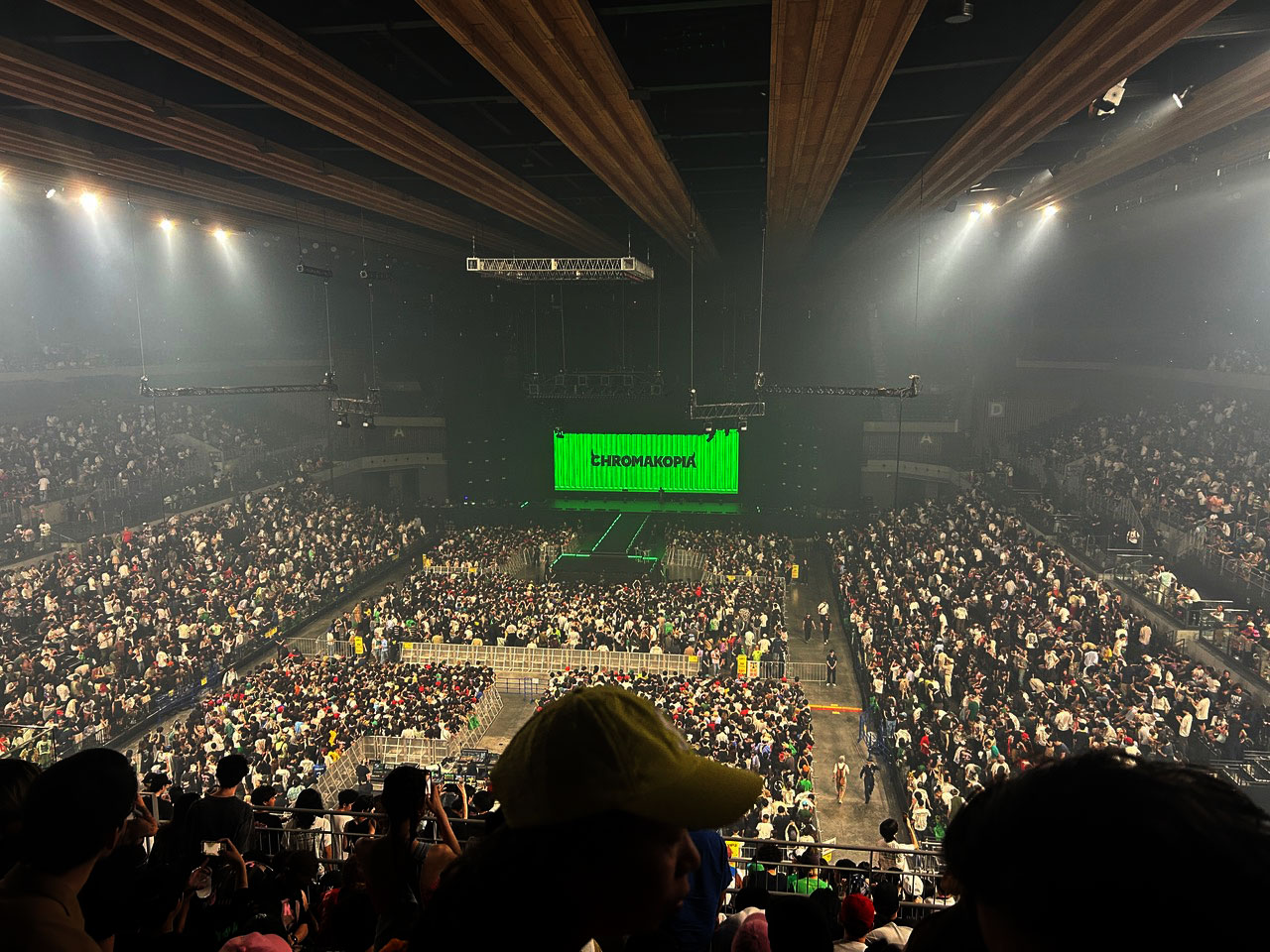
 照明が落ち、巨大スクリーンが一斉に光を放つと、新作『Don’t Tap the Glass』の映像が流れはじめ、観客の熱気は一気に高まった。そしてそのまま、タイラーは“Big Poe”でアリーナ全体を揺らしにかかった。残念ながら私は三階席に追いやられてしまったが、周囲の観客の一部は、これがダンス・ミュージックであることを忘れてしまったかのように静かで、その分アリーナのフロアは熱狂的に応えていた。
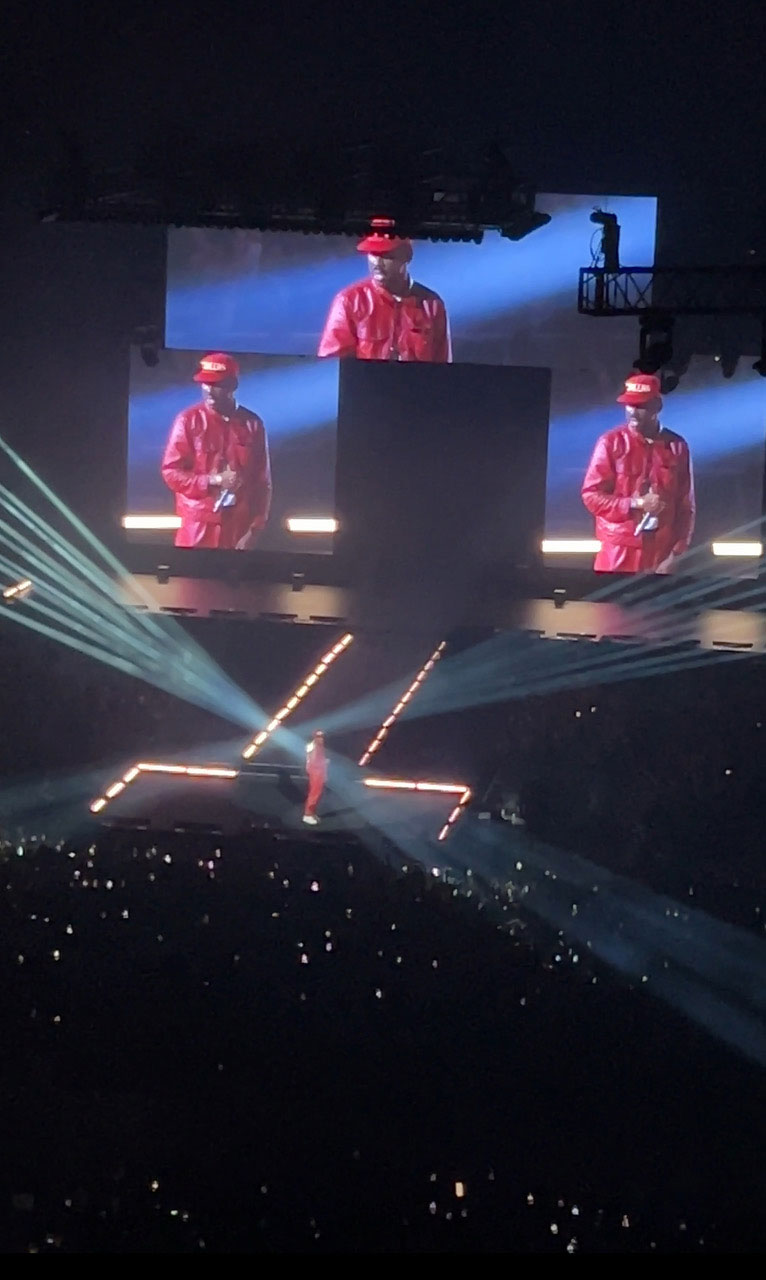
 ステージに現れたタイラーは真っ赤なレザーパンツに白いTシャツ、そして赤のレザージャケットという装い。観客の多くが30歳未満であることを考えると、この色彩の組み合わせがマイケル・ジャクソンの『Bad』や『Thriller』を想起させるものだと気づいた人は少なかったのではないだろうか。タイラーが披露した数々のムーンウォークを見れば、その内輪的なジョークは明らかだったはずだ。
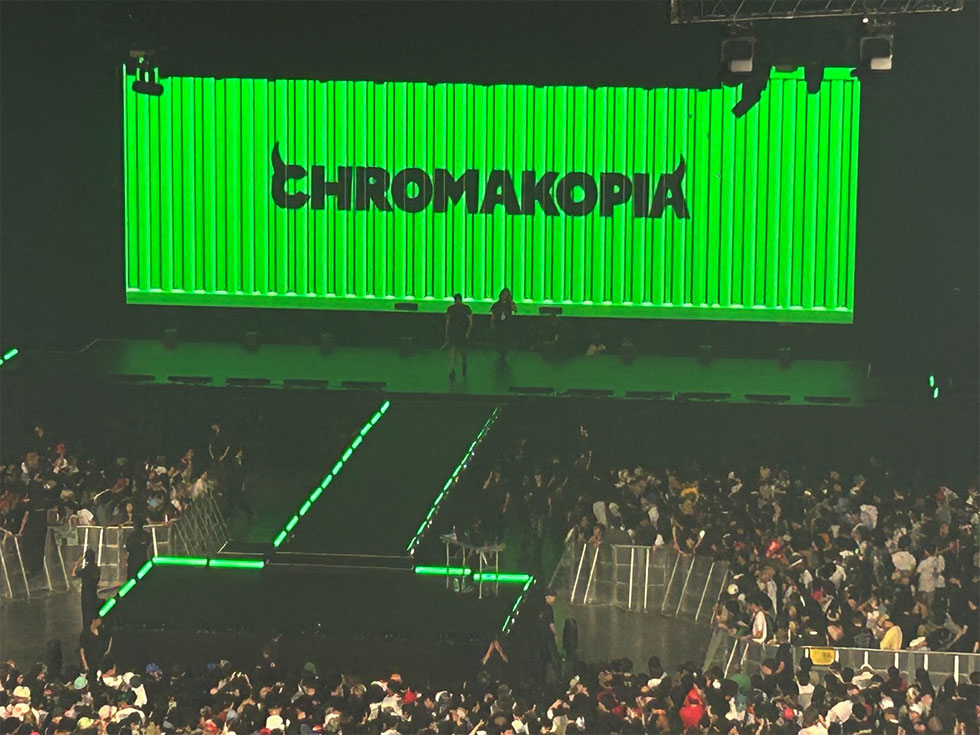
 『Don’t Tap the Glass』の鮮やかな色彩から、次の曲群では『Chromakopia』の緑を基調とした演出へと移行した。だが、ここで違和感を覚えた。タイラーの責任ではないが、ヴィジュアル・チームはスクリーンの光演出に偏りすぎており、ステージ上のタイラー自身は闇に包まれてしまっていたのだ。曲がひとつふたつと続くあいだも、彼の姿がほとんど見えない時間があり、観客としては落ち着かない体験となった。

 音楽自体は素晴らしく、タイラーは純粋なポジティヴ・エナジーの塊として、心を込めてラップを届けてくれた。もっと多くのラッパーがこうした愛情をもってパフォーマンスをすれば、と願わずにはいられなかった。しかし、それでもなお舞台演出には混乱の影が残った。これまでの公演映像を見返してきた私は、今年7月までのツアーでもタイラーが『Chromakopia』のプロモーションに集中し、仮面、アフリカ風のヘアスタイル、そして緑のスーツを纏っていたことを知っている。だが、新作『Don’t Tap the Glass』が突如リリースされたことで、そうした演出はすべて覆され、東京の観客はその世界観を体験できなかった。過去の公演映像で見た華麗な舞台美術を心から楽しみにしていたが、有明アリーナの舞台装置は巨大スクリーンがあるだけで、それ以上は何もなかった。この特別な東京公演における演出の物足りなさは、まさに痛手だった。仕事を休んでまで足を運んだ観客にとってはなおさらだ。
 それでも、知っている曲では声の限りに歌い、馴染みのない曲では耳を傾け続け、一度も座ることはなかった。だがタイラーは座った。三度も。そしてそのうち一度は、床に仰向けに寝そべってしまったのだった。

 “Take Your Mask off”で彼が吐き出した深い心の傷——それはたしかに私の胸にも響いた。本物の誠実さがそこにあった。だが同時に、彼は何度も「暑い」とこぼした。真っ赤なレザージャケットを着たまま、一度も脱がずに。さらに彼は、「しばらく日本には戻ってこないだろう」と、観客の心を射抜くような言葉を投げかけた。思い返せば、前回の東京公演は2017年、ほぼ10年近く前のことだ。そして彼は繰り返し「疲れた」とも語った。私は3〜4時間にわたる長丁場のステージをこなすバンドを見てきたが、この日のタイラーの公演はわずか1時間20分だった。

 もちろん私はライヴを楽しんだ。謎めいた存在であるタイラーを間近に感じられたことは大きな昂揚をもたらした。しかし、ステージ上で「疲れている」と訴える姿には苛立ちも覚えた。時差ボケ、過剰に熱狂的なファン、日々絶え間なく求められる発言、仲間に囲まれない孤独——そうした重荷を背負う彼に共感しないわけではない。だがそれは、毎朝4時に起き、夜8時まで働きづめだった父の労働や、複数の子どもを出産し、7〜9時間立ち仕事をしてから家に帰って夕食を用意した母の姿から聞こえる、「疲れた」と同じではない。
 彼はたしかに観客に感謝していた。しかし、舞台演出の乏しさや、人気曲を断片的に繋いだメドレー形式——それぞれが一節で切られてしまう構成には、「完全なパッケージ」を体験できなかった物足りなさが残った。
 もし今回の東京公演を観た人がいるなら、ぜひ7月にニューヨーク・ブルックリンのバークレイズ・センターで行われたパフォーマンスを観て比較してほしい。


8 long years since his last show in Japan in 2017, Tyler the Creator touched down in Tokyo for 2 nights at the Ariake Arena in Odaiba (Sept 9th and 10th). Unlike his one show at Liquid Room in Ebisu before, packing two dates at Ariake are like day and night. Tyler is hands down popular, one of the best and one of the most influential rappers around the world. And by his own admission, Tyler is tired.
Despite following OFWGKTA from their Tumblr days when literally their ethos and advertising was prominent there (the good old low-fi digital days), I have unfortunately never seen him on stage. Only through YouTube was I able to imagine myself stage diving with him or bouncing to his first 3 albums. And I am sure 80 percent of the audience over the 2 almost sold out nights were in the same boat.
Tyler brought the band Paris, Texas to warm up the crowd and they didn`t fail in their mission to make as best an impression as possible emulating Tyler`s energy and flow. Before and after they took the stage, the anticipation for Tyler for this second and last show in Japan, was very palpable with people running in the hallways anxious to find their seats. This energy brought a smile to my face. Despite daily media oversaturation, I`m glad that anticipation and excitement are still alive.

Once the lights came down, the jumbo screens lit up and images from the new release “Don`t Tap the Glass” appeared gassing everyone up and just like that Tyler started the arena moving to “Big Poe.” Unfortunately relegated to the third floor, it did seem some audience members near me forgot it was dance music but the floor didn`t.
Tyler was out from the beginning dressed totally in red leather pants, white T and a red leather jacket. With a significant segment of the audience under 30, I fear they didn`t get the Michael Jackson reference with the color coordination reflecting “Bad” and “Thriller.” The inside joke should have been obvious with many of the moon walk dance moves Tyler pulled off.
From the bright colors of “Don`t Tap the Glass” the stage changed with the next songs to the green of “Chromakopia” and it`s here where I felt things became a bit off-kilter. I don`t blame Tyler for this but his visual team focused too much on creating nice lights for the jumbo screens while Tyler on stage was almost surrounded in darkness. For more than one song. It was disorientating.
The good music flowed and Tyler, just a ball of pure positive energy, rapped with the heart and love I wish more rappers did. But still there was bits of disorientation. Having watched earlier shows, even up til July of this year, Tyler had focused largely on promoting and performing “Chromakopia” and wore the outfit and hairstyle that he created for it on stage. Mask, African hairstyle and green suit. With “Don`t Tap the Glass” suddenly released though, it seems he threw all of that under the bus so Tokyo audiences didn`t get to experience any of it. Having also seen video of past years of great performances, I REALLY looked forward to a gorgeous set design. The Ariake Area set design unfortunately were literally just jumbo screens and nothing more. The lack of effort for such special show for Tokyo hit me bad. Like I look time off of work to see this show.
I sang my heart out at songs I knew and listened intently to songs I wasn`t so familiar with and I never sat down. But Tyler did. Three times to be exact. Once even lying flat on the ground.

Yes, he was spitting out deep emotional trauma with “Take Your Mask Off” and I fell that. It hit me. All that sincerity. But more than once he complained that it was hot despite wearing a leather jacket he never took off. He sent out arrows to pierce everyone`s heart saying he wouldn`t be back any time soon (keep in mind he hasn't been to Tokyo since 2017 - that`s almost a decade) and complained that he was tired. I`ve seen bands play 3 to 4 hour shows and Tyler`s show was just an hour and 20 minutes.
I enjoyed all of the concert. Being close to the enigma that is Tyler left me high but Tyler complaining on stage about being tired irked me. Though I have empathy for anyone combatting jet lag or having obsessive fans or tons of people asking your opinion every day or the loneliness of not having a crew around to mentally protect you, it still isn`t the same as my father who woke up at 4am to drive to work and stay til 8pm 5 times a week. Or my mother who gave birth to several children and then went back to work standing on her feet for 7 to 9 hours before going back home to cook dinner. I understand he was grateful for everyone coming to the show but with the set design, medleys of his most popular songs - each song cut down to one verse, it felt like we didn`t get the full package.
For anyone who saw the show, I encourage you to watch his performance in New York City this July at Barclays to compare.

interview with Colin Newman/Malka Spigel - ele-king

 「時代の流れに身を任せながらも、自分の原則を守ろうとする」というのが、マルカ・シュピーゲルが、過去数十年にわたって音楽と人生の道を歩む上で指針としてきた哲学を、自ら説明した言葉だ。イスラエル生まれで最初はベルギーを拠点とするポスト・パンクと実験的ポップ・バンド、ミニマル・コンパクトとして活動を始めた。
「君は本当に詩人だね」と、この時間の大半で冗談交じりに語ったのは、彼女のパートナーでイギリスのポスト・パンク時代の伝説のバンド、ワイアーのリード・ヴォーカル兼ソングライターとして名を馳せたコリン・ニューマンだ。
やりとりのなかで、行ったり来たりしながら互いの空白を埋めるように話し、どちらかが割って入って会話の流れを調整する。コラボレーションが基本という感覚こそが彼らの自然な会話の仕方の本質の一部であり、おそらくそれが、音楽家として長く継続できている協働の特性をも垣間見せているのかもしれない。


Immersion
Nanocluster Vol. 1


Immersion
Nanocluster Vol. 2


Immersion
Nanocluster Vol. 3

 1980年代にベルギーで出会ったふたりの、尽きることのない好奇心、新しい音に対する鋭いアンテナを張り巡らせること、そして他者の作品を吸収して共有したくてたまらない、スポンジのような吸収力と解放的な感性が組み合わさったことで、魅惑的で変わりやすいオルタナティヴ・ポップ・ミュージックの歴史に大きな影響を与える(同時に影響を受ける)存在となった。

 〈スウィム(Swim ~)〉レーベルの共同オーナーとして、Githead名義のバンドとして、ここ最近ではエレクトロニック・デュオ、イマージョン(Immersion/没入の意味)名義として『ナノクラスター(Nanocluster)』における複数の人と共働するスピーゲルとニューマンは、おそらくこれまでで一番活発な活動を展開している。今年のはじめ、彼らは『ナノクラスター』シリーズの第3弾をリリースし、イマージョンとしては、アメリカのアンビエント・カントリー・トリオのSUSSと共に砂漠と海、コンクリートと空を融合させた、ヒプノティックで本質的なテクノで宇宙的なコラージュを創り上げた。その一方、イマージョンのニュー・アルバム『WTF?』は時代精神を捉えたタイトルで、9月にリリース予定だ。

 下記は、昨年夏に『ナノクラスター』の「vol.2」「vol.3」のリリース期間中に実施した、スピーゲル(MS)とニューマン(CN)とのインタヴュ-の編集版である。

80年代半ばのブリュッセルに本物のシーンがあった。〈クラムド・ディスクス〉だけでなく、〈クレプスキュール〉もあり、両レーベルにたくさんの国際的なアーティストが集まって、結果的にブリュッセルに住むようになったりしていた。物価も安くてツアーもやりやすかったし。

この世界に入るきっかけは何だったと考えていますか?

マルカ・スピーゲル(以下、MS):知識も技術もない状態でも、とにかく人と集まって一緒になって演奏することから始まった気がします。それでも、クリエイティヴであることの力がどういうものなのかを感じることができたのが大きかった。そして私は‶一緒に居ること〟の力を感じ続けている。私たちが常にコラボレーションをするのはそのため。他の人と演奏すると音楽面だけでなく、人間関係においても魔法みたいなものを感じるから。

コリン・ニューマン(以下、CN):僕はマルカとはまったく違う世界から来ています。いわゆるハードコアからネオクラシカルまでの、ありとあらゆる音楽の領域で、合奏(アンサンブル)にはふたつのアプローチの仕方があると思う。ひとつは、誰かが何か書き留めたものを皆で演奏するタイプ。もう一方は、皆で部屋に集まってその場で一緒に何とかするタイプだとすると、僕は最初の方。ワイアーが、ジャミングが下手くそなのは、周知の事実! 「部屋で一緒に音楽を作ってみよう!」と言っても決して何もできあがらない。基本的な作品の構造と要素があれば、非常に良いものになる可能性はある。それに対して、マルカは完全に怖い物なしなんだ。彼女が文字通り演奏を始めると、その周りに必ず何かが見つかるという具合。僕たちが最初に出会ったのは1985年で、それからほぼ継続的に長い時間、一緒に仕事をしている。

あなたは、ミニマル・コンパクト(Minimal Compact)の5枚目のアルバムをプロデュースされましたね?

CN:そう、『レイジング・ソウルズ/Raising Souls』をね。

その頃、つまり1980年代初頭のベルギーの音楽シーンは、アクサク・マブールとザ・ハネムーン・キラーズのマーク・ホランダー(オランデル)が〈クラムド・ディスクス〉で活躍していた非常に興味深い時代だったようですね。

MS:そう、ある種のエネルギーがあった。レーベル周辺にはタキシードムーンやその他の多様な音楽があって、コリンは完全に魅了されていたと思う。彼は、ロンドンで公有地に不法滞在するような生活から、ブリュッセルに移ってイギリスよりも少し穏やかな人びとや美味しい食事に出会えた。

CN:そうなんだ。すごく気に入っていたよ。本物のシーンがあった。80年代半ばは常に魅力的な時代で、〈クラムド・ディスクス〉だけでなく、〈クレプスキュール〉もあり、両レーベルにたくさんの国際的なアーティストが集まって、結果的にブリュッセルに住むようになったりしていた。物価も安くてツアーもやりやすかったし。

MS:ロンドンはかなり厳しい場所だった! 私はロンドンに行き始めたばかりの頃にショックを受けたの。ものすごく貧しい感じがして。あなたがブリュッセルに惹かれた理由がわかった。誰かと恋に落ちた以外にもね……わかるでしょう?

CN:一目ぼれだったよ。

MS:楽しい場所だったけれど、(シーンが)衰退すると退屈なベルギーになってしまった。

CN:それは、ベルギーのシーンが心理的な境界線を越えてしまったからなんだ。フランドルとワロン地域はほとんど別の国とも言える場所で、シーンは〈R&S〉レコードがあったゲント(ヘント)に移ってしまい、そこがテクノ・シーンのすべてになった。突然、〈R&S〉と契約した国際的なアーティストたちが現れて、シーンを牽引するようになった。エイフェックス・ツインの最初のアルバムをリリースしたのも彼ら。〈ワープ〉レーベルが頭角を現して彼らの輝きを奪うまで、ゲントには強いシーンがあった。

MS:私たちが再びロンドンに興味を持ち始めたのもその頃だったね。

CN:たしかにね。ブリュッセルからゲントへの移住を考えるぐらいなら、ポーランドに移るのと変わらない。どちらにも同じ銀行、同じ店があるけど、言語もメンタリティも全然違う。それに、ロンドンはまさに、拡大し始めている時だった。

MS:私たちはいつも、物事が始まりそうな場所に惹かれる傾向があるね。

CN:僕は1986年にブリュッセルに移ったんだけど、僕たちがそこを離れたのは1992年になってからだった。その時、ロンドンではようやく電子音楽シーンが始まったところだった。

MS:そして私たちはレーベルを立ち上げて、多くの電子音楽のアーティストたちと知りったの。

CN:移住する前には、マルカのミニマル・コンパクトでの活動が下火になっていて、シンガーのサミー・バーンバッハの近所に住みながらあるプロジェクトに取り組んでいたんだけれど、進展しなかった。そしたら、マルカにソロ・アルバムの話が来たんだよね。でも、彼女は知らない雇われのミュージシャンたちとスタジオに入るのを嫌がり、自分たちのスタジオで、自分たち自身で作りたいと思った。

MS:それに、彼らは私たちの考え自体を理解してはくれなかった。その頃ちょうど、自分たちのスタジオを持つということをし始めたばかりだったから。今では普通のことなのにね。

CN:彼女は、‶もうやり始めたからには、最後までやり遂げたい。さっさとやってしまおう″と言ったんだ。ロンドンに引っ越す時には、ガレージをしっかりと録音ができる場所に改造してレコードを作ってから、リリースしてもらえるレーベルを探すつもりだった。持っていた僅かな金でガレージに防音を施して、新しいミキシング・コンソールを買い、レコードを完成させた。だけど、レコードを出してくれるレーベル探しには完全に失敗したんだ。そんななか、ミュート・レコード社長のダニエル・ミラーとミーティングをしたら、「ここまで全部を自分たちでやったのなら、自分たちで出せばいいのに。やり方はこうだ……」と、レーベルの運営方法を2時間かけて指導してもらった。そして突然、アルバムをリリースすることになった。

MS:(私たちの)典型的な回答ね! 質問に対して、もはやまったく別の話題になってしまっている……!

その後、ミニマル・コンパクトのサミー・バーンバッハと一緒に、オラクルという名でコンピレーションを制作して出した。2枚のレコードを出したところで、マルカが言ったんだ。「私たちはテクノ・レコードを作らなければ!」と。

これこそが私の理想のインタヴューの形ですよ。私がやるべきことが少なければ少ないほど良い!

CN:実は、僕たちがレコード会社を作ったことをマルカが認めるまでに一年かかったんだ。彼女にはそれがとても思い上がったことに思えたから! それでも僕たちはマルカの初のソロ・アルバムをリリースし、そこから利益を得ることができた。

MS:あの頃はいまよりもまだやり易い時代だったから。

CN:そして、人びとはもっと多く(音楽を)購入していた。その後、ミニマル・コンパクトのサミー・バーンバッハと一緒に、オラクル(Oracle)という名でコンピレーションを制作して出した。2枚のレコードを出したところで、マルカが言ったんだ。「私たちはテクノ・レコードを作らなければ!」と。

MS:私はそんなこと言っていないけど!

CN:いや、言ったよ!君はもっとインストゥルメンタルな曲を作るという想いにかられていた。そして、常に‶ミステリアス〟という言葉を好んでいたね。

MS:多分、そっちの方がより純粋だからだと思う。テクノには‶フロント〟というイメージがあまり無いところに惹かれたの。音楽の制作者がどこから来た、どういう人なのかは知らなくても、純粋な音楽だけがすべてだと思うようなところに。

CN:そうそう、『NME』では‶顔なしのテクノ・バカ(”faceless techno bollocks)″みたいにまとめられたけれど、それは‶ジャングル″のような言葉と同じで、最初はこき下ろしみたいな呼び方だけど、結局は受け入れられるんだ。‶顔なしのテクノ・バカ″なんて、素晴らしい発想だよね![編註:これはすぐにテクノの匿名性、音楽重視で作り手のルッキズムに依存しない態度を賛辞する言葉になった] 最初のイマージョンのレコードでは、僕たちはドイツ出身だと偽ってウィッグやマスクを着けて宣材写真を撮って、でたらめな偽名を使っていた。レコード会社としては、レコードをリリースするだけだから、それが誰によるものなのかは関係ない。それが最初のイマージョンのアルバム『オシレイティング/Oscillating』だった。

ほぼ同じ時期にリミックス・アルバムもリリースされましたよね?

MS:当時はほんとうに簡単だった。電子音楽のミュージシャンがたくさんいて、誰もがオープンで、「お願いできる?」と聞くと「もちろん、リミックスするよ!」という返事がもらえたものよ。

CN:それはロビン(ランボー、別名スキャナー)が始めたんだよね。バタシー・バークを歩いていた時、彼が「リミックスしてあげるよ!」と言ったんだ。我々も、いいね! という感じで。僕たちはそれが12インチ盤を出す口実になると思った。それで2枚分のリミックス・アルバムを作ったんだけど、2作目の頃には、テクノ界の少し有名なクロード・ヤングのようなアーティストがリミックスを手掛けてくれるようになって、それらのレコードが売れたんだ! まだレーベルを始める前の〈ファット・キャット〉がコヴェント・ガーデンにレコード店を持っていたから、少し多めに白盤を作って〈ファット・キャット〉に渡せば、彼らがトップDJたちに売ってくれていた。

MS:そうやって、自然と広がっていったの。あの自然な流れが好きだったな。今は、すべて業界の仕組みを通さなくてはならなくて、その罠から抜け出すのは不可能ね。

CN:それで、僕たちのそれまでの歴史とはまったく関係なく、ダンス・ミュージック界でクールな音楽を出すレーベルという評判を得たんだ。その次に、LFOのゲズ・ヴァーリーから連絡が来て、「いくつかのトラックがあるんだけど、ワープは全部が‵聴くための音楽′でないと出したくないと言っている。俺はダンスフロア向けの音楽をやりたいのに」と言うんだ。ちょうど息子のベンを迎えに行く車の中でそのカセットを聴いたんだけど、最初のトラック“クオ・ヴァディス/Quo Vadis”を聴いた瞬間にこれはポップ・ミュージックだと思ったね!

MS:彼はG-Manと名義を変えて12インチを出して、この曲は大成功を収めたし、今でもプレイされている。日本でのワイアーのライヴで、ある人がワイアーの出番の前に“クオ・ヴァディス”をプレイしていた。その人は、コリンとこの曲の繋がりを知らなかったと思うけど。聴いた瞬間に、「ワオ! まだプレイする人がいるんだ」と思った。

CN:まさにクラシックな、ダンスのできるミニマル・テクノとして、DJたちに愛されたよね。この頃には僕たちはもう恐ろしいほどの評判を得ていたんだけど、ひとつのスタイルに固執したくはなくて。そして、ドラムンベースが登場し、僕たちも夢中になった。テクノはある種、アメリカンな感じがしたけど、ドラムンベースはまさにロンドンの音楽で、70年代パンクのような興奮を覚えた。突然、信じられないほどのエネルギーの爆発が起きた。正直、90年代半ばのある時点では、もうドラムンベースさえあればいいという感じだった。自分たちでも少し作ったけれど、その後、ロニー&クライドという、ブレイクビートのより知的な側面に分け入って、違う領域に挑戦する人たちと仕事をするようになった。僕たちはもう少しダウンテンポ寄りの作品をいくつか出して、90年代後半にはポスト・ロックの渦に巻き込まれ始めた。僕たちは90年代をアンビエント・テクノから始めて、ポスト・ロックへとたどり着いた。その時の時流に乗ったということだ。レーベルをやるのであれば、常に現代的であり続けなければいけない。

いまの話を聞いて、あなたが先ほど話していたことを思い出しました。あなたは、ネオクラシックからその他のさまざまなジャンルへと続く音楽の糸のようなものについて話してくれましたが、それに名前は付けていないと言いました。実は私もそういったことをよく考えるのです。ジョン・ケージからブライアン・イーノが1970年代にやったこと、それからパンクの時代にもっとも興味深いバンドがやっていたことまで、線を引くことができるのではないかと。それは、クラシック・ロックの正典の枠組み外にある、並行歴史(パラレル・ヒストリー)のようなものではないかとね。

MS:ストリーミングが始まってからすべてが変わったのではないかな。音楽を届ける範囲や、仕組みそのものが変わったのでは?

CN:根本的に変わったのは、どこに力があるかということだと思う。例えば、90年代のインストゥルメンタル・ミュージックの台頭は、アーティストがアメリカやイギリス出身でなくても世界的に活躍できることを意味して、その変化はストリーミングの普及によって完成されたんだ。今ではその現象は‶グローカリズム(glocalism)〟と呼ばれていて、アーティストが自国で成功を収めながら世界中へと広げていくことができる。それと同時に業界は、完全に石化したかのような状態になって——僕が言っているのは、メジャー・レーベルや大手の独立系のことだけど——なんとか過去の体制にしがみつこうともがいている。権力の分散化は確実に起きていて、それをさらに加速化させる必要がある。

[[SplitPage]]

ドラムンベースが登場し、僕たちも夢中になった。テクノはある種、アメリカンな感じがしたけど、ドラムンベースはまさにロンドンの音楽で、70年代パンクのような興奮を覚えた。突然、信じられないほどのエネルギーの爆発が起きた。正直、90年代半ばのある時点では、もうドラムンベースさえあればいいという感じだ。

あなた方が一緒に働き始めた時、コラボレーションが重要になったと言っていましたね。年月を経て、それが大きく成長したように見えます。それはあきらかに、『ナノクラスター』の重要な要素のひとつですよね。

MS:それがすごく魅力的な領域なんです。長年音楽を作り続けていると、知らない人と一緒に働くこともあって、そんな時には自分の安全地帯から押し出されるようなことも起きてくる。どこか違う場所で、他の人たちのやり方に挑戦すると、視野が広がって、多くの選択肢を与えられるの。すべてのコラボレーションが私たちを新たな場所へと連れて行ってくれる。

CN:2000年代になると、ワイアーが再び始動して、それと並行してGitheadというバンドのプロジェクトにも取り組んでいた。10年前には、ブライトンに移住したんだけど、そこでまたイマージョンも復活させることにしたんだ。機材がかなりシンプルで、ただ一緒にギグをするだけでよかったから。イマージョンの前のアルバム『ロウ・インパクト/Low Impact』は1999年のリリースで、その次のレコードは2016年だった。長い間隔が空いてしまったけど、それが僕たちに自由に活動する空間を与えてくれた。それでアルバムを制作して最初は2枚の10インチ盤として発売し、後にCDに編集した――まるで島に住むアナログな生き物みたいなイメージで。実際にそれがタイトルになったんだけど(EP『アナログ・クリーチャーズ/Analogue Creatures』と『リヴィング・オン・アン・アイランド/Living On An Island』 をまとめたアルバム、『アナログ・クリーチャーズ・リヴィング・オン・アン・アイランド』)。実は僕たちがすでにその時、ブレグジットによる疎外感を感じ始めていたのがタイトルに表れているんだ。

今日の取材の前にその曲を聴いていて、そのことに強く感じ入りました。『リヴィング・オン・アン・アイランド』というタイトルと2016という年を見て「ああ、自分もその感覚を知っている!」と思ったんです。

MS:ブレグジットの投票時には、私たちは島に居て、あらゆるものから隔絶されているという強い感覚を覚えたの。

CN:僕たちは海辺に住んでいるしね。

MS:そう。そしてそれがある種の希望と楽観主義を同時にもたらしてもくれる。

CN:いくつかライヴやフェスティヴァルにも出演したけれど、大きな動きはなかったね。
でもブライトン在住の知人が、「ブライトンに居るなら、自分たちの手でシーンを作る必要がある」と言ったんだ。現地の音楽シーンは結構分断されているからね。

MS:ミュージシャンもすごく多いから!

CN:すごく多い! それで僕たちは、「それはどういう意味だろう? どうやったらシーンを生み出すことができるのか? クラブでイベントを企画してもいいけど、他の人とどうやって差別化できるんだろう? そうだ、コラボレーションの要素を入れてみよう」と思いついた。僕たちはターウォーター(Tarwater)とはベルリンのシーンの初期から何年も知り合いだったし、会場をみつけて、ターウォーターとイマージョンがコラボレートするイベントを企画しようということになった。彼らが数日間、僕たちの所に泊まり込んで一緒に曲を作ればよいと考えた。そして、それが上手くいったんだ。

MS:リハーサル中にもスタジオで録音ができたから、基礎となる録音を残すことができたしね。

CN:ザ・ローズ・ヒルという公共の、110人ぐらいのキャパの小さな会場でやったんだよね。ちゃんとしたお客さんで埋めるのも簡単な規模の。

これは、実はワイアーのブルース・ギルバートが人生と芸術について語った大事な声明のひとつ、「文脈がすべてだ(Context is all).」から来ている。僕はいわゆるビッグ・ボーイ・プロダクションと言われるものを常に嫌ってきた。レコードを聴いて、その背後に関わった‶プロデューサー″のエゴが透けて見えるような自己主張の強いもののことだ。

コラボレーションはどのような感じでやるのでしょう? 即興することもあるんでしょうか? それとも事前の準備の方が多めですか?

MS:まず私たちがアーティストにアプローチして、「私たちの方から3つの基本的なアイディアを送るから、あなたの3つの基本の考えを返送してください。何か思いついたものをそこに乗せてみてほしい」と言う。それを基に、あまりやり過ぎない程度に構築していく。それから相手と一緒になって完成を目指すの。毎回違うやり方にはなるけれど、それが基本的な構造かな。全然即興ではないけれど、完成度をそこまで高くしないから「うまく行くだろうか?」とか「良いライヴができるだろうか?」というような多少の緊張感もある。

CN:次に思いついたコラボレーションの相手がレティシア・サディールだった。‶クラウトロック・カラオケ″というものがあってね。

MS:ロンドンに長年住んでいる、日本から来た人が企画している、違うバンドの人達が集まってクラウトロックのヴァージョンを弾くという一夜があって、それが楽しいの!

CN:それをレティシア・サディールと一緒にやったんだけど、彼女はギター演奏の能力だけでなく、すべてのパートを覚えて参加したんだ。僕たちはそんなことをしたことがなかったんだけど! それを見て、彼女に『ナノクラスター』の話を持ちかけたら、セットをやってくれるのではないかと思った。

MS:彼女が私たちの所にやって来て滞在し、一緒に題材に取り組んで。そう、とても良かったわ。

CN:僕たちは多くの素晴らしい人たちを知っているけど、そのうちの何人かは僕たちがその人たちのファンであるという理由からなんだ。ウルリッヒ・シュナウスが宇宙で一番の音楽を作っていた時もあったし、他にもロビン・ランボー、スキャナー、勿論Githeadのね。彼のことももう何年も知っているよ。

MS:それ以来、私たちはますます幅広い分野でコラボを続け、紙の上では機能しそうもない奇抜なアイディアを次々と生み出してきたの。

CN:そこへ突然パンデミックが襲い、2020年5月に僕たちは4つのコラボレーション企画以外はまったくすることがなかったから、「アルバムを完成させよう」と決めた。実はこれは難しい決断だった。というのも、マルカと僕はそれまで一度もアルバムのミキシングをやったことがなかったから。まさに目から鱗が落ちるような経験だった。僕の感覚では、それが当時、僕たちのスタジオから生まれた作品のなかでも最高のミックスのレコードになったんだ。すべてをコラボレーションして制作したからだと思う。

MS:ある意味、ラジオからも影響を受けていたよね。異なるジャンルの曲をたくさん聴くと、音の組み合わせ方など、無意識に影響を受けていたと思う。

CN:その通りだね。それを2021年にリリースして、批評家からはある程度の高評価を得たけれど、パンデミックの最中にはプロモーションは何もできなかった。ライヴもすでに終わっていたので、ツアーを組むのも難しい状況だった。どちらにしても、2021年から22年にかけて、ツアーを検討したミュージシャンは、自分たちで主催するしかなかったし。

パンデミックの状況において、アルバムで他のアーティストたちとはどのように協力して制作できたんですか?

CN:すべてを事前に録音していた。

MS:リハーサルをしながら録音し、それを制作の基盤としたの。現在では、彼らが送ってくれる素材で仕事をしているけれど、次回作のコラボレーション(2025年のSUSSとの『ナノクラスターVol.3』)では、物理的な空間での作業はしないと思う。状況次第だけどね。スタジオ・ワークを完成させるには、互いにパーツを送り合うか、物理的に人が集まるかのどちらかの方法がある。

それは、プロジェクトの進化の一環ですね。始めた頃にはブライトン在住のミュージシャンたちや、移動が容易な人たち中心だったのが、より広範にアーティストを探し始めると、プロセス自体も変わってくる。

CN:まさに。最初の作品をリリースした後、「次のレイヤーに行くにはどうすればよいか」を考えた。多くの人と話をしたけど、誰もブライトンには居なかったし、パンデミック後というのは、誰もが自分のキャリアに集中していた時期だった。僕たちと仕事をするのは贅沢だと思われる可能性もあったから、何か別の方法はないかと考えた。僕たちの知り合いにサウス・バイ・サウスウェストの主なオーガナイザーのひとりであるジェイムズ・マイナーがいたので、そこで何かをやってみようと思った。

MS:それは結構怖いことだった。というのも、オースティンまで遠征して、現地の人たちと音楽を作らなければならなかったから。どうやってやろう?と。その時、リストにソー(Thor)・ハリスの名前を見つけたの。彼はその土地の人で、パーカッションを演奏するので、一緒に何かを創りやすいのではないかと思った。

CN:彼はかなりアメリカのミニマリスト・シーンの核心にいる人物だし。

MS:そして、生まれつきコラボレーションの才能のある人。

CN:ソーは、実に乗り気きだったね。事前に素材を交換したので現場に着いたらすでに基盤となるものもあった。結局、彼の家でリハーサルをすることになった――彼はただ優秀な音楽家であるだけでなく、大工、配管工、便利屋としても何でもござれの職人で、素晴らしい社会的良心も持ち合わせているんだ。

MS:彼は素晴らしい人物だった。彼の自宅で仕事ができたのは良い経験だった。オースティンでは誰もが知る人物。

CN:実際のパフォーマンスでは、ちょっとした試練のようだった。というのも、結局、ホテル・ヴェガスで演奏することになり、半分暗がりの、そこら中、酔っぱらいだらけのなかで、テーブルの上に機材を設置しなければなかったから。

MS:それがコラボレーションの良いところ。それぞれの異なる経験が、いつもなら行かないような場所にまで連れて行ってくれるので、かなりの中毒性がある。私たちは人と一緒に音楽を作ることが大好きだし、他の人の世界に引き込まれるのも特別なことだから。

それが、リスナーとして『ナノクラスター』のアルバムを聴くときに興味深い点のひとつです。音楽的な個性が互いに溶け合っていくかのような感覚なんです。多くの人が関わっていて、各盤面やディスクごとにコラボレーターが違うのに、常に一貫した雰囲気が漂ってくるからです。あなたたちがワイヤーとの作業について説明してくれたのとは対照的ですね。ワイアーでは各人の役割が明確に分けられ、決まっていたという。

MS:コラボレーターが違っていても、音に一貫した豊かさがあると言う声をよくもらいます。

CN:それはおそらく、最終的なミックスのやり方も影響しているだろうね。

MS:でも、それだけではないわ。私たちはそこに人間同士の繋がりを持ち込むから。いつも、最後には友情関係になって終わることが多いよね。

CN:僕たちは、一緒に仕事をする人の空間を作ろうと努めるけれど、文脈を設定した上でそうする。これは、実はワイアーのブルース・ギルバートが人生と芸術について語った大事な声明のひとつ、「文脈がすべてだ(Context is all).」から来ている。僕はいわゆるビッグ・ボーイ・プロダクションと言われるものを常に嫌ってきた。レコードを聴いて、その背後に関わった‶プロデューサー″のエゴが透けて見えるような自己主張の強いもののことだ。制作に関わるのであれば、その音楽とそれを聴く人の間の障壁を取り除くべきだ。リスナーがその音楽のなかに何があるのかを容易に聴けるようにするべきだと思う。自分や他の関係者を良く見せよう、聴かせようとすることではなく、全体が大事なんだ。

レーベル名をSwim(泳ぐ)にしたのはなぜですか?

MS:だめ(笑)? 私たちはいつも響きの良い名前を探しているんだけど。多分、私たちがいつも異なる人びとの世界の間に軽やかに浮かんでいるからかも。でも、ほんとうはよくわからない。それは後からついて来るものだと思う。この名前を聞いて、あなたは何を思い浮かべますか?

私はブライアン・イーノのことを思い出しました。彼の音楽では水が繰り返し登場するテーマで、イマージョンで聴く音にもどこか似たものを感じます。あなた方は、どちらも他のバンドではシンガーとして知られていますが、ここでは多くの曲でヴォーカルを削ぎ落しています。だから、ポップスターやロックスターのエゴを排除して、他の可能性が生まれる流動的な空間を探しているように聴こえます。

MS:私たちは、『ウォーター・コミュニケーション/Water Communication』というコンピレーションも出したし、水は繰り返し現れるテーマなの。そして今は、海辺に住んでいるし。

CN:これは、ある意味、『ナノクラスターVol.2』のもうひとつのコラボレーションであるジャック(ウォルター、別名カブゾア Cubzoa)に引き戻される。2021年頃だったと思うけれど、皆が再びライヴを開催するようになり、僕たちはザ・ローズ・ヒルに行ってカブゾアに真に感銘を受けたんだ。

MS:彼は私たちに曲を送ってくれるようになったんだけど、曲というのは完成されたものなので、最初はどうしたらよいのかと戸惑った。通常は、もっと基本的なところから始めるから。でもとても興味深い挑戦になったし、すごく良い作品に仕上がったと思う。

「いまのバンドは大変なのよね。そうせざるを得ないんだから」「ほんとうにそう! パンデミック以降、業界はミュージシャンに圧力をかけている」

CN:さらにもうひとつ、これまでの『ナノクラスター』ではやったことのないことをしたんだ。それは、素材をどんどん出し合うことだった。最初は素材が足りていなかったから。結果、かなり素晴らしい成功に繋がった。彼の曲とはかなり違うものになったんだ。

MS:彼が一緒に居るとほんとうに良い人なので助かったわ。人間性は非常に重要だから。

前回の作品では、4人のアーティストが参加してそれぞれが10インチの片面を担当されましたが、2作目ではふたりとなり、各ディスクにひとりのアーティストが参加した形になっていますね。

MS:それは事前に決めたことではなかったけど、作業を進めるうちに素材が十分そろったことに気付いたの。今後はもしかしたら、コラボレーションはひとつだけになるかもしれない(注:実際、『ナノクラスターVol.3』では、SUSSのみとのコラボになった)。

CN:ルールを設けてはいないよね。ただ、僕たちはダブル10インチ(2枚組の10インチ盤)が好きで。この着想は、完全に実用面でのふたつの理由から生まれた。ひとつ目は、最初のアルバムを製造した際、12インチのヴァイナルをプレスするのに数か月かかったのに、10インチならずっと早く作れたということがあった。また、最初のアルバムには4つのまったく異なるプロジェクトが含まれていた。だから‶それぞれに専用の面があれば、それが自然な仕切りになる″と考えた。

MS:アーティストにとってもより興味深くなるしね。

CN:そう。それぞれが独立した作品になればね。当然のようにデジタル配信では、別々のEPとしてもリリースされているし、ストリーミングでは、短い長さのリリースがトレンドになっているようだ。例えば、20曲入りのアルバムをリリースしても、注目されるのは1、2曲だけで、残りは無視されてしまう。ストリーミングでは聴く人の注意力が極端に短いから。別々のEPにすることで、異なる人たちがそれぞれ別のアーティストに集中できると思った。でも実際には、媒体によるということなんだけど。

そして2作目では、各アーティストがより広い範囲でプレイする余地が得られると、EPのような短いフォーマットではなく、違う方向性になる気がします。

MS:そうかも。各アーティストがより多くの表現で貢献できるようになることが重要。

現在のあなた方の作品に共通するテーマのひとつは、独立した所有権の尊重のように感じます。ワイアーの場合も、バンドがカタログの大部分を所有しているというのは事実でしょうか?

CN:僕たちは80年代の作品は所有しておらず、70年代、80年代の出版権も持っていないけれど、70年代作品のマスターテープは保持していて、2000年以降の作品のすべても持っている。〈スウィム〉からリリースしたアーティストの一部は、自分たちで権利を買い戻していて、他のアーティストは特に気にしていないようだけれど、僕たちは喜んで権利を返還するつもりなんだ。他の人の音楽に執着する必要はない。

MS:あなたの場合は、所有権を持つことがとても重要だと思う。だって、大手レーベルが持つ影響力というものに嫌というほど、気付かされたんだから……

CN:僕たちにとっては、個人的にかなり大きな違いになったよね……。勿論、僕は非常に恵まれた立場で話しているわけだけど。つまり、70年代のワイアーの素材が何世代にもわたって受け入れられてきたから。それは70年代にリリースされた当時の人たちだけでなく、世代を超えて受け継がれて若い人にまで響いている、決して静かではないダイナミックな現象なんだ。さらにストリーミングの数字から判断すると、リスナーは減少するどころか、増加している。自らでマスターの権利を所有し、収益の大部分をバンドに還元できると、生計を立てるための基盤ができる。もしもオリジナル・メンバーと同世代の人たちが公務員になっていれば、はるかに多くの収入を得ていただろう。だけど、60代、70代、80代のミュージシャンのなかには、生活に苦労している人も多い。ツアーに出なければ家賃を払えないから、過酷な条件でツアーを続けるしかないんだ。

MS:でも、私たちが一緒に作るものをすべて所有していることには、メリットとデメリットの両方がある。外部レーベルのように、作品をより広めるような力はないから。

CN:お金がかかるからね。宣伝費や製造費、その他すべてに費用がかかる。だけど、例えばすでにやっているコラボレーションのひとつは、ブライトンを拠点とするバンド、ホリディ・ゴースツというサムとカットのカップルで、僕たちとも仲が良い。彼は30代前半で、ツアーのブッキング方法まで良く知っているんだ。僕の世代のミュージシャンは、ツアーのブッキングの仕方などまったく知らないと思う。

MS:いまのバンドは大変なのよね。そうせざるを得ないんだから。

CN:ほんとうにそう! パンデミック以降、業界はミュージシャンに圧力をかけている。

日本でも似たような状況だと感じます。あの数年で、何かが急激に加速した、‶それ以前とそれ以後″があるんです。若手のミュージシャンたちが、まるで優秀なビジネスマンのように見えるのはある意味で尊敬に値するけど、彼らがそうせざるを得ないことに同情してしまいます。

MS:そうよね。ミュージシャンとして、ただ音楽を追求する自由は、素晴らしい以外の何ものでもない。

(了)

[[SplitPage]]

“I think you swim with the times, but you try to hold onto your own principles,” is how Malka Spigel describes the philosophy that’s guided her path through music and life over the past several decades — initially with Israeli-born, Belgian-based post-punk and experimental pop band Minimal Compact.

“You’re such a poet,” jokes her partner through the greater part of that time, Colin Newman, who made his name as the lead vocalist and songwriter of UK post-punk legends Wire.

A sense of back-and-forth, of each filling the gaps left by the other, of one stepping in and adjusting the flow of the conversation — of collaboration, essentially — is a natural part of the way they talk, and perhaps offers a window into the nature of their long-lasting collaboration as musicians too.

The pair met in Belgium in the 1980s and a combination of endless shared curiosity, a finely honed antenna for new sounds, and a porous, open sensibility to both absorb and eagerly share other people’s work has seen them leave their in fluence on (and be influenced by) by a fascinating and fluid alternative history of popular music.

Working together as co-owners of the Swim~ label, in the band Githead, as the electronic duo Immersion and most recently with a series of collaborators in the Nanocluster live and recording project, Spigel and Newman are perhaps more active than they’ve ever been. Earlier this year, they released the third of their Nanocluster series in collaboration, Immersion merging with US ambient-country trio SUSS to create a hypnotic, techno-organic, shifting kosmische collage of desert and sea, concrete and sky. Meanwhile, Immersion’s new album, under the zeitgeist-grabbing title “WTF?”, is set for release in September.

The following interview is an edited version of a conversation with Spigel (MS) and Newman (CN) last summer in the period between the second and third Nanocluster releases.

__________

IM : What do you think was your starting point that got you on this train?

MS: I think just getting together with people and playing together without any knowledge and technical ability, but feeling already the power of what it’s like to be creative. But also the togetherness, for me is the power that always stays there. That’s why we always collaborate: there’s some kind of magic when you play with other people, not only on the music side but on the human side.

CN: I come from a very different world from Malka. I mean, within whatever you call this whole gamut of music that runs from hardcore to neoclassical or whatever, there seem to be two approaches among ensembles. One is somebody writes something and the ensemble plays it, or the ensemble stand in a room and figure it out together. I come from the first approach. Wire is famously rubbish at jamming! If you’d said, “Let’s stand in a room and figure out some music together,” that’s never happened. If you have a basic structure and some compositional elements that are going in there, then it can be very, very good. Whereas Malka is completely fearless: she will literally just start playing and you kind of find things that go around what she’s playing. We first met in 85, so that’s a long period of pretty much continual working together.

IM : You produced maybe the fifth Minimal Compact album, right?

CN: Yeah, “Raging Souls”.

IM : That looks like a very interesting period for music in Belgium in the early 80s, with the Crammed Discs label and Marc Hollander from Aksak Maboul and The Honeymoon Killers.

MS: Yeah, there was some kind of energy. There was Tuxedomoon and other kinds of music around the label, and I think Colin was pretty much charmed by the whole thing. He came from living in a squat in London into Brussels, and the nice food and people who are kind of softer than in the UK.

CN: Yeah, I loved it. It was a real scene. And that period around the mid-80s was a really fascinating time. It wasn’t just Crammed Discs, there was Crépuscule, and both labels had a lot of international artists who ended up living in Brussels because it was cheap and good for touring.

MS: And London was a pretty harsh place! I was a bit shocked when I started going to London! It felt pretty poor. I could see why you were charmed with Brussels. Apart from falling in love with… you know!

CN: It was love at first sight.

MS: It was a fun place, but when it died off, it just became boring Belgium.

CN: What happened was the scene in Belgium crossed the psychological border. Flanders and Wallonia are almost two separate countries, and the scene moved to Ghent because that’s where R&S Records were based, and that was the whole techno scene was. Suddenly there were all these international artists signed to R&S and they were leading the pack. I mean, they put out the first Aphex Twin albums. Until Warp came and stole their thunder, there was a strong scene in Ghent.

MS: That’s also when we started getting more interested in London again.

CN: That’s true, if you’re in Brussels and you’re thinking about moving to Ghent, you might as well be moving to Poland. You have the same banks and same shops, but you have a totally different language and an entirely different mentality. And London was just starting to expand.

MS: We always feel attracted to places where things kind of start.

CN: I moved to Brussels in 1986 and we finally left in ’92, and at that point, the electronic scene was just starting in London.

MS: And started a label, and started to get to know more electronic music artists.

CN: Before we left, Malka’s time with Minimal Compact had sort of fizzled out, and we lived around the corner from the singer, Samy Birnbach, and sort of worked on a project that didn’t go anywhere. Then Malka got the offer to do a solo album, but she didn’t want to go into the studio with a bunch of hired musicians. We wanted to make it ourselves in our own studio.

MS: And they just didn’t get the concept. It was the beginning of people owning their own studios, and now it’s so common.

CN: She said, “Well I’ve already started on it. I want to finish it. Let’s just do it.” We moved to London with the idea that we could convert our garage into a proper space for recording, then make that record and figure out if we could find someone to release it. We took the little money we had, soundproofed the garage, bought a new mixing board and set to work on finishing the record. Then totally failed to find a label for it, but I had a meeting with (Mute Records boss) Daniel Miller and he said, “You’ve done it all yourselves, so why don’t you just release it yourselves as well? This is what you do…” So I had like a two-hour instruction about how to run a label. And suddenly we were releasing an album.

MS: Typical answer! He asked a question and now we’re a million miles away!

IM : This is my ideal interview. The less work I have to do, the better!

CN: It took Malka a year to actually admit that we had a record company. She thought it was well pretentious! But we put out Malka’s first solo album, and we made some money out of it!

MS: It was easier in those days.

CN: And people bought more. And after that we put out a compilation of the material we’d worked on with Sami Birnbach from Minimal Compact, under the name Oracle. So we’d released two records and then Malka said, “We have to make a techno record!”

MS: I never said that!

CN: Yes you did! You were very much into the idea that we had to make something more instrumental. You always liked the word “mysterious”.

MS: I guess it’s more pure. I always felt attracted with techno to how it doesn’t have too much of a “front image”. The people making the music, we don’t know where they come from, it’s all about the purity of music.

CN: Yeah, summed up in the NME with the phrase “faceless techno bollocks”, which rather like all those other words, like “jungle”, which starts off as a put-down but you sort of embrace it: “faceless techno bollocks”, what a brilliant idea! With the first Immersion record, we just pretended to be from Germany and we had publicity photos with wigs and masks, we had made-up names. If you’re a record company, you just release records: they could be by anybody. That was the first Immersion album, “Oscillating”.

IM : You also put out a remix album at almost the same time, didn’t you?

MS: It was really easy at the time. There were lots of electronic musicians, people were open, you’d ask someone, “Yeah, I’ll do you a remix!”

CN: It was Robin (Rimbaud, a.k.a. Scanner) that started it. We were walking in Battersea Park and he said, “I’ll do you a remix!” Oh, alright! Then we thought that would be an excuse to put out twelve-inches. We did two volumes of remixes and by the second one, we were getting slightly bigger names in the techno world doing remixes for us, like Claude Young, and those records were selling! Fat Cat Records had a shop in Covent Garden, and basically you’d manufacture some extra white labels, give them to Fat Cat, and they would sell them to all the top DJs.

MS: So it kind of spread naturally. I like the way it was so organic. Now everything goes through the industry and it’s impossible to break out of that kind of trap.

CN: And we started to have a reputation within dance music that was nothing to do with our history, just as this label that puts out cool music. The next thing that happened was that Gez Varley from LFO got in contact with us and he said, “I’ve got these tracks and Warp don’t want to put it out because they want to be all ‘listening music’ and I want to to do dancefloor.” And I remember listening to his cassette while going to pick up our son Ben from school in the car, listening to the first track, “Quo Vadis”, and I just thought, “This is pop music!”

MS: He called himself G-Man. And we did really well with it. I mean, people still play “Quo Vadis”. I heard it in Japan, when Wire played a gig and there was someone playing earlier, I don’t think he connected you with the track, but he played “Quo Vadis” and I thought, “Wow! People are still playing it!”

CN: It’s just an absolutely classic bit of danceable minimal techno and DJs loved it. So by this point we had a fearsome reputation but didn’t want to stick in one style. And then drum’n’bass happened. We were biiiiig on drum’n’bass. Techno was sort of American, but drum’n’bass was just London music, and it was kind of exciting like the 70s punk thing: suddenly you have this unbelievable explosion of energy. There was a point in the mid-90s when, to be honest, drum’n’bass was the only music that you needed. We made a little bit of it ourselves, but then we started working with Ronnie & Clyde, who were sort of the more intellectual side of breakbeat or pushing into a different kind of area. We put out some other stuff that was kind of more downtempo, and then towards the end of the 90s, we started to get involved in the whole post-rock thing. We charted a course through the 90s, starting with ambient techno and ended up with post-rock. It was all about what was going on: if you’re a label, you’ve got to be contemporary.

IM : It reminds me of something you said earlier. You talked about this thread of music that runs from neoclassical through all these other things, and you didn’t have a name for it. But it’s something I often think about: that there’s a line you could draw through stuff like John Cage, through what Brian Eno was doing in the 1970s and what a lot of the most interesting bands of the punk era were doing. It’s like a parallel history outside that classic rock canon.

MS: Didn’t everything change because of streaming. It changed how far it can reach and how it works.

CN: I think the fundamental change is in where the power lies. For example, the rise of instrumental music in the 90s meant that artists didn’t have to be from America or the UK to be international artists, and that thing has really been completed now with streaming, where you have what they call “glocalism”, where artists can do really well in their territory and spread out. At the same time, the industry is absolutely petrified and they’re doing everything they can to hang on — I’m talking about the major labels and the large independents — to the way it was. There’s definitely been a devolution of power and that has to be accelerated.

IM : You said that collaboration is something that became important when you started working together, and it seems like that’s grown a lot over they years. It’s obviously a big part of what Nanocluster is.

MS: It’s a fascinating area, because after so many years of making music, you get pushed out of your comfort zone because you’re working with a person you might not even know very well. So to kind of find yourself somewhere else and to try to go towards what they do, it opens you up and gives you ways forward with more options. Every collaboration takes us somewhere else.

CN: Wire happened again through the 00s, we had a parallel project, Githead, which was also a band, and we moved to Brighton ten years ago. We made a decision when we got to Brighton that we would reactivate Immersion because the equipment was quite modest and we could just play gigs together. Immersion’s last album (“Low Impact”) had come out in 1999 and the next one came out in 2016. It’s a long time between records, but that offered us a space to just get on and do stuff, so we did an album, which we initially released as two 10-inches and then compiled onto a CD — like analogue creatures living on an island, which was actually the title (the EPs “Analogue Creatures” and “Living On An Island” which were compiled into the album “Analogue Creatures Living On An Island”). So we were already starting to feel the alienation of Brexit in that title.

IM : I was listening to that earlier today and that struck me. I saw “Living On An Island”, then the date 2016 and thought, “Oh yeah, I know that feeling!”

MS: There was a really strong feeling at the time of the Brexit vote that we’re on an island, kind of separate from everything.

CN: And we live next to the sea, too.

MS: Yeah, which gives you a kind of hope and optimism at the same time.

CN: We did a few gigs, maybe a couple of festivals, but there wasn’t a lot going on with it. But someone we knew in Brighton had told us, “If you’re in Brighton, you need to create your own scene.” It can be quite divided-up.

MS: There’s LOTS of musicians!

CN: Lots of musicians! So we thought, “Well what does that mean? How can we create a scene? Let’s create a night in a club, but how can we make that different to anybody else’s? Well let’s have a collaborative element in it.” We’d known Tarwater for absolutely years, right from the early days of the Berlin scene, and we thought, “We’ll find a venue, do Tarwater and Immersion collaborating together. They can stay with us for a couple of days, we can work out the pieces together.” And it worked.

MS: And we could record it in our studio while we were rehearsing, so we had a basic recording of it.

CN: We did it at The Rose Hill, which is a small community venue that holds about 110 people — easy to fill it up with the right thing.

IM : How does the collaboration come about? Is there improvisation, or more prior preparation?

MS: We approach the artist and say, “We’ll send you three very basic ideas, you send us three basic ideas: try and put something on it that you come up with.” And we kind of build it, but not too far. Then we get together and sort of complete it in a way. It’s different every time, but that’s the basic structure. It’s not improvisation at all, but it’s not so complete that there isn’t a kind of tension about “Is it going to work? Is it going to be good live?”

CN: The next person we thought of was Laetitia Sadier. There’s something called “Krautrock Karaoke”.

MS: It’s someone from Japan who’s been living in London for a long time, and he’s been organising nights where people from different bands get together and play a version of krautrock. It’s fun!

CN: We did one with Laetitia Sadier. She came with not only the competence of her guitar playing: she’d actually learned all the parts, which is more than we’d ever done! It was amazing. So we thought maybe if we ask her, she’ll do a Nanocluster set.

MS: And she came over, stayed here, worked on material, and yeah, it was good.

CN: We know a lot of people, some of them just because we’re fans. There was a point when Ulrich Schnauss was making some of the best music on the planet, and then Robin Rimbaud, Scanner, of course who was in Githead. We’ve known him for years.

MS: And since then, we’ve been collaborating further and further afield and come up with more weird ideas that maybe shouldn’t work on paper.

CN: And then suddenly the pandemic hit, it was May 2020, we had these four collaborations, absolutely nothing else to do, so we thought, “Let’s finish the record.” And that was a difficult decision because Malka and I had never worked on mixing an album before. It was a real eye-opener: it was at that point the best mixed record that had come out of our studio, in my opinion, and it was because we were doing everything as a collaboration.

MS: It was kind of influenced by the radio show as well. When we play a lot of songs from different genres, we hear sounds, how things are put together, and it does unconsciously influence how we work.

CN: Absolutely. So we put that out in 2021, to some critical acclaim but in the middle of a pandemic you can’t do anything about promoting it much. All the gigs had been done already, so a bit difficult to tour it. And anyway, if any musicians in 2021-2022 were thinking about touring, they were thinking about touring themselves.

IM : Given the pandemic situation, how were you able to work together with the artists on the album?

CN: Everything was recorded beforehand.

MS: So while we rehearse, we record, and that becomes the base to work on. Now we’re working on stuff that they send us, and I don’t think something physical, in a room, is going to happen for this next collaboration (2025’s “Nanocluster vol. 3” with SUSS). So it depends. There’s always a way to finish studio work, whether we send parts to each other or peeople are physically here.

IM : This is also part of the way the project has evolved, by the sound of it. When you started, it was musicians in Brighton or who could travel easily, but as you start looking further afield for artists to work with, maybe that changes the process.

CN: Absolutely. What happened was that we put the first one out and then we thought “How do we move that on to the next layer?” Because we’d spoken to a lot of people but none of them were in Brighton, and the post-pandemic period was one when people were very much looking at their own careers. Doing stuff with us could be seen as a luxury. So we thought, “How can we do this another way?” We know quite well one of the main organisers of South By Southwest, James Minor, and we thought, “OK, why don’t we do something there?”

MS: It was quite scary because we have to travel to Austin and somehow create music with someone already there, so how do you do it? Then we saw Thor Harris on the list: he’s local, he plays percussion and seemed like it might be easy to make something together.

CN: And he’s very much in the American minimalist world.

MS: And he’s a natural collaborator.

CN: Thor was really up for it, we exchanged some material so we had something to build on when we got there. We ended up rehearsing in his house — the house that he built himself because he’s not only a very competent musician: he’s also a very competent carpenter, plumber and odd-job man, who also has this amazing social conscience.

MS: He’s an amazing guy. It was a great experience to work in his house. Everybody knows him in Austin.

CN: It was a bit of a baptism of fire in terms of the actual performance. We ended up playing at Hotel Vegas. We had to set up a table with all our gear on, in semi-darkness with drunk people falling all over us.

MS: It’s the beauty of the collaboration: each experience is different and each experience takes you somewhere you wouldn’t otherwise be. That feeling is quite addictive because we love making music together but to be pulled into someone else’s world as well is special.

IM : That’s one of the things that I find interesting, hearing the Nanocluster albums as a listener: it’s the feeling of all the musical egos dissolving into each other. Even though there’s a lot of people involved and the collaborator is switching with each side of the record or each disc, quite a coherent atmosphere comes out of it. The opposite of how you described working with Wire where each person’s role is very clearly fixed and separated.

MS: We do hear from people that even though there’s different collaborators, there’s a fullness to the sound.

CN: I guess that’s also how we mix it in the end.

MS: But not only that: we bring something human-wise where we connect with the person. It’s always ended up being a friendship.

CN: I mean we try to create a space for the person but we set a context. That’s actually one of Bruce Gilbert from Wire’s big statements about life and art: “Context is all.” I always hate what I call “big boy production” where you hear a record and you know there’s been a “producer” involved because it’s got that ego about it. If you’re working on production, you should be taking away the barrier between the music and the person listening to it: you should make it easy for the person to hear what’s in the music. It’s not about making yourself sound good, or about making this other person sound good: it’s about the whole thing.

IM : Why did you choose the name Swim~ for the label?

MS: Why not? (Laughs) I mean we always look for good sounding names. I suppose we always float easily between the worlds of different people. I don’t know, though. That’s something that comes after the fact. What do you think when you hear the name?

IM : It reminds me of Brian Eno. Water is such a recurring theme in his music, and I felt he does something a little similar to what I hear in Immersion. You’re both musicians who are known as singers in your other bands, but here you’ve stripped away the vocals in a lot of it. So it’s like taking away the pop star or rock star ego and finding some more fluid space where other things could happen.

MS: We had a compilation called Water Communication, so water seems to be a theme that keeps coming back. And now we live by the sea.

CN: This kind of brings us back to Jack (Wolter, a.k.a. Cubzoa), the other collaboration on Nanocluster Volume 2. I think it was back in 2021, when people were starting to have gigs again, and we went to The Rose Hill and we were really impressed by Cubzoa.

MS: He ended up sending us songs, and we thought, “What are we going to do?” because songs are quite complete things. Normally we start from something more basic, but it was an interesting challenge and I think it turned out really well.

CN: And the other thing was we did something that we had so far not done with Nanocluster, which is bash out some material between us because we didn’t have enough material at first. It was a quite spectacular success. They were quite different to his songs.

MS: It helps that he’s such a nice guy to be with. The human side is so important.

IM : With the last one, there were four artists, with each getting one side of the 10-inch but with the second one it’s just two, with one artist per disc.

MS: It’s not something we decided in advance, but it became obvious as we worked that there’s enough material. In the future it might be just one collaboration (Note: this ended up being the case with “Nanocluster vol.3” with SUSS).

CN: There’s no rule. Though we like the double ten-inch. The idea for it came about through two entirely practical reasons. One was that when we manufactured the first album, pressing 12-inch vinyl was taking absolutely months when you could do 10-inches much quicker. And then also on the first album there were four really different projects. So we thought, “If each one gets their own side, it’ll make a natural division between them.”

MS: And it’s more interesting for the artists, too.

CN: Yeah, if they’ve got their own separate things. And of course with the digital release, they are separate EPs as well. With streaming, the trend seems to be towards shorter releases. You’ll notice that someone releases an album with like twenty tracks, but only one or two will get attention and the rest will be ignored because there’s a bit of a short attention span in streaming. So we thought separate EPs and then perhaps different people will tend more towards one or towards another one. But it’s just about the medium, really.

IM : And I guess with the second one, each artist having more space to play with takes it to a different place than with a smaller, EP-length canvas.

MS: Yeah, there’s more expression for each artist to contribute.

IM : One thing that seems to run through your work now is a respect for independent ownership. I think even with Wire now the band owns most of its catalogue, is that right?

CN: We don’t own the 80s stuff and we don’t own the publishing on the 70s or 80s stuff, but we own the masters on the 70s stuff and we own everything since 2000. Some of the artists that we’ve released on Swim have taken back their own rights and others don’t seem to be bothered so much, but we’re happy to give back the rights. We don’t need to be hanging onto other people’s music.

MS: With you, it’s really important to have ownership because you became much more aware about how big labels can really…

CN: It’s made a massive difference to us personally. Of course I talk from a very priveliged position because it just so happens that Wire’s 70s material caught generation after generation. It’s not a static thing where the only people who listen to Wire’s music from the 70s are contemporaries of when it came out. It seems to go down the generations and catch younger audiences as well, so it’s a dynamic thing. And that audience, from what I can see in the streaming figures, is growing, not diminishing. So owning the master rights and getting the majority of the money into the band gives you a living. I mean people of the age of the original members, if they’d gone into the civil service, could easily be making much more money, but a lot of musicians in their sixties, seventies and eighties are struggling. Having to go on tour in poor conditions because if they don’t go on tour, they can’t pay their rent.

MS: There is an avantage and a disadvantage in that we own everything that we make together. We don’t have the power of an external label that can maybe push it more.

CN: It does cost money. You have to spend money on promotion, you have to spend money on manufacturing and all the rest of it. But, for example one of the collaborations that we’ve already started is with a band who are based in Brighton called Holiday Ghosts — with Sam and Kat. We’re two couples and we get on really well. He’s in his early thirties, and they know how to book a tour: they don’t have any problem with that kind of stuff. Musicians of my generation would not have even the first idea how to book a tour.

MS: I mean it’s so hard for bands nowadays, they have to be.

CN: They have to be! And since the pandemic, the industry has squeezed the musicians.

IM : It feels similar in Japan, where there’s a before and after where something accelerated massively over those years. Young musicians seem like such good businesspeople, and I sort of admire them but I kind of feel sorry for them that this has had to happen to them.

MS: Yeah, the freedom of just being a musician is amazing.

Stereolab - ele-king

 未来を見つめるために過去を振り返るのは、つねにステレオラブの習慣の一部だった。アートワークには1960年代の実験的なステレオ・テスト・レコード盤の要素を取り入れ、音のルーツはクラウトロックの攻撃的でモータリックなモダニズム、フランス現代思想や戦後のマルクス主義の変種などの緩めの解釈、ルチア・パメラやノーマン・マクラレン等の創造力豊かな変わり者たちによるポップ・カルチャーの難解な奥義などの多岐にわたる過去から引き出したあらゆる要素が、政治批判、技術楽観主義、そして子どものようなクリエイティヴな遊びを融合させた、進歩の土台となる精神を構築してきた。
 
 だが、その進歩という考え方が、なかなかトリッキーではある。ステレオラブの新譜があなたを本当に驚かせたのはいつが最後だっただろうか? 私にとって、それはおそらく2001年の『Sound Dust』だったのではないかと思うが、すでに1997年に『Dots and Loops』がリリースされた時点で、ステレオラブのアルバムを思い浮かべるときに必要なすべての要素が揃ったと感じていたことにも言及しておきたい。とはいえ、それ以降の作品に創造性が欠如していたわけではない。グループはしばしば、自分たち自身で障害物をこしらえて、グルーヴを壊し、プロセスを複雑化して、お決まりのパターンに陥るのを防ぐことを繰り返してきた。2004年の『Margerine Eclipse』で特にその手法が際立っているが、このアルバムは“デュアル・モノ”方式で録音され、ふたつの独立した録音が各チャンネルにあり、それらが組み合わさって音が聴こえてくるというものだった。

 『Instant Holograms on Metal Film』の制作過程でもそのような仕事がなされたのかは知る由もないが、2008年の『Chemical Chords』のセッションからの音源で編まれた2010年の『Not Music』以来の今回の新譜は、まさにステレオラブのアルバムらしい音に聴こえる。完璧なメロディの再構築、音楽的要素やテーマなど、愛聴家たちが期待するものが揃っている。私の周りの人びとの意見はというと、眩暈がするような興奮を覚えた人と、期待はずれだったという人に二分されている。ある人は“自動操縦(オートパイロット)化されたバンド”という表現で総括した。
 私はその批判は、的外れであると思う。何よりもその精緻な再現性だけで、“オートパイロット”化という言葉がほのめかす怠惰という疑いを晴らすことができるからだ。それよりも私が感じとったのは、17年ぶりに集まったミュージシャンたちがこの“ステレオラブ”と呼ばれるものの記憶を呼び覚まし、再構築するために懸命に努力する様子だった。最後に一緒に奏でた音楽から彼らを隔てた長い時間自体が、そのプロセスを複雑化する障害物として機能し、再びステレオラブになるという行為がその概念の枠組みとなっているのだ。
 これは、単なる技術の実践を超えたもののように感じてしまう。長い時間、離れていた音やプロセス、そして人同士が再接続を果たすという感情的な行為なのだ。

 冒頭から、“Mystical Plosives”の電子的なアルペジオが“Aerial Troubles”へと突入すると、何か強烈なものの存在を感じる。ビートが予想より一瞬だけ早く始まり、ポップなフックに辿り着こうと焦っていかのようだ。メロディとテーマだけで、アルバム発売前のシングル“Melodie Is A Wound”が“Ping Pong”と同じ作曲者によるものだとわかるが、いずれも、より広がりのある密度の濃い作品となっている。この曲とA面全体が、新しい家のすべての部屋を見せたくてたまらない、無我夢中な案内人に連れまわされているような感覚だ。
 ティム・ゲインとレティシア・サディエールはどちらも前回のアルバム以来、活発な活動を続けており、この再構築されたステレオラブの構造にも、それぞれの作品の要素が絡まっている。ティムのプロジェクトであるキャヴァーン・オブ・アンチ・マターのホルガ―・ツァップもゲスト参加した、インストゥルメンタルな“Electrified Teenybop!”はふたりのアルバムの一枚にも違和感なく収まりそうな曲だ。一方、レティシアが頻繁にコラボレートするマリー・メルレ(アイコ・シェリーの)がバック・ヴォーカルで参加している。
 ある意味、ティムとレティシアの、その間の数年にわたる活動が、彼らが自分たちの過去を振り返るというプロセスを必要とした大きな理由のひとつかもしれない。キャヴァーン・オブ・アンチ・マターがシンセティックなモダニズムのサウンドに激しく傾倒したのに対し、レティシアの方は、特に昨年の『Rooting For Love』では物理的なものと精神的なものに対峙していた。ステレオラブの開発ツールは、両者が再び一緒に演奏できるようにするだけでなく、それぞれの創造的なこだわりを追求する余地を提供しており、その枠組みのなかで両者のアプローチが絡み合うことが織り込み済みなのだ。

 『Rooting For Love』では、現代政治がかなり強調されていたが、それはより抽象的な形で詩的に表現されていた。だが『Instant Holograms on Metal Film』 では、資本主義の破壊的なダンスと、機能不全を好む独裁体制を、執拗に、鮮明に描いている。

「Is there some form of justice possible or (なんらかの正義の形というものは実現可能なのだろうか、それとも)/So long, public’s right to know the truth(国民の真実を知る権利の終焉か)/Gagged, muzzled by the powerful(権力者に口を塞がれて封じられ)/Cultivate ignorance and hate(無知と憎しみを増殖させる)」

 と、レティシアは「Melodie Is A Wound(メロディとは傷である)」で問いかけ、こういった率直な真剣さを嫌がる人たちの目を白黒させる。

 A面の、歌詞を通じて現在の混乱した社会情勢に対する社会的、政治的、そして経済的な批判をアルバムの基盤とするやり方は、音楽のより理論に基づいた側面と結びつき、彼女の宇宙的な進歩の処方への、ある程度の具体的かつ抽象的な入口を構築している。
 そして、おそらくここが A面の政治に対する真剣さに賛同していた人のなかでも、レティシアの政治観が精神的なものばかりでなく、ニューエイジの領域に近い要素にまで密接に結びついているために、離れてしまう人が出てくる分かれ目になっているのかもしれない。とはいえ、このアルバムは、ステレオラブがこれまで表現してきたなかでもっとも完全な、政治的かつ個人的な宣言となっている。全体を貫いているのは、ただ問題点を明らかにする
だけでなく、ある種の解決策への道筋を示そうとする献身である。 

「Juncture invites us to provide care (この岐路は私たちにケアの提供を促している)/Palliative (一時しのぎの緩和ケアを)/ For dying modernity (死にゆく現代性に)/While offering antenatal care for the inception of the new, yet undermined future (一方でまだ定まっていない新たな未来の始まりに産前ケアを提供しながら)/ That holds the prospect for greater wisdom (より大きな英知の可能性を持つ未来のために)」

 レティシアはこのように“Aerial Troubles”で語り、『Rooting For Love』の歌詞は、彼女の革命的な実践において、対立ではなく愛と共感を中心に据えていると言及している。

 “Wisdom(知恵・英知)”は彼女が繰り返し使う言葉だが、その使い方は“明晰さ”と大体一致しており、社会という名のフィルターを通して見る訓練がなされる前に世界を見透かしてしまう、子ども特有の純真さのような感覚のことなのかもしれない。おそらく、多少はフランス左派の哲学者、コルネリュウス・カストリアディスの影響もあるのだろう。彼はイド、自我と超自我に分割される前の子どもの精神を、精神的な単子(サイキック・モナド)と説明し、健全な社会には、内省のための精神分析的なツールが不可欠であると考えた。そのような自己分析なしでは、私たちは自分たちの意欲に気付けないばかりか、真の自律性を獲得することができず、自治制のない社会は機能しないからだ。
 フランス語のつづりによる“Monade”は、もちろん、レティシアが自身の名前のみを使って活動するようになる前に音楽をリリースする際に使用した名称だが、これは単なる精神分析学的な用語ではなく、グノーシス主義とも強く結びついた神秘的な言葉である。
 アルバムのB面へと進み、とくに豊かでサイケデリックなC面になると、歌詞の社会批判は、診断的な内容から治療の段階へと進み、彼らが描く救済への道には、だんだんとグノーシス主義的な宇宙論が映し出される——資本主義の現実主義的支配者、デミウルゴス(“Vermona F Transistor”の神のふりをするジョーカー)が、人類が英知や啓発を得て、モナドの高潔で純粋な光の中で真の人間性を手に入れるのを妨げようとするが、その神聖な一部の火花は本来、我々がそれぞれ内包しているものなのだ。

 だが、ここで重要なのは、これらの表現方法のすべてが、本質的には個人的なものへと行き着くことなのだ。レティシアが“Vermona F Transistor”で「The architect, our higher self (建築家という私たちの高次なる自己)」と歌うその言語は霊的なものであり、「Explore without fear the rhizomic waves (恐れることなく、根茎状の波を探索せよ)」と歌うところでは、ドゥルーズとガタリの批判理論を想起させるが、“Esemplastic Creeping Eruption”のタイトルでは、コールリッジの詩の言葉を引いており、一体感(wholeness)と結合(union)という繰り返されるテーマは、宗教、心理学、政治と愛における語彙の核心的な部分だ。  「統合」のテーマは、バンドの再結成という文脈において、特に心に迫るものだ。“Esemplastic Creeping Eruption”のエンディングの歌詞

「It is because I am you, it’s because you are me (なぜなら、私はあなたであり、あなたは私だから)/Eternally entwined, mirage of separateness(永遠に絡み合った、分離と言う幻影)/Meeting with a stranger, a lost part of myself (見知らぬ人との出会い、失われた自分の一部) /It’s because I am you, it’s because you are me (なぜなら、私はあなたであり、あなたは私だから)/Two halves of one(一個の二つの半身)/Union, compound (結合、複合)」

は、人間に共通する普遍的なテーマとしても解釈できるが、ステレオラブ自身にとっても、強力な響きを持つ文脈となっている。

 アルバムの最終面は、注目を集めたがるA面や暗さのあるB面、サイケデリックなC面とは対照的に軽やかで、爽やかさと安心感のある音調になっている。最終面より前の面でも探求された多くのテーマを再訪するが、アルバムと同様に、次へと漕ぎ出す出発点として過去に焦点を当てている。“Colour Television”が「Open are the possibilities(可能性は無限に広がっている)!」と宣言し、“Flashes From Everywhere”では、「冒険的な進み方」を約束している。

 最終的に、政治批判や哲学、心理学、宇宙論といった深遠な風景を駆け抜ける、目の回るような旅の後にステレオラブが『Instant Holograms on Metal Film』で提示する前進への道は、決して不明瞭なものではないし、大袈裟なものでもない。彼らはただ、こう言っている。「自分自身の意欲と偏見について熟考し、明晰さと自律性を獲得しよう。その明晰さで異なる可能性を探求し、自分自身と他者を、精神的、社会的に、あるいは長年離れていたポップ・グループとして、同一のものの一部として結びつき、大胆に、自由に創造しよう」


by Ian F. Martin

The idea of looking back in order to look forward is one that’s always been a part of Stereolab’s praxis. The artwork that drew from 1960s experimental and stereo test records, their sonic roots in the aggressive, motorik modernism of krautrock, various loosely interpreted strains of French Theory and postwar mutant Marxism, the pop cultural esoterica of creative eccentrics like Lucia Pamela and Norman McLaren — it all drew from the past to construct an ethos combining political critique, technological optimism and childlike creative play as a platform for progress.

That idea of progress is a tricky one, though. When was the last time a new Stereolab album really surprised you? For me, perhaps that was 2001’s Sound Dust, although I’d argue that all the key elements you need to imagine a Stereolab album were in place with the release of Dots and Loops in 1997. That’s not to say there was a lack of creativity at work beyond that point, though: the group would often construct roadblocks for themselves to throw themselves off their groove, complicate their process and prevent themselves from falling into patterns. They do this most strikingly in 2004’s Margerine Eclipse, which was recorded in “dual mono” with two independently coherent recordings, one in each channel, that combine to create the song you hear.

Whether there was some process of that kind at work behind the scenes of Instant Holograms on Metal Film, I don’t know, but this first new album since 2010’s Not Music, which was itself pieced together from recordings made during the 2008 sessions for Chemical Chords, sounds exactly like a Stereolab album: an immaculate recreation of the melodies, musical elements and themes a fond listener would expect. Opinions among people around me have been split between giddy excitement and disappointment: a feeling one person summed up as of “a band on autopilot”.

I think that criticism misses the mark. The meticulousness of the recreation alone absolves the band of the suggestion of laziness “autopilot” implies. Rather, the sense I get is of musicians working together for the first time in seventeen years, working hard to remember and reconstruct this thing called Stereolab — the gulf of time that separates them from their last music together itself functioning as a roadblock that complicates their process, the act of becoming Stereolab again its own conceptual framework.

It feels more than just a technical exercise, though. It’s an emotional process of reconnecting with sounds, processes and people after a long time.

From the start, as the electronic arpeggio of Mystical Plosives bursts into Aerial Troubles, there’s something insistent, beats kicking in just a moment before you’re expecting them, almost an impatience to get to the pop hook. Both in melody and themes, early single Melodie Is A Wound is identifiably the same songwriters who wrote a song like Ping Pong, but it’s both more expansive and densely packed. The song, and the whole of side A, really, feels like being swept along by a deleriously enthusiastic guide, eager to show you all the rooms of their new house.

Tim Gane and Laetitia Sadier have both been active over the years since their last album, and elements of both their own work twine through the structure of the reconstructed Stereolab. Holger Zapf from Tim’s project Cavern of Anti-Matter makes an appearance, and the instrumental Electrified Teenybop! would fit just as easily into one of their albums. Meanwhile, Laetitia’s frequent collaborator Marie Merlet (of Iko Chérie) joins on backing vocals.

In a way, Tim and Laetitia’s work in the intervening years may be a big part of what makes this process of looking back on their own past necessary. Where Cavern of Anti-Matter leaned hard into the sound of synthetic modernism, Laetitia, especially on last year’s Rooting For Love, sought to engage with the physical and the spiritual. The Stereolab toolkit allows them both to play together again, offering space for each to explore their own creative obsessions within a framework where the intertwining of those approaches is baked in.

Where contemporary politics underscored much of Rooting For Love, they do so lyrically in a more abstract way. Instant Holograms on Metal Film, though, lays out with urgent clarity the destructive dance of capitalism and its dysfunctional lover authoritarianism.

“Is there some form of justice possible or / So long, public's right to know the truth / Gagged, muzzled by the powerful / Cultivate ignorance and hate,” Laetitia asks on Melodie Is A Wound, no doubt causing all the sorts of people who cringe at such direct earnestness to roll their eyes.

The way Side A grounds the album in a social, political and economic critique of the current troubled climate both links the album lyrically with the more theoretical side of the music, and constructs a more or less tangible entry point for her more cosmic prescription for progress.

This is probably the point where even some of those who were OK with the political earnestness of Side A begin to check out, because Laetitia’s politics are woven intimately with something spiritual, even new age-adjacent. However, the album maps out what might be the most complete political and personal manifesto Stereolab have ever expressed. What underscores it all, throughout, is a devotion to not just identifying problems but mapping out some sort of route to a solution.

“The juncture invites us to provide care / Palliative / For dying modernity / While offering antenatal care for the inception of the new, yet undetermined future / That holds the prospect for greater wisdom,” she says on Aerial Troubles, and ss on Rooting For Love, the lyrics here centre love and compassion rather than conflict in her revolutionary praxis.

The word “wisdom” is one she returns to again and again, used in a way that seems to be roughly congruent with “clarity” and perhaps the sense of childlike innocence that sees the world clearly through eyes that haven’t yet been trained to see through society’s filters. There’s perhaps the influence of French leftist philosopher Cornelius Castoriadis in this, who describes a child’s psyche before it is broken up into the id, ego and superego as the “psychic monad”, and saw the psychoanalytical tools of self-reflection as crucial to a healthy society, because without such examination, we cannot be conscious of our motivations and therefore be truly autonomous, and a society cannot function without autonomy.

Monade (in the word’s French spelling), of course, was the name Laetitia used to release music under before settling into using her own name alone, and it’s not just a psychoanalytical term but a mystic one with strong connections to gnosticism.

As the album moves into Side B and especially the richly psychedelic Side C, and the lyrics’ social critiques move from the diagnostic to the curative, the route they sketch out towards salvation increasingly mirrors gnostic cosmology — the archons of the capitalist realist demiurge (“the joker who pretends a God to be,” of Vermona F Transistor) holding humanity back from attaining wisdom or enlightenment and experiencing their full humanity in the incorrubtible pure light of the monad, part of whose divine spark we each contain.

Importantly, though, all these modes of expression come down to something fundamentally personal. The language is spiritual on Vermona F Transistor when Laetitia sings “The architect, our higher self”, it recalls the critical theory of Deleuze and Guattari where she sings “Explore without fear the rhizomic waves”, it draws language from the poetry of Coleridge in the title Esemplastic Creeping Eruption, and the repeated theme of wholeness and union is a key part of the vocabulary of religion, psychology, politics and love.

That theme of union is a poignant one in the context of the band’s reunion. The ending of Esemplastic Creeping Eruption with the lines “It is because I am you, it's because you are me / Eternally entwined, mirage of separateness / Meeting with a stranger, a lost part of myself / It’s because I am you, it's because you are me / Two halves of one / Union, compound” can be read as a general statement about collective humanity, but rings powerfully in the context of Stereolab itself.

The final side of the album takes on a lighter, breezier, more reassuring tone than the attention-hungry Side A, the darker side B and the psychedelic Side C. It revisits many lof the points explored on the earlier sides, but perhaps like the album itself, its focus is on summarising the past as a kicking off point for where to go next. “Open are the possibilities!” declares Colour Television, with Flashes From Everywhere promising an “Adventurous way to proceed”.

For all the giddy journey they take you on through this esoteric landscape of political critique, philosophy, psychology and cosmology, the route forward Stereolab offer on Instant Holograms on Metal Film isn’t an obscure one, in the end. It’s not a grand one either. It simply says: reflect on your own motivations and biases in order to achieve greater clarity and autonomy; use that clarity to explore different possibilities; see yourself and others united as part of the same thing, whether spiritually, as a society, or maybe even as a long-separated pop group; and create boldly and with freedom.

interview with Rafael Toral - ele-king

 Bandcampに掲載されたラファエル・トラルのプロフィールによると、彼はそのキャリアを通して、‶サウンドのなかの音楽と、音楽を超越したサウンドのあいだを行ったり来たりしている〟という。このポルトガル出身の音楽家は、実験音楽の世界でもう30年以上も極めて重要な存在であり続けているが、目下のところ、昨年のアルバム『Spectral Evolution』をきっかけに再評価の波に乗っている。このアルバムは、トラルの尽きることのない探求心の溢れる実践のさまざまな要素——初期の『Wave Field』(1995)などで聴かれた液化したようなギターの音色や、2004年から2017年に取り組んだ「Space Program」時代に収集した、規則にしばられない自由なDIYの電子楽器の数々など――が融合された、記念碑的な作品なのだ。なかでも、鍵となる構成要素は、伝統的なジャズのハーモニーで、“アイ・ガット・リズム”や“A列車で行こう”の即座に認識可能な(ただし、氷河の形成のごとくゆっくりとした)コード進行が、アルバムに意外な情感の重みを与えている。
『Spectral Evolution』は、3年がかりの骨の折れる緻密な制作プロセスの結果であり、その間トラルは作品の56ものヴァージョンを制作した。アドヴァイスを求めて友人のジム・オルークに聴かせると、感銘を受けたオルークは、長年休止状態にしていた自身のレーベル〈Moikai〉を再始動させ、アルバムを発売するために動き出したのだった。
 2008年以来となる日本ツアーでオルークと石橋英子と共演する前に、トラルはEメールでのやりとりを通じて、音楽家としてのジャズとの関わり、ますます醜くなっていく世界のなかでの美の重要性、そして、『Spectral Evolution』をライヴで演奏した際に経験した‶愛のフィードバック〟について語ってくれた。
 この会話は明確さの保持と長さを考慮して編集されている。

ますます醜くなっている世界において、私たちは美しいもの、広い意味での美しさ、単に綺麗というだけではなく高潔さをそなえたもの、たとえば、誠実さなどから手を離すべきではないんだ。

『Spectral Evolution』についての昨年のトーン・グロウとのインタヴューで、あなたは「このレコードを作るために多くのことを学んで研究し、開拓する必要があった」と語っていました。これについて、もう少し教えていただけますか?

ラファエル・トラル(Rafael Toral、以下RT):まず、このアルバムにはたくさんのジャズ・コードが含まれているんだけど、それらを繋ぎ合わせるためには、自分が何をやっているのかを明確に知らなければならなかった。ひとつの音符が本来あるべき所からずれるだけで、和音が違う色調に変化する仕組みを理解する必要があったんだ。私にはその準備ができていなかったから、正しい形に仕上げるために説得力を持たせて、最終的に美しく仕上げるまでに相当な努力を要した。その過程でジム・オルークに助言を求めたら、彼がリリースを決断してくれたという経緯がある。

あなたとジムとの関係について教えてください。ふだんから、制作途中の作品を共有することはあるのでしょうか? それとも、今回だけが特別だった?

RT:ジムとは1995年頃からの大の仲良しで、最初に出会ったのはシカゴでだった。彼は常に忙し過ぎるぐらいだったから、私のことで煩わせようなんて思ったことはなかったんだ。でも、今回だけは違った。アルバムでやろうとしたことが自分の能力を超えてしまい、私はアレンジやハーモニーのことで苦慮していた。だから背に腹は代えられないと思った。ジムが私よりも音楽の多くの分野で知識が豊富だと知っていたから、友人として音を聴いてほしいと頼んだんだ。

ご自分の能力の限界を突破するのは、あなたの仕事では日常的なことのように思うのですが、このような挑戦を続けるための意欲はどこから得ているのでしょう?

RT:私はただ、自分がすべきことを理解しようと思っているだけかな。自分の力をどこに注ぐべきなのか、やりたいことの中核はどこにあるのか、その時の前向きな動きとは何か、何が言われているのか、そしてそれが私の名を冠してやる価値のあることなのかどうか。多くの場合、それは私が土台から築き上げなければならないもので、約束とヴィジョンを伴うものでもある。私はたとえそれで自分を追い込むことになっても、実行するしか選択肢がないことが多いんだ。もっと言えば、私たちはまだ進化が終わっていないことを忘れがちだけど、人間には進化する義務があると思っているんだよ。

あなたの仕事において、美の役割があるとすれば、それは何ですか?

RT:(考えながら)うーん、役割ではないかもしれないけれど……私は一方では、20世紀の文化に浸って育ってきた。つまり、大雑把にいえば、キュビズムからパンク、セリエリズムからグリッチまで、構造の解体や脱構築、破壊することで忙しかった。私が若い頃には、美しいものを真っ当な芸術として見なすべきではないとする風潮があったんだ。これは当然、ものすごく粗雑な一般論だけど、私はそういった束縛から自分を解放して、美を現代の芸術には不可欠な要素として受け入れる必要があると思った。これは延々と議論することができる話で、要約するのは難しい。もう一方で、美というのは、単なる文化的で美学的な話でもなくて、個人の好みを超えたところにあるものだ。好みと、私たちが目で見て、耳で聴くことへの生物学的、そして神経学的反応には、多くの重複する部分がある。例をあげると、完全5度の響きを美しく感じるのは、実は単純な数学的な比率の3対2の隔たりに基づく音程で、自然な振動現象だ。その振動が人の身体の細胞を共鳴させ、背筋が寒くなるぐらい良い音だと感じると、もう何が起きているのかわからなくなる。美とはそれほど深いところにまで届くんだ。最後にもうひとつ、ますます醜くなっている世界において、私たちは美しいもの、広い意味での美しさ、単に綺麗というだけではなく高潔さをそなえたもの、たとえば、誠実さなどから手を離すべきではないんだ。

ピタゴラスは正しかったというわけですね! この科学的な側面について、深く掘り下げたことはありますか?

RT:私は科学にはあまり入こんでいないかな。科学は文明の柱のひとつではあるけれど、測定できないものや、説明できないことを欠いている側面もある。むしろ私は、頭でそういったことを‶知る〟ことを避けている。私は直感で自分の動きを確認するようにしているんだけど、それは直感が脳よりも身体に根差した知識からくることが多いからだ。そして、何よりもその辺はリスナーが音楽を自分なりに取り込むことができるように、オープンにしておきたい思いがある。

あなたが言及された‶高潔さ〟という資質は、優れた芸術と凡庸な芸術を差別化する要素のひとつでもある気がします。美しさについての考えを再考することになった特定のきっかけはあったのですか?

RT:今日、醜さが飛躍的に増加していることや、文明の衰退……なんかであることはたしかだね。不思議なことに、美を守り続けるのは、生存戦略となりつつあり、精神の健全さを保つための意識的な努力にほかならない。それは、広義に理解された美しさのことだ。たとえば、嘘を広めるよりも、事実を認識する方が美しい。あるいは、対立する世界を結んで、対話を促すような美しさ。それが『Spectral Evolution』の核心なんだ。

『Spectral Evolution』に収録された最終ヴァージョンを制作するのに、それだけの労力がかかっていることを踏まえると、それをライヴで演奏したときの感覚はどのようなものだったのでしょうか?

RT:コンサートは、アルバムから構造的な恩恵を受けているので、非常に隙の無い構成になっていて、ライヴで聴く音の響きは、まるで物理的にサウンドフィールド(音場)に没入しているような感覚になる。ハーモニーの情感的な側面と、振動の物理的な体験が結びつけられているんだ。オーディエンスにとっては、とても強烈な体験になっているようで、たまに「泣きそうになった」と打ち明けてくれる人もいる。私にとって、リスナーを音に引き込むことが重要で、それによって愛のフィードバックが生まれるんだよ。

‶愛のフィードバック〟とは、素晴らしい表現ですね! これはあなたとオーディエンスの関係性についての多くを物語っていると思います。

RT:一部のコンサートでは、その感覚が非常にクリアに感じられるんだ。このアルバムとすべての音は愛を込めて制作され、オーディエンスもまた、愛を込めた聴き方で受け入れてくれ、彼らの積極的な関与と、感情の質がステージに送り返されてくるんだよ。

私は常にオーディエンスを敬愛してきたし、彼らの人生で活用できる何かを提供できることにすごく感謝している。何かを捧げて、それが良い受け取り方をされると、それ自体が自分にまた贈り物として戻ってくるんだ。私はいつも、彼らが自宅を出てチケットを購入し、私が演奏するどんな音をも聴くために時間を費やしてくれることを思うと、それに値するものを提供しなければいけないと、心に誓っている。

あなたのキャリアを通じて、オーディエンスとの関係性は、どのように発展してきたのでしょうか?

RT:私は常にオーディエンスを敬愛してきたし、彼らの人生で活用できる何かを提供できることにすごく感謝している。何かを捧げて、それが良い受け取り方をされると、それ自体が自分にまた贈り物として戻ってくるんだ。私はいつも、彼らが自宅を出てチケットを購入し、私が演奏するどんな音をも聴くために時間を費やしてくれることを思うと、それに値するものを提供しなければいけないと、心に誓っている。

『Spectrum Evolution』をライヴで演奏す際に経験されたという激しい感情的な反応は、
新しいことなのでしょうか? 過去の他のプロジェクトからも同じような反応を引き出したことはありますか?

RT:これは新しい体験なんだ。過去にやってきたことよりもずっと情感のこもった作品だし、ライヴではそれを激しい形で表現しているから。

アーティストのなかには、‶感情的(ルビ:エモーショナル)〟な音楽を、あなたが先ほど美しさについて述べたような、疑いの目で見る人もいると思います。あなたもおっしゃったように、これはあなたにとって新しい領域だと思いますが、どうやってここに辿り着いたのでしょう?

RT:はっきりとした感情を扱うのは、私にとっては新しいことだけど、決して意図的なものではなかった。私としては、感情をオープンにしながらも、抽象性を保つことで、リスナーが自分自身の感情を投影できるようにしたいと考えているんだ。これらのハーモニーには感情が組み込まれていて、そこから逃れることはできないと思う。でも、実は、私はそのサウンド自体により興味があるんだけど。

『Spectral Evolution』のライヴは、パフォーマンスごとにどれほど違うものなのでしょうか?

RT:ライヴ版は、拡張されていて、一部の移行部はよりゆったりとしたテンポで演奏している。当初、このアルバムは、ライヴ演奏をする前提で作ったものではなかった。だから、可能な限りライヴでは多くのギター・パートを実際に演奏し、そのいくつかでは即興している。それでも、全体的にはすごく一貫性を保っているよ。細部のヴァリエーションはあるけどね。会場の響きとPAの設定が決定的な影響を与えるから、毎回良い音にするために、何時間もサウンドチェックに費やしている。

あなたのサウンドチェックにはどういったことが含まれますか? その一連の流れを効率化するためのメソッドをお持ちですか? それとも毎回が新しい挑戦のようなものなのでしょうか?

RT:その両方だね! 良い会場で良いPAシステムがあれば作業は楽になることもあるけど、普通は、課題が見つかるものだ。もちろん順序立ったやり方をしていて、強烈でありながらも人びとを誘い込むような、サラウンドな、コクのある音を作るのを目標にしている。誰かを無理に押すようなサウンドではなく、引き込むような音。支配するのではなく、包み込むようなサウンドをね。会場ごとに全然違うから、綿密なチューニングが必要なんだ。

昨年末にあなたが『The Wire』誌で発表した「Wire Mix」を聴いていたのですが、あれはアルバムの素晴らしい補完物となっていますね。ケニー・バレルは本来、私の好みではないのですが、この文脈では完璧に理に適っています。興味本位でお聞きしますが、あなたと伝統的なジャズとの関係はどのようなものなのでしょうか?

RT:常に軌道上の衛星になったような感覚だね。ものすごく注目しているけど、自分は別の場所に立っているような。以前、フリージャズに影響を受けた私のエレクトロニクスのプロジェクト「Space Program」について、こう言及したことがある。‶音楽以外の、すべてがジャズだ〟と。それとはまったく異なる理由から、同じことが『Spectral Evolution』にも当てはまるんだ。ジャズにおける高い人間性には心からの敬意を抱いている。学ぶべきことも、感じるべきことも多い。(ジャズには)知性と心のための深い層が存在するんだ。

あなたのジャズへの理解と、先ほど挙げていただいたような特徴は、歳を重ねるごとに深まっていると思いますか?

RT:ああ、それは確かだね! 私が15歳だった頃、ジャズは理解できなかったし、興味も持てなかった。たまには良いと思えるものに出会うことはあったけれど、それを理解するための知識や経験がなくて、5年か10年経ってから、ようやくその真価を認められるようになった。それらの意味や価値は、それをどのように採り入れるかによって変化していく。例えば、初めてケニー・バレルを聴いたときには、彼がもっとも刺激的なジャズ・ギタリストだとは思えなかったけど(なんとも二〇世紀らしい考え方だね)、自分が演奏するようになってからは、彼をより尊敬するようになった。

あなたはジャズのギタリストとしての技術を持っていると思いますか?

RT:えーっ? いや、まったく! できるだけ学んで吸収したいと思ってやってはいるけど、それはジャズ・ギタリストを目指してやっていることではないし。私は実際の‶音楽〟ではなく、演奏される音に興味を持っているんだ。

「Space Program」時代には、完全にギターから離れていたのですか?

RT:15年間ギターに触っていなかったね。より多くを要求されるギター文化を受け入れるようになった今、まるで一から始めるような気持ちになる。学ぶべきこと、練習すべきことが多くてハードルも高いから、8歳ぐらいの子どもに戻ったような感じだ。困ったことに、自分はほとんどのギター特有の表現法に興味がないのに、それでも演奏はしたいから、どうやったらいいのかと考え中だ……。

あなたは最近、「Layers」という新作からの抜粋を発表しましたね。それについて何か教えていただけることはありますか?

RT:「Layers」は、持続音が蓄積されて、少しずつ互いを置き換えていくという作品で、調性音楽から無調に変化させながら演奏される。その後、とんでもなく複雑に変化し続けるハーモニクスを生み出す装置に通されるんだ。これは、完全にライヴで演奏するための新作だ。「Layers」は、創作過程としてのパフォーマンスを指向した、単一の作品であるのに対し、『Spectral Evolution』は、作曲における繋がりの広い領域を表している。「Layers」はすでに未来の一部であり、自分が愛することを実践している。未知と対峙するということを。


■ラファエル・トラル公演概要
Scaffold #1

2025.06.26
京都 Club METRO | OPEN 19:00 / START 20:00  
早割¥4,000 ドリンク代別途 [受付期間:5/19 17:00〜5/23 23:59迄]
前売¥5,000 ドリンク代別途
https://www.metro.ne.jp/schedule/250626/

2025.06.28
鳥取 jig theater | OPEN 18:00 / START 19:00  
前売 \ 5,500 (定員80名)
https://x.gd/WLRbt

2025.07.01
渋谷クラブクアトロ| OPEN 18:00 / START 19:00
前売 ¥6,000 ドリンク代別途
https://www.club-quattro.com/shibuya/schedule/detail/?cd=017126
出演者: Rafael Toral / Jim O‘Rourke×石橋英子

お問い合わせ:
京都Club METRO: ticket@metro.ne.jp
鳥取jig theater:mail@jigtheater.com
渋谷クラブクアトロ:03-3477-8750

主催 (Organize):PARCO
制作(Produce):DOiT / CLUB QUATTRO
協力(Cooperation):Club METRO / jig theater

[[SplitPage]]

interview with Rafael Toral

Written by James Hadfield

As Rafael Toral’s Bandcamp profile puts it, he’s spent his career “bouncing between the music within sounds and the sounds beyond music.” The Portuguese musician has been a vital presence in the world of experimental music for over three decades, but he’s currently enjoying a renaissance on the back of last year’s “Spectral Evolution.” A landmark work, the album unites different strands of Toral’s endlessly inquisitive practice: the liquefied guitar tones heard on early releases like “Wave Field” (1995); the menagerie of unruly DIY electronic instruments he assembled during his “Space Program” period, which ran from 2004-2017. The key ingredient is classic jazz harmony, including the instantly recognisable (if glacially slow) chord progressions of “I Got Rhythm” and “Take the ‘A’ Train,” which give the album a surprising emotional heft.
“Spectral Evolution” was the result of a painstaking three-year process, during which Toral produced 56 versions of the piece. When he turned to his friend Jim O’Rourke for advice, the latter was so taken by what he heard, he revived his long-dormant Moikai label in order to release it.
In an email exchange with Toral ahead of his first tour of Japan since 2008 – where he’ll be sharing a bill with O’Rourke and Eiko Ishibashi – the musician discussed his relationship with jazz, the importance of beauty in an increasingly ugly world, and the “feedback of love” he’s experienced while performing “Spectral Evolution” live. The conversation has been edited for clarity and length.

Speaking about “Spectral Evolution” in an interview with Tone Glow last year, you said you “had to learn and study and develop a lot in order to make this record.” Can you expand on this?

Well, the album has lots of jazz chords and to connect these chords together you need to know what you’re doing. I had to understand why and how a single note out of place steers a chord into a different colour. I wasn’t prepared for that, so a lot of work went into having it done correctly, then convincingly, then beautifully. As I was struggling with that, I asked Jim for advice, and that’s how he decided to release it.

Can you tell me about your relationship with Jim? Do you often share your works-in-progress with him, or was this a special case?

Jim and I have been great friends since 1995 or so; we first met in Chicago. He’s always been way too busy, so it doesn’t occur to me to distract him with stuff. But this case was different: I was struggling with the harmonies and arrangements, because the album was beyond my capacities and I knew I didn’t have a choice but to climb up to that bar. I knew Jim has much more knowledge in many fields of music than myself, so I asked him to listen, as a friend.

Reaching beyond your capacities seems to be a regular thing in your work. Where do you find the motivation to keep pushing yourself like this?

Well, I just try to make sense of what I am supposed to do: Where should my energy go, and where is the nexus of what I want to do; what is a positive move in its time, what is being said, and whether it should bear my name. Very often, it turns out to be something I must build from the ground up and it entails a promise, a vision. I don’t really have a choice but to fulfil it, even if that means I’ll be pushing myself. Besides, I guess it’s easy to forget we’re not done with evolution: I think we actually have the obligation to evolve.

What role does beauty have in your work?

[Thinking] Well, maybe not a role, but… on the one hand, I’ve grown up immersed in 20th century culture, which, broadly speaking, was mostly busy with dismantling/deconstructing/destroying structures, from cubism to punk, from serialism to glitch. When I was young, anything that was “beautiful” was not to be considered seriously as legitimate art. This is a very gross generalisation, of course. But I felt I needed to claim freedom from that and embrace beauty as something integral to today’s art. We could discuss this forever – I can’t really put it in a nutshell. On the other hand, beauty is not simply cultural/aesthetic; it goes beyond one’s likes and dislikes. There’s a lot of overlap between preferences and our biological and neurological response to what we see and hear. Like, a perfect fifth sounds great and is beautiful, but it’s an interval from a simple mathematical proportion, 3/2, and is a natural vibrating phenomena that has the cells in your body resonating, and who knows what else is happening, when a sound gives you chills down the spine because it’s so good – beauty does go that deep. And lastly, the world is getting so ugly that we better hold on to what is beautiful – in a broad sense, not just pretty, but anything that contains elevated qualities, like integrity, etc.

Pythagoras was right! Have you delved much into the science of this?

I haven’t gotten into the science much. Science is a pillar of civilisation but also lacks everything it can’t measure and explain. I also try to keep away from “knowing” that sort of thing with my head. I try to validate my movements with intuition, often from a kind of knowledge that pertains more to the body and not so much to the brain. And besides, I always prefer to leave that open, for the listener to have their own way to integrate the music.

I think the elevated qualities you’re talking about are also often what separates great art from the mediocre. Was there any particular impetus that made you reconsider your thoughts about beauty?

Definitely today’s exponential increase of ugliness, the decline of civilisation… holding on to beauty is strangely becoming a survival strategy, a conscious effort towards sanity. And yes, beauty understood broadly. Like, acknowledging facts is beautiful, as opposed to spreading lies. Or the beauty of bringing opposite worlds together and having them talk to each other: That’s what “Spectral Evolution” is all about.

Given how much work was involved in producing the final version of “Spectral Evolution” heard on the album, what’s it been like performing it live?

The concert benefits from the album’s structure, which makes it very solid, and the way it sounds live is like being physically immersed in a sound field. It connects the emotional aspects of harmony with the physical experience of vibration. It seems to be intense for the audience; sometimes people tell me they almost cried. For me, it’s important to draw listeners into the sound and that creates a feedback of love.

“Feedback of love” is a great image – I think it says a lot about the relationship you have with your audience.

In some concerts, it can be felt very clearly. These sounds and this whole album have been made with love and it’s been met with a loving way of listening by the audience, and that engagement, that quality of feeling, beams back to the stage.

How has your relationship with your audience developed over your career?

I’ve always respected the audience very much and I’m grateful for how I’m able to contribute something they use in their lives. When you give something and it’s well received, that receiving is in turn a gift back to you. I always commit myself to deliver something that justifies their getting out of their homes and buying a ticket and spending their time listening to whatever I play.

Are the intense emotional reactions you’ve encountered when performing “Spectral Evolution” something new, or have you elicited similar responses with other projects in the past?

This is new, as it’s much more emotional than anything I’ve done before, and it’s delivered with intensity.

I think there are artists who'd view "emotional" music with the same suspicion you talked about earlier, in relation to beauty. As you said, this is new territory for you, but how did you arrive here?

Dealing with clearer emotions is new to me and is unintentional. I like to keep emotions open and abstract so that the listener can project their own. These harmonies have emotions built-in and it’s almost impossible to escape them. I’m more interested in their sound, however.

How much does “Spectral Evolution” vary from one performance to the next?

The live version is expanded; some transitions take a more relaxed time. The album was not originally conceived to be played live, so I play as many live guitar parts as possible, and a few of those are improvised. But it’s very consistent: The variation is in the details. The room acoustics and the PA configuration have a decisive effect, and that’s why I spend hours of soundcheck making it sound good every time.

What does your soundcheck involve? Have you found any ways to streamline the process, or is it always a challenge?

Both! I mean, sometimes a fine PA in a good venue makes things easier, but it’s usually a challenge. I do have a sequenced method and the goal is to create a surround body of sound that is intense but invites people in. A sound that doesn’t push you, but pulls you instead. A sound that isn’t there to dominate, but to embrace you. Every room is different, so the tuning has to be very precise.

I was listening to the mix you did for The Wire at the end of last year, and it’s a fascinating complement to the album – Kenny Burrell isn't normally my thing, but he makes perfect sense in this context. Out of interest, what’s your relationship like with the jazz tradition?

It’s always been like a satellite in orbit. Totally focused in but standing elsewhere. Once I said about the Space Program (my previous free-jazz inspired project of electronics), “It’s all jazz, except the music.” For entirely different reasons, the same applies to “Spectral Evolution.” I have a lot of admiration for the heightened humanity of jazz. There’s a lot to learn and a lot to feel. Layers of depth for the mind and heart.

Do you think your appreciation of jazz, and the qualities you mentioned, has deepened as you get older?

Oh yes, indeed! When I was 15, jazz just didn’t make sense to me and I didn’t have any interest in it. Sometimes, I’d come across something that I could acknowledge was good but I didn’t have the references or experience to process it, eventually becoming able to appreciate it only 5 or 10 years later. The meanings and values change with respect to how you integrate them. For example, when I first heard Kenny Burrell, I thought he wasn’t the most exciting jazz guitarist (there goes the typical 20th-century thinking). But when I started playing, now I’ve come to respect him a lot more.

Do you have jazz chops as a guitarist?

Gosh, no! I do try to learn and absorb everything I can, but it’s definitely not towards becoming a jazz guitarist. I’m interested in the sound of the guitar as it’s played, more than the actual “music”.

Did you completely step away from the guitar during your Space Program period?

I didn’t touch a guitar for 15 years. As I’ve embraced a much more demanding guitar culture, I feel like starting from scratch. There’s so much to learn and practice, because the stakes are so much higher, so it’s almost like I’m 8 years old or so. To make it more difficult, I find myself uninterested in most guitar idioms, but I still want to play – so I’m figuring out what…

You recently released an extract of a new piece called “Layers.” What can you tell me about it?

“Layers” is an accumulation of sustained notes, gradually replacing themselves, played with varying degrees of tonal intention. Then it goes through some gear that brings out incredibly complex and shifting harmonics. It’s a new piece to be played fully live. “Layers” is just one specific thing, more simple and completely oriented to performance as a creative process, as opposed to “Spectral Evolution” which is a broad field of connections in composition. “Layers” is already part of the future and doing what I love: engaging with the unknown.

2 3 4 5 6 7 8 9