「Real World」と一致するもの

Milford Graves With Arthur Doyle & Hugh Glover - ele-king

  森は、不可知の風景であり、深い知識が集積した生態系の謎が散乱しているが、その謎は生態系そのもののみが知り得る。森は、森自体が脈動する惑星で、自らを養い、存在し、再生していくことができる。一方、人間は年齢に関係なく怖がりの赤ん坊であり、真の自由に戸惑い、未知なるものへの不安に尻込みしてしまう。ミルフォード・グレイヴスによるこの黄金の宝に、なぜ「森の子どもたち」というタイトルがつけられたのかを想像してみると、ライナーノーツに書かれているように、グレイヴス自身が所有していた音源のテープは“Pygmy”(ピグミー)とラベリングされ、アルバムの内容とは関係のないオーディオ・ドキュメンタリーが収録されていたが、それは歴史と不安から自由になり、森に放たれた勇敢な子どもたちのみが本当の自由を体験し、知ることができるという意味なのかもしれない。それは形式を捨て去り、厳格な伝統を回避し、未知なる空間へと飛び込むフリー・ジャズ・プレイヤーたちが到達したいと望む種類の自由なのだ。子どもは真のユートピアを提示する隠喩なのである。

 ミルフォード・グレイヴスはレジェンド中のレジェンドだ。そして、地球上でもっとも重要な、忘れられたジャズの伝説である。教授という肩書のほか、心臓の類まれな研究者であり、武道家でもあった。ミルフォードの存在なしに、伝統的なブラック・ミュージックのドラム・スタイルと前衛音楽の間にある橋を乗り越えて理解することはできなかっただろう。ミルフォードなしでは、ドラミングが持つ、心臓の異常に対するヒーリング効果についての有効な研究や関心はほとんどなかったのではないか。ミルフォードなしには、アメリカのライトニング・ボルトや、日本、アメリカ、そしてヨーロッパの、そのほかのノイズ・ジャズ・バンドの存在もなかったかもしれない。ドラムスでの総攻撃をすることが可能で、最初は野蛮なパンクのように聴こえるかもしれないが、ミルフォードの演奏は、黒人の歴史、大陸、そして無数のディアスポラ文化が完全に繋がったものなのだ。今日もなお、彼がドラムをたたくか、カオスのようなヴァースを歌ったとしても、東京からラゴス、ロンドン、ニューヨークまでのクラブにいるあらゆる年齢層の人たちの共感を得られるだろう。世界共通言語のクリエイターであるミルフォードは、はじめこそ静かに活動を開始したが、1964年にニューヨーク・アート・カルテットで、アミリ・バラカと悪名高い『Black Dada Nihilismus』を録音し、歴史に名を刻むような評判を確立した。それ以降、彼はジョン・コルトレーンの葬儀やサン・ラーのレコーディングでジャムをし、セシル・テイラー、ソニー・シャロック、ルー・リード、日本のジャズ・レジェンドの阿部薫、アルバート・アイラ―など、“ジャズの神様”のサークルで演奏するようになり、その後自身のグループで、ミルフォードは『Babi』 や『Nommo』、『Meditation Among Us』などいくつかの正真正銘のジャズの名盤を録音した。日本のオーディエンスなら、偉大なる舞踏家、田中泯とのコラボレーションによる日本ツアーで自閉症の人のための学校や子どもと地元のお年寄りのためのコンサートなどでの演奏を覚えているだろう(YouTubeをチェック!!!)。ミルフォードの美学は、ジャズのみならずほかのジャンルのミュージシャンと比べてもじつに革命的だった。日本の地方の町の神社の舞台で、フリー・ジャズのレコードを買うことなど絶対に想像もできないような地元の高齢者に囲まれて演奏したばかりでなく、聴衆を巻き込んで一緒に演奏し、対話への参加を促したのだ。このようなことができるのは、ごく限られたミュージシャンだけである。

 私がミルフォードを発見したのは90年代。世界でフリー・ジャズが復活した頃で、とくに活動の中心地ニューヨーク・シティでは、伝説的なニッティング・クラブや多数の地元のフェスでも受け入れられ、知られていた。NYCで一番ホットなアーティストのジョン・ゾーンがダウンタウンでフェスをキュレートしたのだが、そのヘッドライナーのひとりで、黒人たちのヒーローである詩人のアミリ・バラカが30年以上ぶりにニューヨーク・アート・カルテットと再会し、舞台に上がることが発表された。これは過剰な宣伝が展開されたギグのひとつだった。『Black Dada Nihilismus』 を読んだ時の記憶が蘇り、逃してはならない公演となった。コンサート自体は猛烈に激しかったが、詩が轟くその先に佇むミルフォード・グレイヴスが注目をさらい、歴史的な結果をもたらした。こうして、私は初めてミルフォードを知った。私の父親と同じ姓を持つ男のことを。

 興味をそそられた私は、数か月後に興奮してミルフォードとゾーンのデュオを観に出かけた。この時期は、ミルフォードの音楽と哲学にとっての再生の時でもあった。80年代と90年代の多くの時期にも忘れられた存在だったが、激しいパフォーマンスと真新しいレコーディングでその名声を取り戻し、「彼はまだやれるのか?」という人々の疑問とのギャップを埋めてみせたのだった。

 ステージ上でのミルフォードは、プログレッシヴなビートのなかに多文化を宿し、やがてその無数のテンポがひとつに融合する。彼の百科事典のようなブラック・ミュージックの歴史、アフロ・キューバン・リズムとネイティヴ・アフリカン・ミュージックについての知識は、彼を神秘主義者のようにみせた。彼は決して単一文化を信仰、実践することはなかった。「彼はまだそんなことできるのか? まだあれを保ち続けているのか?」白髪頭で60歳を過ぎたミルフォードは、ステージ上でたくさんの魔法を呼び覚まし、30分以上、ノンストップのライヴ・セットの終わりに、何度もゾーンを肩車したのだ。その間も、ゾーンはメロディックな叫びを爆発させ続けた。この数年間がミルフォードの最後の美しい旅となった。目撃することができ、それについて彼と話しができたことは私にとって僥倖だった。

 だからこそ、この新しい録音がいかに貴重なものであるかということを否定するべきではない。私が観たのは、長年かけて収穫され、集積した知識の頂点であった一方、『Children of the Forest』は、彼の成熟期のはじめの頃を聴いているかのようだ。

 これらの録音は、猛烈だ。1976年に数か月にわたって行われた個別のセッションが収録されているが、それを受けとめるのには骨が折れる。とくに2023年に生きる私たちの、インスタグラムの5秒間に慣らされたマインドにとっては。悲しくなるほど、注意力が低下しているからだ。したがって、これらのセットの魔法は、歴史的かつ文化的であるというばかりでなく、高次元の力が私たちを内面の傷から救うべく提供してくれる、本物のソノリティ(響き)に耐えるレッスンでもあるのだ。

 ミルフォードは、ニューヨーク・シティという地球上で唯一の、磁石のようなエネルギーを自然に育む場所で、このように輝けるサウンドを提供できる演奏者たちを選んだ。アーサー・ドイルとヒュー・グローヴァーは、新しい音楽の文化と信念が浸透した、最盛期を迎えた男たちだった。絶え間なく疾走するミルフォードが、瞬時にジャンル間を行き来するのに追随し、補完することまで出来た彼らはミルフォードのもっとも有名な代表作のひとつ、『Babi』の録音にも参加した。そのため、この魔法の証拠にさらなるアクセスができるのは……とても刺激的なことだ。彼らのインタープレイの美を解するには、複数回の傾聴と、深い分析と審美眼が問われる。なにせ未来は、フリー・ジャズにとって何年も優しくなることはないからだ。

 ニューヨーク・ジャズ・シーン最盛期の1976年、レーガノミクス、クラック世代、エイズ世代、ヒップホップやヘヴィメタルの誕生など、80年代に突入する4年前に録音された『Children of the Forest』 は、ファイヤー・ジャズ/フリー・ジャズという芸術形式が一般社会での重要性を失いかけた時期を記録したともいえる。フリー・ジャズは60年代から70年代にかけても、常に広い尊敬を集めていたわけではないが、80年代には変化する文化力学により、大きく影を潜めることとなった。消滅こそしなかったものの、ジャズは大きく停滞した。この停滞期のはじめ頃、ミルフォード自身も姿を消した。学者としての活動と、家庭生活の中に行方をくらましたのだった。ドラム・キットを抱えてのツアーという厳しい道程は、ほぼ脇に追いやられた。ミルフォードは、90年代後半にゾーンと出会うまで、ほとんど何も録音することはなかった。入手可能なミルフォードの音源は、両手で数えられるほどだった。この状況をサン・ラーやセシル・テイラーと比べてみると、歴史的な重要性の高さを認識できる。私が最後にミルフォードを訪ねたのは、ジャマイカ郊外とニューヨークのクイーンズの、彼が自らの手で装飾した自宅で、私は録音の少なさを彼に訴えた。すると、彼は、地下室のコンパクトな書斎の片側に、リリースされたばかりのニューヨーク・アート・カルテットのボックス・セットとその他のものが山積みになっている所を指さし、希望を捨てるなと言った。まだほかに控えているものがある、と。幸いなことに、『Children of the Forest』で、私たちには彼の演奏芸術とビートセントリック(ビート中心主義)の世界観への新たな窓が残されている。


Kinnara : Desi La

The forest is an unknowable landscape deep in knowledge and littered with mysteries of ecosystems only the ecosystems themselves understand. The forest to itself is a pulsating planet that feeds itself and knows how to exist and regenerate. Humans on the other hand no matter their age are scared babies hesitant toward real freedom always held back by trepidation of the unknown. If I were to imagine why this golden treasure by Milford Graves were named “Children of the Forest,” besides the linear notes stating the original tape from Graves himself was labeled Pygmy and included unrelated documentary audio of said subject, it might be to say that courageous children released into the forest, free from history and apprehension, only can experience and know true freedom. The type of freedom that free jazz players who discard formality, avoid strict tradition, and dive into unknown spaces are eager to achieve. The child state a metaphor of real utopia.
Milford Graves is a legend above legends. And also one of the most important forgotten jazz legends on Earth. Besides being a professor, heart irregularity researcher and a martial artist. Without Milford, there would be no understanding of the bridges between traditional Black music drum styles and avant garde music. Without Milford, there would be little valid research or interest in the healing properties of drumming toward heart

irregularities. Without Milford, there would be no bands like Lightning Bolt (US) and other noise jazz bands in Japan, the US, and Europe. Capable of creating an all out of assault on drums that might mirror savage punk at first listen, Milford`s playing is a complete connection of Black history, continents and numerous diaspora cultures. Even today were he to drum or sing chaotic verses, it would be relatable to all ages in clubs from Tokyo to Lagos to London to New York. A creator of a universal language, Milford started off quieter but no less historic establishing his reputation with the New York Art Quartet in 1964 recording the infamous cut “Black Dada Nihilismus” with Amiri Baraka. From then on he was always in the “jazz god” circles playing at John Coltrane`s funeral, jamming and recording with Sun Ra, Cecil Taylor, Sonny Sharrock, Lou Reed, Japanese free jazz legend Abe Kaoru, Albert Ayler and then his own groups. Milford recorded several bonafide jazz classics like “Babi”, “Nommo,” and “Meditation Among Us.” Japanese audiences should remember well his collaborations with Japanese dance / acting legend Min Tanaka and their amazing tours around Japan at a school for autism, rural concerts to both kids and elderly locals, and concert stages. (check YOUTUBE!!!!). Milford`s aesthetic was more revolutionary than most musicians jazz or not. In the middle of a rural Japanese town, on a Shinto stage surrounded by elderly locals who would never know to buy a free jazz record, he not only played to the audience but played with them, encouraging them to join in the

dialogue. Few musicians have the language or confidence to do this.
When I discovered Milford, it was the 90`s. Free jazz resurging around the world and especially in its epicenter NYC, was appreciated and celebrated in the many clubs like the legendary Knitting Factory and numerous local festivals. John Zorn was one of the hottest artists in NYC and curated a seaside festival downtown. One of the headliners, Amiri Baraka. A hero poet to all Black people, the announcement that he would take the stage in a 30 year + reunion with the New York Art Quartet was one of the strongest hype gigs going round. Memories of reading “Black Dada Nihilismus” made the date impossible to miss. The concert itself was absolutely blistering but standing out beyond the bellows of poetry was the drummer. Milford Graves took the stage and the results were historic. And so I came to know of Milford for the first time. A man who had the same last name as my father.
Intrigued I excitedly ran to see Milford play in a duo with Zorn months later. This period would become a renaissance for Milford`s music and philosophy. Nearly forgotten in the 80`s and much of the 90`s too, he reclaimed his fame with blistering performances and brand new recordings that filled the gap of “could he still do that?”

On stage, Milford inhabited multi-cultures within a progressive beat that merged numerous tempos in one. His encyclopedic knowledge of black music history, afro- cuban rhythms and native African music as well made him almost a mystic. He was never monocultural in belief or practice. “Could he still do that? Does he still have it?” Milford, gray haired and past his 60`s conjured so much magic on stage and more than once lifted Zorn on his shoulders right at the end of the 30 minute nonstop live set while Zorn would continue blasting his melodic screams. These years would be Milford`s final beautiful journey. One I was blessed to witness and talk to him about.
So it should not be dismissed at how valuable this new recording is. While what I saw was the culmination of years of harvested knowledge, CHILDREN OF THE FOREST, on the other hand is like listening to him at the beginning of his maturity.
The recordings are brutal. Several separate sessions over months in 1976 but still it is a lot to take it. More so now in 2023 because of our 5 sec instagram minds. Our attention spans have incredibly deteriorated. Sadly. Hence the magic of these sets are not only historical or cultural but lessons in patience for the moments that higher powers provide us genuine sonorities to rescue us from our internal injuries.

Milford chose players who could provide these glorious sounds in New York City, the one place on Earth that naturally nurtured this type of magnetic energy. Arthur Doyle and Hugh Glover were men in their prime seeping in the culture and belief of the new music. Able to follow and compliment Milford`s continuous gallop between split second genres. These men would follow Milford in recording one of his most famous works, Babi. So having access to more evidence to the magic is .......so exhilarating.The beauty of their interplay demands multiple listenings and deep analysis and appreciation. Especially because the future would not be kind to free jazz for many years.
Recorded in 1976, at the height of the New York City jazz scene, 4 years before entering the 80`s, Reagonomics, the crack generation, the AIDS generation, the birth of hip hop and heavy metal, CHILDREN OF THE FOREST is a recording of the art form of fire jazz / free jazz at the end of its significance in general society. Free jazz was not always wildly respected in the 60`s or 70`s but in the 80`s it would largely be overshadowed by a shifting cultural dynamic. Jazz didn’t disappear but it did grow largely stagnant. At the beginning of this stagnancy, Milford himself disappeared. Disappeared into scholastic life and family life. The rough road of touring with a drum kit largely cast aside. Milford recorded almost nothing again til meeting with Zorn in the late 90`s. I think I can count the

number of available Milford recordings on 2 hands. Compare this situation to Sun Ra or Cecil Taylor and the gravity of historical importance is huge. When I last visited Milford at his self-styled home in a normal suburb in Jamaica, Queens, New York City, I complained about the lack of recordings available. He pointed to his just released New York Art Quartet box set and a pile of things accumulated in the other end of his compact study basement suggesting don’t give up hope. More is on the way. Luckily with CHILDREN OF THE FOREST we are left another window into the art of his playing and his beatcentric world view.

Gilles Peterson - ele-king

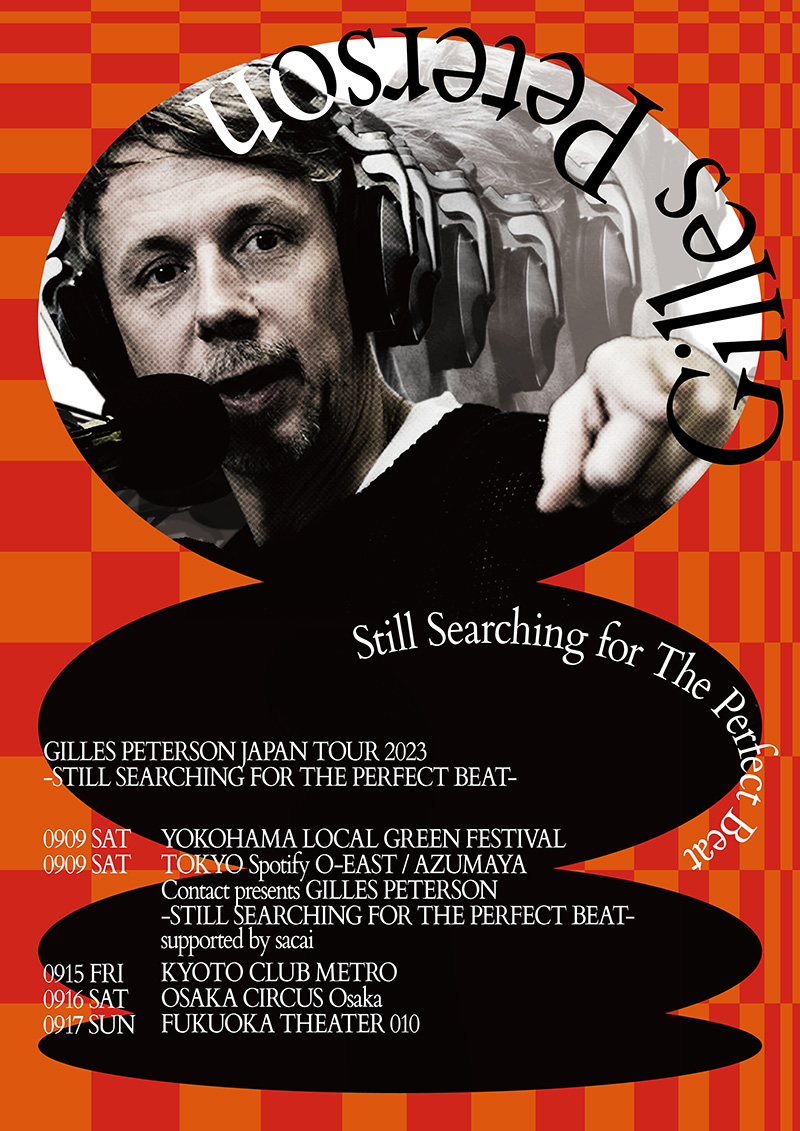
 ジャズとクラブといえばこの人、イギリスを代表するDJ、ジャイルス・ピーターソン。その選曲の素晴らしさもさることながら、自身のレーベル〈Brownswood〉においてはUKジャズからアフリカ、グローバルまでと幅広く質の高い作品のリリースを続けている、多くのミュージック・ラヴァーたちから信頼のリジェンドが4年ぶりに来日する。東京はO-EAST/AZUMAYAにてオールナイトで開催。これは行くしかない。日本でジャズとクラブを盛り上げてきた功労者にして盟友の松浦俊夫、ファッション界を中心に活躍するDAISUKE G.、Fraser Cookeといった日英の音楽愛好家が参加する。なお、本イベントにはファッション・ブランド、sacaiのサポートが決定している。

2023年9月9日土曜日
―――――――――――
Contact presents Gilles Peterson
-Still Searching for The Perfect Beat-

supported by sacai
at Spotify O-EAST / AZUMAYA

―――――――――――
Lineup:
GILLES PETERSON (Brownswood Recordings / BBC / Worldwide FM I UK)
TOSHIO MATSUURA
DAISUKE G.
FRASER COOKE

Lighting:
MACHIDA

Laser & Visual Effect:
REALROCKDESIGN

―――――――――――
Open 11PM
¥5000 Door
¥4000 Advance
¥3000 Early Bird Ticket (Limited to 100)
¥2000 Under 23
―――――――――――


Gilles Peterson (ジャイルス・ピーターソン)
1980年代よりクラブ・シーンのキーパーソンとしてジャズを中心にしながらも、ジャンルという音楽の境界線を砕き、多くのアーティストと点で結ばれながら世界中のDJとアーティストに大きな影響を与え続け、またリスナーに愛されてきたイギリスを代表するDJ。ラジオ・プレゼンター、クラブDJ、アーティストのプロデュース、フェスティバル主催・キュレーションなど、40年近く第一線で音楽トレンドを発信し続けるテイスト・メイカー。英国営放送局BBC Radio 6 Musicにて週末の看板番組を担当。また2016年、自らオンライン・ラジオ・プラットフォーム「Worldwide FM」を立ち上げた。ロンドンで開催されるWorldwide Awards、フランスのセットで開催されるWorldwide Festivalのホストを務め、2019年にはイギリスで新しいフェスティバルWe Out Hereを立ち上げた。またレーベル・オーナーとして新世代のアーティストを紹介する為に「Brownswood Recordings」を主宰し、次々と新しい才能を発掘し、世に送り出している。自身の作品としては2021年にインコグニートのブルーイとのプロジェクトSTR4TAをスタート。これまでに2枚のアルバムをリリース。また最近は初の著書「Lockdown FM - Broadcasting In A Pandemic」を上梓した。
http://www.gillespetersonworldwide.com


松浦 俊夫 TOSHIO MATSUURA
1990年、United Future Organization (U.F.O.)を結成。5作のフル・アルバムを世界32ヶ国で発表し高い評価を得る。2002年のソロ転向後も国内外のクラブやフェスティバルでDJとして活躍。またイベントのプロデュースやホテル、インターナショナル・ブランド、星付き飲食店など、高感度なライフスタイル・スポットの音楽監修を手掛ける。2013年、現在進行形のジャズを発信するプロジェクトHEXを始動させ、Blue Note Recordsからアルバム『HEX』をワールドワイド・リリース。2018年、イギリスの若手ミュージシャンらをフィーチャーした新プロジェクト、TOSHIO MATSUURA GROUPのアルバムをワールドワイド・リリース。「TOKYO MOON」(interfm 金曜 23:00) 好評オンエア中。
http://www.toshiomatsuura.com


Daisuke G.
1975年生まれ、2007年。源馬大輔事務所を設立。クリエイティヴ・ディレクター/DJ。ファッション、音楽を取り巻く様々なものをプロデュース。店舗内装、イベントと空間プロデュースなども手掛ける。現在のクライアントにはsacai、香港Joyce、Lane Crawford Consultantなども手がける。人気DJとしても大活躍中。
https://www.mixcloud.com/daisuke-gemma/


Fraser Cooke.
(Nike | Mild Bunch)

―――――――――――
【開催日時】
2023年9月9日(土) 23時~5時

【会場】
Spotify O-East
東京都渋谷区道玄坂2丁目14-8
https://shibuya-o.com/east/

【料金】
当日 ¥5000
前売り ¥4000 *8/11(金)13時よりzaiko / e+にて取り扱い
早割り ¥3000 *8/4(金)12時よりzaiko / e+にて100枚限定取り扱い
23歳以下 ¥2000 *要写真付き身分証明書

【前売取扱】
zaiko: https://contacttokyo.zaiko.io/e/Gilles-Peterson-20230909
イープラス:https://eplus.jp/sf/detail/3931120001-P0030001

*20歳未満の方はご入場できません
*写真付き身分証明書をお持ちください

ジャイルス・ピーターソン・ツアー・インフォ

GILLES PETERSON JAPAPN TOUR 2023
-STILL SEARCHING FOR THE PERFECT BEAT-

9月9日(土) 横浜 Local Green Festival
9月9日(土) 東京 Spotify O-EAST / AZUMAYA
Contact presents GILLES PETERSON
-STILL SEARCHING FOR THE PERFECT BEAT-
supported by sacai
9月15日(金) 京都 CLUB METRO
9月16日(土) 大阪 CIRCUS Osaka
9月17日(日) 福岡 THEATER 010

 私はノエル・ギャラガーには我慢がならない。

 私はかれこれもう30年近く彼のことを嫌ってきたが、自分でもそのことが少し引っかかっている。長い間、尋常ではないほどの成功を収め、愛されるソングライターとして活躍し続けているということは、彼は実際、仕事ができるのだろう。かなり個人的なことになってしまうが、これほど長期にわたって、自分がひとりのミュージシャンを嫌ってきた理由を自分でも知りたいのだ。

 1990年代半ばのティーンエイジャーだった私にとって、その理由は極めて単純だった。ブラーとオアシスのどちらかを選ばなければならないような状況で、私はブラー派だった。それでも、『NME』のジャーナリストたち──当時、いまの自分より若かったであろうライターたち──の安っぽい挑発で形成された見解に、大人、しかも中年になってまで引きずられるべきではないだろう。私も少しは成長しているはずだし、大人になるべきだよね?

 当時、私が最初に言ったであろうことは、彼の歌詞がひどいということだ。振り返ると、ノエルの歌詞は、デイヴィッド・バーマンやモーマスが書くような種類のよい詞ではなかったし、そもそもそれを意図していたわけでもなかった。彼らはパンク・ロックな、私のようなミドル・クラスのスノッブや評論家はファック・ユーという立ち位置で、「彼女は医者とヤッた/ヘリコプターの上で」のような狂乱状態とナンセンスな言葉が飛び交う、韻を踏む歌詞で注目を集め、面白がられた。その核心は、おそらく曲の魂が歌詞ではなく音楽に込められていたということで、それが理解できないのは心で聴いていないということなのかもしれない。

 そんなわけで、私が不快感を覚えたのが「心」の部分だったのではないかと思うようになったのである。つまり、ノエルの曲の感情的な部分が安っぽく安易に感じられ、バンドに投影され自信に満ちた威張った態度が、十代を複雑な迷いや疑念のなかで過ごした人間には響かなかったのではないだろうか。

 これは、現在のノエルの音楽に対しては不公平な批評だ。そもそもあの威勢の良さは、リアムと彼の嘲るようなロック・スターのヴォーカルに起因するものだった。ノエルは、ロック・スターとしての存在感がはるかに薄く、声も細くて脆弱な楽器だ。興味深いのは、ノエルとかつてのライヴァル、デーモン・アルバーンの音楽的な野心が大きく乖離するなかでも、彼らのポップ・ソング作りには、むしろ類似性が見られたことだった。二人の、シンガーソングライターたちの小さめで疲れ気味の声が、中年期の哀愁の色彩を帯びるのは容易なことだったから。ノエルの「Dead to the World」を聴くと、デーモンの声で“And if you say so / I’ll bend over backwards / But if love ain’t enough / To make it alright / Leave me dead to the world” (もし君が言うなら / 精一杯努力するよ / でも愛が足りないなら / 上手くやってくれ / 僕にはかまわないで) が歌われるのが、容易く想像できる。

 さらに、ノエル・ギャラガーはハイ・フライング・バーズの新作『Council Skies (カウンシル・スカイズ)』 では以前に比べて謙虚で、少なくとも思慮深い人物であるように感じられる。レコードを通してある種の喪失感に貫かれており、“Trying to Find a World that’s Been and Gone” では、「続ける意志」を持つことについてのお馴染みのリフレインが、たとえそれが無益な戦いであっても意味があるというメランコリックな文脈で描かれている。タイトル・トラックでは、1990年代の野心的な威勢の良さが、ぼんやりとした脆い希望へと変化している。それはおそらく、大富豪となったノエルがハンプシャーの私有地にいても、未だに思い出すだろう公営住宅地の空の下での、存続する誓いにほかならない。

 しかし、必ずしもその内省的な感覚が、歌詞としてより優れているとはかぎらない。初期のオアシスのパンクな勢いなしには、陳腐なものが残るだけだ。アルバムのタイトル・トラックは、“Catch a falling star” (流れ星をみつけて) という名言で始まり、すぐに“drink to better days” (より良い日々に乾杯) できるかもしれないという深淵なる展望が続く。だが、曲はそれでは終わらず、次々と天才的な珠玉の詞が火のように放たれる。“Waiting on a train that never comes”(来ないはずの電車で待つ)、“Taking the long way home”(遠回りをして帰る)、“You can win or lose it all” (勝つこともあれば、すべてを失うこともある)。ノエルの詞に対する想像力のあまりの陳腐さに、私が積み上げてきた彼のソングライティングに対する慈愛にも似た気持ちが、すべて消え去り、苛立ちだけが募り始める。“Tonight! Tonight!” (今夜! 今夜こそ!)、“Gonna let that dream take flight” (あの夢を羽ばたかせるんだ)というライムで、退屈なタイトルがつけられたクロージング・アンセムの“We’re Gonna Get There in the End”にたどり着く頃には、もう自害したくなっている。ノエルの愚かさ(インタヴューでのノエルは、私の反対意見をもってしても、鋭く、観察力があるようにみえる)ではなく、彼がリスナーを愚かだと見くびっているところに侮辱を感じるのだ。

 私は自分のなかに募るイライラを抑制し、少しばかり視点を変えてみる必要がある。

 ノエル・ギャラガーについてよく言われるのは、彼が料理でいうと「肉とポテト」のようなありふれた音楽を作るということだ。これは話者によっては、批評とも賞賛ともとれるが、いずれにしても本質を突いているように感じられる。メロディが次にどうなるのか、5秒前には予測できてしまうのが魅力で、一度歌詞が音楽の中に据えられると、摩擦なく滑っていき、漠然とした感情がそこにあることにも気付かずに通り過ぎてしまいそうだ。これは、細心の注意を払って訓練され、何世代にもわたり変わることのなかった基本的な材料を使って作られた、音による慰めの料理なのだ。 “Love is a Rich Man” を力強く支える同音反復するギター・フックは、ザ・ジーザス&メリー・チェイン(2017)の “The Two of Us ” と同一ではないのか? あるいはザ・ライトニング・シーズ(1994)の “Change” か? ザ・モダン・ラヴァーズ(1972)の “Roadrunner” なのか? それは、それらすべての未回収の記憶であり、蓄積されたロックの歴史のほかの100万ピースが半分だけ記憶された歓喜の生暖かい瞬間にチャネリングされるようなものだ。

 別の言い方をすれば、そこに驚きはない。これは、いつまでも自分らしく、変わる必要はないと教えてくれる音楽なのだ。この音楽は、自分の想像を超えてくるものを聴きたくない人のためのものだ。そして、ここで告白すると、私のある部分は、ノエル・ギャラガーのことが好きなのだ。オアシスとノエル・ギャラガーズ・フライング・バーズ両方のライヴもフェスで観ているし、私の意志とは裏腹に、飲み込まれて夢中になってしまった。九州で友だちとのドライブ中に、彼のカーステレオから “Be Here Now ” が流れてきた時も、20年ぶりに聴いて、それまでそのアルバムのことを考えたことすらなかったのに、すべての曲と歌詞を諳んじていたのを思い出した。結局のところ、決まり文句のように陳腐な表現は、その輪郭が脳裏に刻みこまれるほどに使い古されたフレーズに過ぎない。自分の一部になってしまっているのだ。

 そういう意味で、ノエル・ギャラガーに対する私自身の抵抗は、音楽的な癒しや保守性に惹かれる自分の一部分への抵抗ということになる。何故に? この私のなかの相反する、マゾヒスティックな側面はいったい何なのだろう。なぜ、ただハッピーではいられず、聴く音楽に緊張感を求めずにはいられないのだろう?

 基本的に、芸術作品のなかのささやかな緊張感は刺激的だ。ザ・ビートルズの “ストロベリー・フィールズ・フォーエバー” の冒頭がよい例で、ヴォーカルのメロディは本能が期待する通りのG音できれいに解決する一方、基調となるコード構成の、突然のFマイナーの不協和音に足元をすくわれる。リスナーの期待と、実際に展開されるアレンジの間の緊張感が、聴き手を楽曲の不確かな現実の中へと迷いこませ、馴染みのないものとの遭遇がスリルをもたらすのだ。

 オアシスが大ブレイクを果たしていた頃、ロック界隈で起こっていたもっとも刺激的なことは、ほぼ間違いなくローファイ・ミュージックという不協和音のような領域でのことだった。オアシスのデビュー・アルバム『Definitely Maybe(『オアシス』)』が初のチャート入りを果たした1994年の同じ夏、アメリカの偉大なロック・バンド、ガイディッド・バイ・ヴォイシズがブレイクのきかっけとなったアルバム『Be Thousand』をリリースしていた。彼らもまた、オアシスと同様にブリティッシュ・インヴェイジョンにより確立された、ロック・フォーメーション(編成)の予測可能性をおおいに楽しんでいたが、GBVのリーダー、ロバート・ポラードは、自身が“クリーミー”(柔らかく、滑らかな)と“ファックド・アップ”(混乱した、めちゃくちゃな)と呼んでいるものの間にある緊張感について主張した。彼が“クリーミー”すぎると見做したメロディは、リリースに耐えうるように、なんらかの方法でばらばらにして、曲を短くしたり、やみくもにマッシュアップしたりして、不協和音的なサウンドエフェクト、あるいは音のアーティファクト(工芸品)を、DIYなレコーディング・プロセスから生みだし、馴染みのある流れを遮るように投入するのだった。

 アメリカ人音楽評論家で、プロの気難し屋の老人、ロバート・クリストガウは、『Bee Thousand』を「変質者のためのポップス──上品ぶった、あるいは疎外された、自分がまだ生きていることを思い出すのに、痛みなしには快楽を得ることができないポストモダンな知識人気取りの者たち」と評した。そのシニカルな論調はともかく、クリストガウのGBVの魅力についてのアプローチは功を奏している──そう、快楽は確かに少し倒錯的で、これは音による「ツンデレ」なフェティッシュともいえる。そしてその親しみやすいものと倒錯したものとの間の緊張感が、リスナーの音楽への求愛のダンスに不確かさというスリルを注入してくれるのだ。

 ノエル・ギャラガーがかつて、退屈で保守的だと切り捨てたフィル・コリンズのようなアーティストの仕事にさえ、緊張感はある。ノエルに “In The Air Tonight ” のような曲は書けやしない。ヴォーカルは緩く自由に流れ、音楽の輪郭は耳に心地よく響くが、常にリフレインへと戻ってくる。曲に命を吹き込むドラムブレイクは、繰り返しいじられるが、長いこと抑制されてもいる。ソフト・ロックへの偏見を捨て去れば、フィル・コリンズのサウンドに合わせて、ネオンきらめく映画のなかのセックス・シーンを想像して、深い官能で相互にクライマックスに達することができるだろう。ノエル・ギャラガーの音楽で同じシーンを想像してみても……いや、やはりやめておこうか。私はたったいま、 “Champagne Supernova” を聴いて同じことを想像してみたが、非常に不快な7分半を過ごしてしまった。上手くはいかないのだ。

 ノエルの歌は、ある種の集団的なユーフォリア(強い高揚感)を呼び起こすことに成功しているが、それがほとんど彼の音楽のホームともいえるところだ。彼の歌詞とアレンジの摩擦の少なさは、社交的な集まりの歯車の潤滑油には最適で、リスナーにそのグループの陽気なヴァイブスに身をゆだねること以外は特に何も要求しない。おそらく、アシッド・ハウス全盛期のノエルの青春時代と共通項があるが、その違いはジャンルを超えたところにある。アシッド・ハウスには、「あなたと私が楽しむこと」を望んでいない体制側(スペイスメン3の言葉による)と、我々と彼らとの闘争という独自の形の緊張感が存在した──それはより広い意味でいうと、過去(トーリー党=英国保守党)と未来(大量のドラッグを使用して使われていない倉庫でエレクトロニック・ミュージックを聴くこと)との間の闘争だった。ノエルは明らかにそういった時代と精神に多少の共感を示しつつ、たまにエレクトロニック・アクトにもちょっかいを出しながら、彼自身の音楽は、常に未来よりも過去に、反乱者よりもエスタブリッシュメント(体制派)に興味を示してきたのだ。そして、時折公の場で繰り出す政治や他のミュージシャン、あるいは自分の弟に関するピリッと香ばしい発言には──哲学的、性的、抒情的、あるいは“ポストモダンな知識人ぶった”アート・マゾヒズムであれ、直感的なある種の緊張感は、ノエル・ギャラガーの音楽には存在しないのだ。

 もちろん、このことに問題はない。彼は音楽とは戦いたくない人のために曲を作っているのだし、それを上手にやってのけるのだから。

 この記事を書き始めた時、自分とはテイストの違いがあるにせよ、過去にノエルに対して公平性に欠ける態度をとっていたことを反省し、ソングライターとしての彼の疑いようのない資質を成熟した大人として受け入れ、融和的な雰囲気の結末に辿り着くのではないかと思っていた。しかし、それは彼と彼の音楽にとってもフェアなことではないと思う。平凡さはさておき、彼の真の資質のひとつは、感情をストレートに表現するところだからだ。

 だから、本当のことをいうと、私はいまでもノエル・ギャラガーの音楽が嫌いだ。私のなかの一部分が、彼の音楽を好いているから嫌いなのだ。彼は、私のなかにある快感センサーを刺激する方法を知っている。不協和音のスリルを忘れ、彼の音楽に没入する自分を許してしまい──本気で耳を傾けることを思い出した後に、6分間死んでいたことに気付かされるのだから。


The problem with Noel Gallagher (and why he’s good)written by Ian F. Martin

I can’t stand Noel Gallagher.

I’ve disliked him for nearly thirty years, and this bothers me a little. To have been an extraordinarily successful and well loved songwriter for so long, he must in fact be good at his job. More personally, for me to have hated a musician like that for so long, I want to know why.

As a teenager in the mid-90s, the reason was pretty simple: you had to choose between Blur and Oasis, and I chose Blur. Still, I probably shouldn’t carry into adulthood and middle age musical opinions that were moulded by the cheap provocations of NME journalists — writers who were probably younger at the time than I am now. I should be more mature than that, right?

At the time, the first thing I would probably have said was that his lyrics were bad. Looking back, they certainly weren’t good lyrics of the sort a David Berman or a Momus might write, but they were never meant to be: they were a punk rock fuck-you to middle-class snobs and critics like me, and the way lines like “She done it with a doctor / On a helicopter” jump deliriously and nonsensically from rhyme to rhyme is attention-grabbing and funny. The core of it, perhaps, is a sense that the soul of the song is carried by the music, not the lyrics, and if you can’t get that, you’re not listening with your heart.

So I start wondering if maybe that “heart” is what I found off-putting — that the emotions in Noel’s songs felt cheesy and facile, that the confident, swaggering attitude that the band projected didn’t speak to someone who spent their teens lost in complexity and doubt.

This is an unfair critique to bring to Noel’s current music. For a start, so much of that swagger was down to Liam and his sneering rock star vocals. Noel has far less of a rock star presence and his voice is a thinner, more vulnerable instrument. It’s interesting that even as Noel and former rival Damon Albarn’s musical ambitions have widely diverged, their pop songwriting has also revealed more points of similarity: two singer-songwriters with small, weary voices that easily carry the melancholy tint of middle age. Listen to Noel’s song “Dead to the World” and it’s easy to imagine Damon’s voice singing the lines “And if you say so / I’ll bend over backwards / But if love ain't enough / To make it alright / Leave me dead to the world”.

There’s a sense, too, that Noel Gallagher is a more humble, or at least thoughtful figure than he used to be on his new High Flying Birds album “Council Skies”. A sense of loss runs through the record, with the song “Trying to Find a World that’s Been and Gone” placing a familiar refrain about having “the will to carry on” in the melancholy context of a struggle that’s worth it even though it might be futile. In the title track, meanwhile, the aspirational swagger of the 1990s seems to have faded into a duller and more fragile hope that persists in the promise of the council estate skies that Noel can still presumably remember from his millionaire Hampshire estate.

That greater sense of reflection doesn’t necessarily mean the lyrics are any better, though. Without the punk swagger of early Oasis, all that’s left is cliché. The album’s title track opens with the words of wisdom “Catch a falling star”, swiftly followed by the profound observation that we might “drink to better days”. The song isn’t done though, firing nuggets of poetic genius one after the other: “Waiting on a train that never comes”; “Taking the long way home”; “You can win or lose it all”. The sheer banality of Noel’s lyrical imagination banishes every charitable thought I’ve been building up about his songwriting, and my irritation begins to rise. By the time he rhymes “Tonight! Tonight!” with “Gonna let that dream take flight” on the insipidly titled closing anthem “We’re Gonna Get There in the End”, I want to kill myself. I feel insulted not by how stupid Noel is (he comes across as sharp and observant in interviews, even when I disagree with him) but how stupid he thinks his listeners are.

I need to dial back my annoyance and get a bit of perspective.

An common remark about Noel Gallagher is that he makes “meat and potatoes” music. It’s a comment that’s either criticism or praise depending on the speaker, but it feels true either way. The appeal is that you always know what his melodies are going to do five seconds before they do it, and once placed inside that music, the lyrics glide by frictionlessly: vague sentiments that you barely recognise are even there. This is sonic comfort food made with practiced care from basic ingredients that have remained unchanged for generations — is the chiming guitar hook that anchors “Love is a Rich Man” the same as “The Two of Us” by The Jesus and Mary Chain (2017)? Is it “Change” by The Lightning Seeds (1994)? Is it “Roadrunner” by The Modern Lovers (1972)? It’s the accrued memories of them all, and of a million other pieces of rock history channeled into a warm moment of half-remembered exultation.

To put it another way, there are no surprises: this is music that tells you it’s OK to be yourself forever and never change. It’s music for people who don’t want to hear anything that challenges their expectations. And a confession: a little piece of me does like Noel Gallagher. I’ve seen both Oasis and Noel Gallagher’s Flying Birds live at festivals and both times got swept up in it despite myself. I remember driving with a friend through Kyushu as “Be Here Now” came on his car stereo, and I knew all the songs, all the words, more than 20 years after the last time I heard or even thought about the album. After all, what is a cliché but a phrase so well worn that it’s contours are carved into your brain? It’s part of you.

So my resistance to Noel Gallagher is really a resistance to that part of myself that’s drawn to musical comfort and conservatism. But why? What is this contrary, masochistic side of me that can’t just be happy and needs some tension with the music I listen to?

Fundamentally, a bit of tension in a piece of art is exciting. The opening of The Beatles’ “Strawberry Fields Forever” is a great example, with the vocal melody resolving cleanly on the G note where instinct tells you to expect it, while the underlying chord structure pulls the rug out from beneath you with a dissonant F minor. The tension between the listener’s expectation and what the arrangement actually does sends you tumbling into the song’s uncertain reality and there’s a thrill in this contact with the unfamiliar.

Around the time Oasis were breaking big, arguably the most exciting thing happening in rock music was in the dissonant sphere of lo-fi music. In the same summer of 1994 that Oasis’ debut “Definitely Maybe” first hit the charts, America’s greatest rock band Guided By Voices were releasing their breakthrough album “Bee Thousand”. While they, like Oasis, revelled in the predictability of the same established British Invasion rock formations, GBV leader Robert Pollard also insisted on a tension between what he called “creamy” and “fucked-up”. For him, a melody deemed too “creamy” would need to be mutilated in some way to make it acceptable for release: songs cut short or mashed together in haphazard ways, discordant sound effects or sonic artefacts emerging from the DIY recording process thrown in to interrupt the flow of the familiar.

American music critic and professional grumpy old git Robert Christgau described “Bee Thousand” as “pop for perverts — pomo smarty-pants too prudish and/or alienated to take their pleasure without a touch of pain to remind them that they're still alive”. The cynical tone aside, Christgau nails the appeal of GBV’s approach: yes, the pleasure is a little perverse — the sonic equivalent of the “tsundere” fetish — but that tension between the familiar and the oblique injects the thrill of uncertainty into the courtship dance the listener does with the music.

Even with an artist like Phil Collins, who Noel Gallagher has in the past dismissed as boring and conservative, there can be tension at work. Noel could never write a song like “In The Air Tonight”. The vocals flow loose and free, caressing the contours of the music but always locking back in for the refrain; the drum break that kicks the song into life is teased repeatedly but held back for so long. Get over your soft rock prejudices and you can imagine a deeply sensual, neon-bathed movie sex scene that reaches a mutually satisfying climax to the sound of Phil Collins. Imagine the same scene set to the music of Noel Gallagher… or maybe don’t. I just spent an uncomfortable seven and a half minutes listening to “Champagne Supernova” while trying to picture it, and it just doesn’t work.

What Noel’s song does succeed in evoking, though, is a sort of collective euphoria, and that’s where his music is most at home. The frictionlessness of his lyrics and arrangements work best lubricating the gears of social gatherings without demanding anything much from the listener other than that they submit themselves to the buoyant vibe of the group. It shares something, perhaps, with Noel’s youth during the height of acid house, but the differences go further than genre. Acid house had its own tension in the form if an us-and-them struggle with an establishment that didn’t (in the words of Spacemen 3) “want you and me to enjoy ourselves” — which is to say more broadly between the past (the Tory party) and the future (taking massive amounts of drugs in a disused warehouse while listening to electronic music). While Noel clearly has some sympathy with that era and ethos, and has flirted with electronic acts on occasion, his own music has always been more interested in the past than the future, more establishment than insurgent. And for all his occasionally spicy public remarks on politics, other musicians or his brother, a visceral sense of tension — whether philosophical, sexual, lyrical or “pomo smarty-pants” art-masochism — has no place in Noel Gallagher’s music.

This is fine, of course: he makes songs for people who don’t want to fight with their music, and he is very good at it.

I thought, when I started to write this, that I might end there, on a conciliatory note, with the realisation that I’d been unfair on Noel in the past and with a mature acceptance of his undoubted qualities as a songwriter, despite my differences in taste. But I don’t think that would be fair to him or his music either: for all his banalities, one of his genuine qualities is that he is a straight shooter emotionally.

So in truth, I still hate Noel Gallagher’s music. I hate it because a part of me likes it. Because he knows how to work that little part of me and stimulate those pleasure sensors. Because I let myself forget the thrill of the dissonant and sink into it — until I remember to really listen, and then I realise I’ve been dead for six minutes.

Jaimie Branch - ele-king

 2017年の『Fly Or Die』で注目を集め、その野心的なスタイルで将来が期待されていたものの、昨年亡くなってしまったジェイミー・ブランチ。才あるこのジャズ・トランぺッターが生前ほぼ完成させていたというアルバムがリリースされることになった。パンクやノイズからアフロ・カリビアンの要素までが含まれる作品に仕上がっているようだ。CDの発売は9月6日。注目しよう。

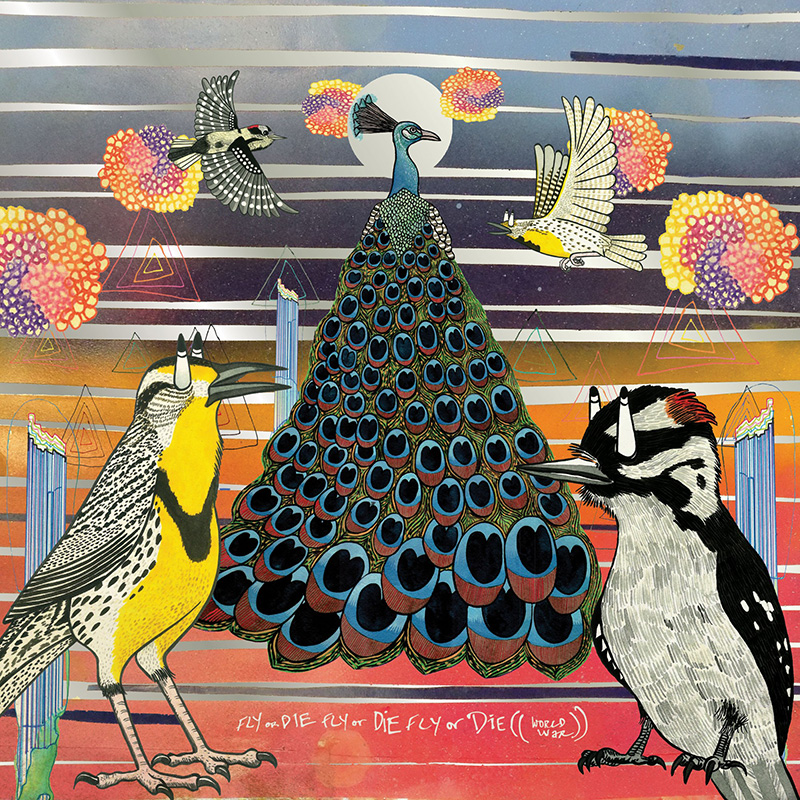
Jaimie Branch『Fly or Die Fly or Die Fly or Die』
2023.09.06(水)CD Release

2022年8月22日39歳という若さで亡くなった、ダイナミックなジャズ・トランペット奏者/作曲家ジェイミー・ブランチによる、瑞々しく、壮大で、生命力に溢れた遺作となるアルバムが完成。メンバーには、チェリストのレスター・セントルイス、ベーシストのジェイソン・アジェミアン、ドラマーのチャド・テイラーが参加。

ジェイミー・ブランチが亡くなった時、彼女が率いたフライ・オア・ダイの新作はミキシングを残すのみで、ほぼ完成していた。遺族と共に完成までこぎ着けたこのアルバムは、デビュー作『Fly Or Die』から変わらないメンバーと制作されたが、その音は随分と遠いところへと我々を導く。パンク・ジャズのダイナミズムとノイズから、アフロ・カリビアンの陽気なポリリズムまでがここには刻まれている。かつてないほどにフィーチャーされているジェイミーのヴォーカルは、ハードコアとソウルの間を深く揺れ動く。美しいという形容こそが相応しいアルバムだ。(原 雅明 ringsプロデューサー)

ミュージシャン:
jaimie branch – trumpet, voice, keyboard, percussion, happy apple
Lester St. Louis – cello, voice, flute, marimba, keyboard
Jason Ajemian – double bass, electric bass, voice, marimba
Chad Taylor – drums, mbira, timpani, bells, marimba

with special guests-
Nick Broste – trombone (on track 5 & 6)
Rob Frye – flute (track 5), bass clarinet (track 5, 6 & 7)
Akenya Seymour – voice (track 5)
Daniel Villarreal – conga and percussion (track 2, 5, 6 & 7)
Kuma Dog – voice (track 5)

[リリース情報]

アーティスト名:Jaimie Branch(ジェイミー・ブランチ)
アルバム名:Fly or Die Fly or Die Fly or Die

リリース日:2023年09月06日(水)
フォーマット:CD
レーベル:rings / International Anthem
品番:RINC109
価格:2,700円+税
販売リンク:
https://ringstokyo.lnk.to/WQEQcd

オフィシャル URL :
http://www.ringstokyo.com/jaimie-branch-fly-or-die-fly-or-die-fly-or-die-world-war/

Nondi_ - ele-king

 ジューン・タイソン。彼女はいまの私の母と同じくらいの年齢だが、私が母にジューンの話をしたとしても、きっと誰のことなのかわからないだろう。ジューンはいわば盗賊団のなかの女神で、サン・ラーのもっとも有名な曲の数々を歌った偉大な声だった。また、彼女は私が初めて出会った、実験的な音楽に取り組む黒人女性でもある。

 2023年の現在、さて、どれだけの黒人女性が冒険的な音楽活動を成し遂げているのか、数えるのは難しい。ダンスやR&B、ラップなど主流の音楽では、慣習の外に踏み出す人はほとんどおらず、いま、私の頭に浮かぶのはわずか3人だ。NkisiMoor Mother、そしてLazara Rosell Albear。みんなそれぞれ素晴らしい、が、金メダルに値するのは間違いなくNondiだろう。 彼女の『Flood City Trax』はすでに、ジャンル分けなど許さないエクレクティックな音世界を持っている。

 アルバムには、ジュークにインスパイアされたという彼女の言葉通りハードコアなトラック、“01-25-2022 ” がある。この曲は刺激的な故障であり、説明するのが困難なほど背徳的だ。女王の鞭よりも鋭い殺人的な魅惑をもって、クラブでリピートされもしたら胴体は疲労困憊してもなお回旋し続けるだろう。しかし、それは1曲だけ。このアルバムの真のリズムは、1曲目の "Floaty Cloud "からはじまる。ヴェイパーなメロディ、DIYベッドルーム・プロダクション、そして決して途絶えることのないビート。これはフロア専用のダンス・ミュージックではないし、そうなるように作られたものでもない。Nondiが駄菓子屋の子供のように自分の正直な気持ちに従ったことは明らかで、私たちは、彼女のこの知恵によってますます祝福される。夢見心地は早い段階からはじまり、最後のトラックまで止まらない。が、ジューク・ミュージックが安定を保つための地面に杭を打っているとしたら、彼女のオーラル・ヴィジョンの焦点はそこではないのだ。

 ジューン・タイソンのことを考えると、彼女の声は同時にラーの声でもあった。ジムクロウ時代を生き抜いた彼女らの世代は、貧しい隔離されたコミュニティで育ち、白人の差別主義者が所有する農園(プランテーション)の近くに住むか時給自足の暮らしをしていた。私はジューン・タイソンの美しさに、斧を持ったカントリー・ウェアの女性が佇むこの反抗的なジャケットと同じ感覚を覚える。他方でそれは、『カラーパープル』の記憶をよみがえらせもする。あの、貧しくても反抗的な姿勢を。これこそFAFO*ってヤツだ。

 また、このジャケットは、多くの黒人がよく知っている状況を明確に示してもいる。何百万人もの人びとの命を剥奪した1970年代以前の南部の生活を思い出しながら、この女性は斧を持って復讐に燃えているのだ。

 そして、新しいシンセサイザーの宝庫を切り開く準備ができている。ジャケットに描かれた小作人のイメージと、各トラックから発せられる鮮やかな色のコントラストは、Nondiのトラックスとその意図の奥に染み込んだフューチャリズムの深さを示している。これは、黒人としての生活の重圧に苦しむ魂を癒す温かいサウンドだ。Nondiは、私の飢えた心に語りかけてくる。K-POPやフェイクDJに疲れ、私はひとつの様式などには留まらないミュージシャンを渇望している。ようこそ、Nondi。


*「FAFO」はもともとブラック・イングリッシュ。2022年に米ポップ・カルチャーの文脈でも流行り、同年の流行語大賞に選ばれた。「火遊びをすると火傷するかもしれない」、あるいは「もう火傷してしまった」ということを伝える生意気な表現だったが、いっぽうでは「斬新な挑戦に遭遇したときの」仲間の「気概」を表現しているとし、Urban Dictionaryではこのフレーズに「自信の表明」の意味も含めている。


Nondi_ / Flood City Trax / Planet Mu

June Tyson. About my mother`s age now but if I mentioned June to her, I’m sure she’d have no idea who she was. But June was a goddess among thieves, she was the grand voice of many of Sun Ra`s most famous songs. She was also the first Black woman I ever encountered doing experimental music. And to be sure even in 2023, it is damn hard to count how many Black women embrace eclectic music outright. Sure dance, Rnb, rap etc, they dominate but outside of convention few tread. I can only count 3 off hand. Nkisi, Moor Mother, and Lazara Rosell Albear. All amazing in their own right but Nondi is definitely going for the gold medal. With “Flood City Trax”, she already has an eclectic sound world that mentions genres and promptly ignores them. By her own words, she was inspired by Juke and indeed there is a hardcore Juke track, “01-25-2022”. To say that the track smacks fails to illustrate how vicious it is. A killer headturner sharper than lashes from a dominatrix. If on repeat at a club, torsos would gyrate into exhaustion. But that is only one track. The true rhythm of the album starts from 1st track “Floaty Cloud Dream”. Vapor melodies, DIY bedroom production, and a beat that never truly snaps. This is not foot to the floor dance music nor was it made to be. It’s clear that Nondi follows her voice like a kid in a candy shop. We are all the more blessed by this wisdom. The dreaminess starts early and doesn’t stop til the very last track. While Juke music is a stake in the ground for stability, it isn’t the focus of her aural visions.

In thinking of June Tyson, she was the voice of Ra just as much as he himself was. Their generation straight out of the Jim Crow era, grew up in poor, segregated communities, DIY living near or on plantations owned by white racists. When I think of the beauty of June Tyson, I get the same feeling with the defiant cover of the woman in country clothes carrying an axe. It immediately conjures memories for me of the Color Purple. Poor but defiant. A real FAFO attitude.

The cover is a clear nod to conditions that many Black people know all too well. Recalling pre1970`s southern life that greatly disenfranchised the lives of millions, the woman is instead vengeful holding an axe ready to defend my people and cut open a treasure trove of new synth sounds too. The extreme contrast between the share cropper imagery from the cover and the vibrant colors emanating each track shows the depth of futurism seeping deep in the trax and intention of Nondi. Warm sounds that soothe souls suffering from the weight of Black life. Nondi is a musician that speaks to my starving heart. With K-pop and fake dj fatigue, I am famished for a musician that doesn’t give a fuck about clear genres. Welcome Nondi.

Laurent Garnier - ele-king

 先日ひさびさの来日を果たし、すばらしいDJセットで踊らせてくれたロラン・ガルニエ。さらに嬉しい知らせの到着だ。
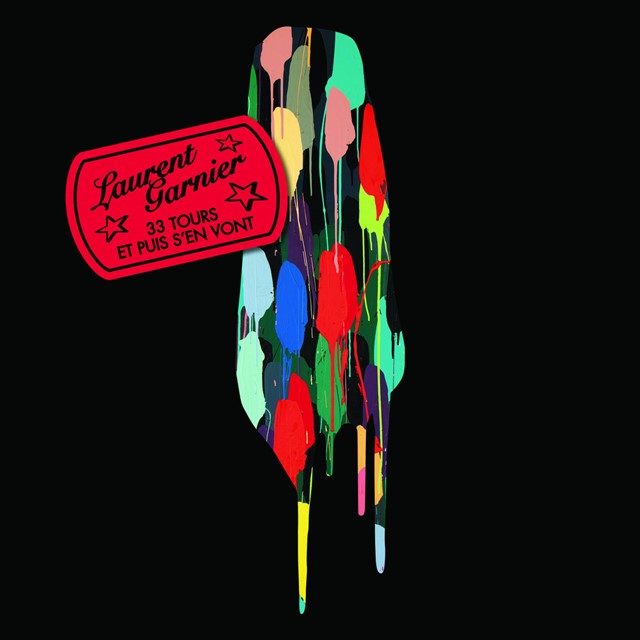
 じつに8年ぶり、2015年の『La Home Box』以来となるアルバムがリリースされる。『33 Tours Et Puis S'en Vont』なるタイトルで彼自身のレーベル〈COD3 QR〉から5月25日にリリース。
 テクノ、ドラムンベース、ヒップホップ、パンクの要素がとりいれられているらしいが、なんと故アラン・ヴェガのヴォーカルもフィーチャーされている。この2年間の最高到達点であると同時に、自身のルーツへと立ち返るアルバムでもあり、「ダンスフロアとテクノへのトリビュート」でもあるとのこと。
 またこの新作の発表と同時にガルニエは、2024年末をもって、ツアーからは一歩退く考えであることを明かしてもいる。「ほこりをかぶった古臭いジュークボックス」になるのを避けるため、というのがその理由だそうだ。とはいえDJをやめるつもりは毛頭ないようで、生涯DJをつづけることを強調してもいる。
 バンドキャンプはこちら

artist: Laurent Garnier
title: 33 Tours Et Puis S'en Vont
label: COD3 QR
release: May 26 2023

tracklist:
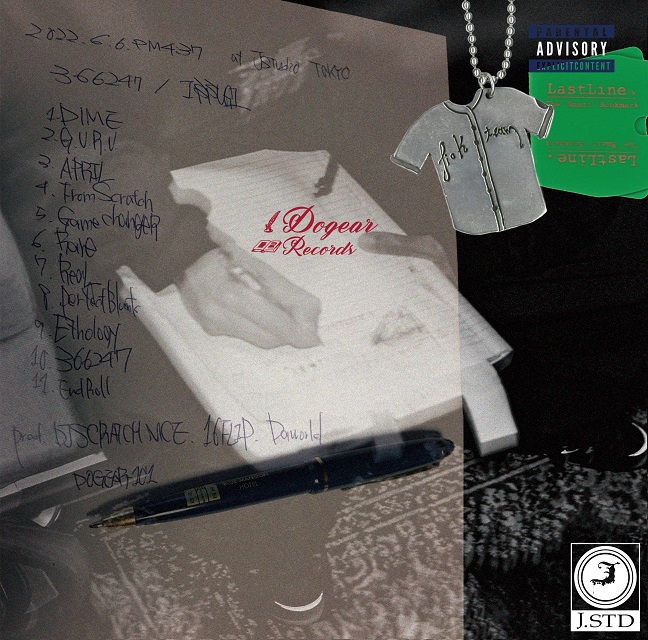
01. Tales From The Real World (feat.Alan Watts) (vocal version)
02. Liebe Grüße Aus Cucuron
03. Let The People Faire La Fête
04. Give Me Some Sulfites
05. In Your Phase feat. 22Carbone
06. Granulator Bordelum
07. Reviens la Nuit
08. On the REcorD (part 3)
09. Saturn Drive Triplex (feat. Alan Vega)
10. Sado Miso
11. Closer to You (feat. Scan X)
12. Au Clair De Ta Lune
13. Cinq O'Clock In Le Matin
14. Le Swing Du Pouletto
15. Sake Stars Fever
16. Multiple Tributes [to multiple people, for multiple reasons]
17. ...Et Puis S’en Va!
18. Tales From The Real World (version instumentale)

R.I.P. Alan Rankine - ele-king

 昨年のウインブルドンではニック・キリオスが大活躍だった。全身に刺青が入った黒人のテニス・プレイヤーで、ショットが決まるたびに客席の誰かに大声で話しかけ、勝っても負けてもオーストラリア本国に戻ればレイプ疑惑で裁判が待っていた(精神障害を理由にいまだに裁判からは逃げている)。大坂なおみが開いたエージェント・オフィスが初めて契約した選手であり、日本に来た時はポケモンセンターの前に座り込んで「絶対にここから離れない」とSNSに投稿していた。僕の推しはカルロス・アルカラスだったんだけれど、昨年は早々とキリオスに負けてしまったので、そのまま惰性でキリオスを追っていた。そうなんだよ、危うくカルロス・アルカラスのことを忘れてしまうところだった。それだけインパクトの強い選手だった。僕がカルロス・アルカラスを応援し始めたのはピート・サンプラスに顔が似ていたから。90年代のプレースタイルを象徴するテニス・プレイヤーで、あまりにもプレーが完璧すぎて「退屈の王者」とまで言われた男。W杯のカタール大会でエンバペがゴールするたびにマクロンが飛び跳ねていたようにサンプラスが00年の全米オープンで4大大会最多優勝記録を打ち立てた時はクリントンも思わず立ち上がっていた。試合でリードしていても苦々しい表情だったサンプラス。内向的で1人が好きだったサンプラス。僕がピート・サンプラスを応援し始めたのはアラン・ランキンに顔が似ていたから。僕はアラン・ランキンの顔が大好きだった。セクシーでガッツに満ち、野獣に寄せたアラン・ドロンとでもいえばいいか。初めて『Fourth Drawer Down』のジャケット・デザインを見た時、この人たちは何者なんだろうと思い、どんな音楽なのかまったく想像がつかなかった。

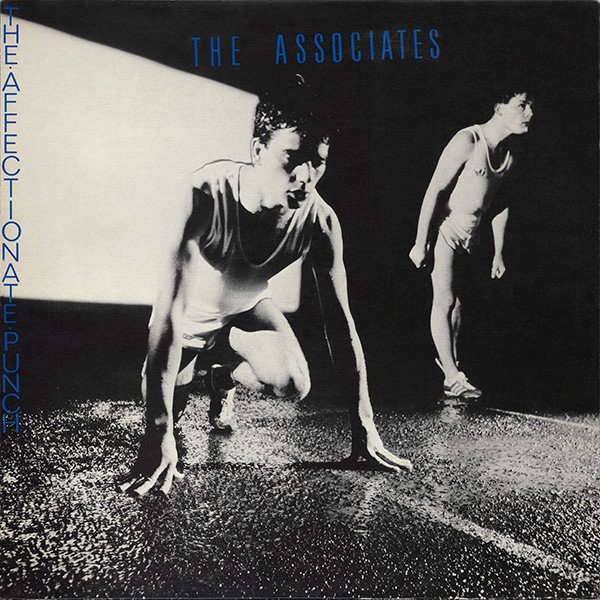
The Associates – The Affectionate Punch(1980年)

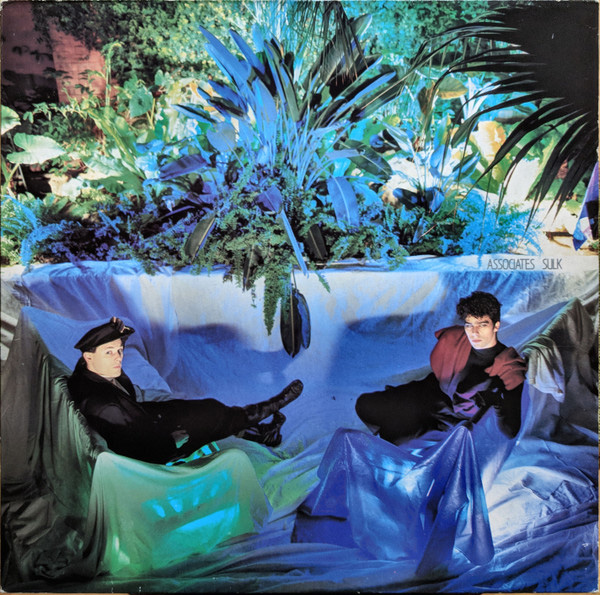
 なんだかわからないままに聴き始めた『Fourth Drawer Down』はなんだかわからないままに聴き終わった。朗々と歌い上げるビリー・マッケンジーのヴォーカルと実験的なのかポップなのかもわからないサウンドは現在進行形の音楽だと感じられたと同時に「現在」がどこに向かっているかをわからなくするサウンドでもあった。その年、1981年はヒューマン・リーグがシンセ~ポップをオルタナティヴからポップ・ミュージックに昇格させた年で、シンセ~ポップのゴッドファーザーたるクラフトワークが『Computerwelt』で自ら応用編に挑むと同時にソフト・セル『Non-Stop Erotic Cabaret』からプリンス『Controversy』まで一気にヴァリエーションが増え、一方でギャング・オブ・フォー『Solid Gold』やタキシードムーン『Desire』がポスト・パンクにはまだ開けていない扉があることを指し示した年でもあった(タキシードムーンはとくにベースがアソシエイツと酷似し、アラン・ランキンは後にウインストン・トンのソロ作を何作もプロデュースする)。『Fourth Drawer Down』はそうした2種類の勢いにまたがって、両方の可能性を一気に試していたようなところがあった。それだけでなく、グレース・ジョーンズ『Nightclubbing』に顕著なファッション性やジャパン『Tin Drum』から受け継ぐ耽美性も共有し、オープニングの“White Car In Germany”では早くもDAF『Alles Ist Gut』を意識している感じもあった。混沌としていながら端正なテンポを崩さない“The Associate”を筆頭に、PILそのままの“A Girl Named Property”、物悲しい“Q Quarters”には咳をする音が延々とミックスされ、あとから知ったところでは“Kitchen Person”は掃除機のホースを使って歌い、“Message Oblique Speech”のカップリングだった“Blue Soap”は公園のようなところにバスタブを置いて、その中で反響させた声を使っているという。まるでジョー・ミークだけれど、ジョー・ミークにはない重いベースと破裂するようなキーボードが彼らをペダンチックな存在には見せていない。

 これらが、しかし、すべて助走であり、アラン・ランキンとビリー・マッケンジーが次に手掛けた『Sulk』はとんでない方向に向かって華開く。昨年、同作の40周年記念盤がリリースされ、全46曲というヴォリウムに圧倒されながらレビューを書いたので詳細はそちらを参照していただくとして、ここではスネアをメタル仕様に、タムを銅性の素材に変えたことで、インダストリアルとは言わないまでも、全体に金属的なドラム・サウンドが支配するアルバムだということを繰り返しておきたい。『Sulk』はパンク・ロックのパワーを持ったグラム・ロック・リヴァイヴァルであり、ニューウェイヴの爛熟期に最も退廃を恐れなかった作品でもある。あるいは15歳のビョークが夢中で聴いたアルバムであり、彼女のヴォーカル・スタイルに決定的な影響を与え、イギリスのアルバム・チャートでは最高10位に食い込んだサイケデリック・ポップの玉手箱になった。『Sulk』はちなみにイギリス盤と日本盤が同内容。アメリカ盤とドイツ盤がベスト盤的な内容になっていた。ジャケットの印刷技術もバラバラで、リイシューされるたびに緑色が青に近づき、裏ジャケットのトリミングも違う。オリジナル・プリントはイギリスのどこかの美術館に収蔵されているらしい。

 ビリー・マッケンジーが『Sulk』の北米ツアーを前にして喉に支障をきたし、アメリカで売れるチャンスを逃したとして怒ったアラン・ランキンはアソシエイツから脱退、『Sulk』に続いてリリースされたダブルAサイド・シングル「18 Carat Love Affair / Love Hangover」(後者はダイアナ・ロスのカヴァー)がデュオとしては最後の作品となってしまうも、『Fourth Drawer Down』以前にリリースされていたデビュー・アルバム『The Affectionate Punch』のミックス・ダウンをやり直して、同じ年の12月には再リリースされる。元々の『The Affectionate Punch』はなかなか手に入らず、その後、イギリスでようやく見つけたものと聴き比べてみると、ミックス・ダウンでこんなに変わってしまうものかと驚いたことはいうまでもない。たった2年でアラン・ランキンが音響技術の腕を確かなものにした自信が『The Affectionate Punch』の再リリースには漲っていた。同作からは“A Matter Of Gender”が先行カットされ、結局、デビュー・シングル“Boys Keep Swinging”(デヴィッド・ボウイの無許可カヴァー)などを加えて元のミックス盤も05年にはCD化される。『Sulk』に続く道も感じられはするけれど、オリジナル・ミックスはまだシンプルなニューウェイヴ・アルバムで、この時期は〈Fiction Records〉のレーベル・メイトだったキュアーとヨーロッパ・ツアーなどを行なっていたことからロバート・スミスがギターとバック・コーラスで参加、ベースのマイケル・デンプシーはその後もアソシエイツとキュアーを掛け持っていた。ロバート・スミスは後にビリー・マッケンジーが自殺する直前、キュアーのライヴを観に来てくれたのに声をかけ損なったことを悔やんで「Five Swing Live」をリリースしたり、“Cut Here”をつくったりしている。

The Associates – Sulk(1982年)

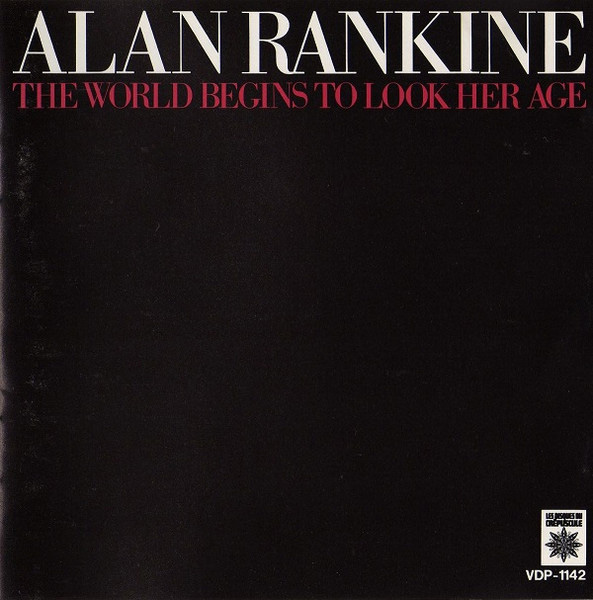
 バンドを脱退したとはいえ、『Sulk』の名声はアラン・ランキンにプロデュース業の仕事を舞い込ませる。ペイル・ファウンテインズ“Palm Of My Hand”は“Club Country”で用いたストリング・アレンジを流用しながら彼らのアコースティックな持ち味を存分に活かし、反対にコクトー・ツインズ“Peppermint Pig”はあまりにもアソシエイツそのままで、これは派手な失敗作となった。彼らのイメージからは程遠いインダストリアル・ドラムに加えて近くと遠くで2本のギターが同時に鳴り続けるだけでアソシエイツに聞こえてしまい、ノイジーなサウンドに尖ったリズ・フレイザーのヴォーカルが入るともはやスージー&ザ・バンシーズにしか聞こえなかった。そして、アンナ・ドミノやポール・ヘイグのプロデュースから縁ができたのか、アラン・ランキンのソロ・ワークも以後は〈Les Disques Du Crépuscule〉からとなる。アソシエイツ脱退から4年後となったソロ・デビュー・シングル“The Sandman”は幼児虐待をテーマにした静かな曲で、カップリングは戦争を取り上げた暗いインストゥルメンタル。続いてリリースされたファースト・ソロ・アルバム『The World Begins To Look Her Age』はアソシエイツのようなエッジは持たず、80年代中盤のニューウェイヴによくあるAOR風のシンセ~ポップに仕上がっていた。これはランキンを失ったマッケンジー単独のアソシエイツも同じくで、マッケンジーもまた気の抜けたアソシイツ・サウンドを鳴らすだけで、2人が離れてしまうと緊張感もないし、いずれもメローな部分ばかりが際立つ自らのエピゴーネンに成り下がってしまったことは誰の耳にも明らかだった。2人がそろった時の化学反応はやはり1+1が3にも100にもなるというマジックそのものだったのである。しかし、2人は93年まで再結成に意欲を示さず、とくにビリー・マッケンジーはイエロやモーリツ・フォン・オズワルドといったユーロ・テクノの才能と組んでサウンドの更新に勤め、それなりに意地は見せていた。アラン・ランキンは『The World Begins To Look Her Age』の曲を半分入れ替えて〈Virgin〉から『She Loves Me Not』として再リリースした後、〈Crépuscule〉から89年に『The Big Picture Sucks』を出して、まとまった音源はこれが最後となる。

Alan Rankine – The World Begins To Look Her Age(1986年)

 93年に再結成を果たしたアソシエイツは6曲のデモ・テープを製作するも94年からアラン・ランキンは地元グラスゴーのストウ・カレッジで教鞭に立ち、それほど頻繁に作業ができなくなった上にビリー・マッケンジーが97年1月に自殺、新しいアルバムが完成されるには至らなかった。そのうちの1曲となる“Edge Of The World”はその年の10月にリリースされたビリー・マッケンジーのソロ名義2作目『Beyond The Sun』に“At Edge Of The World”としてポスト・プロダクションを加えて収録され、さらに3年後、キャバレー・バンド時代のデモ・テープなどレア曲を37曲集めた『Double Hipness』には6曲とも再録されている。6曲のデモ・テープは『The Affectionate Punch』に戻ったような曲もあれば、新境地を感じさせる“Mama Used To Say”にドラムンベースを取り入れた“Gun Talk”など完成されていれば……などといっても、まあ、しょうがないか。ザ・スミスがビリー・マッケンジーを題材にした“William, It Was Really Nothing”に対する10年越しのアンサー・ソング、“Stephen, You're Really Something”も週刊誌的な興味を引くことになった。アラン・ランキンが残した音源は少ない。ビリー・マッケンジーと組んだアソシエイツとその変名プロジェクトにソロ・アルバム2.5枚とソロ・シングル3枚、クリス・イエイツらと組んだプレジャー・グラウンド名義でシングル2枚のみである。また、2010年まで大学教員を続けたランキンは大学内に〈Electric Honey〉を設け、ベル&セバスチャンのデビュー・アルバム『Tigermilk』など多くのリリースにも尽力している。

 ビリー・マッケンジーがソロでつくった曲は間延びした印象を与えることが多かったけれど、アラン・ランキンが加わるとそれがタイトになり、まるで伸び伸びとは歌わせまいとしているようなプロダクションに様変わりした。アソシエイツはそこが良かった。歌が演奏にのっているというよりも声と演奏が戦っているようなサウンドだったのである。まったくもって調和などという概念からは遠く、ビリー・マッケンジーがどれだけ気持ちよく歌っていてもアラン・ランキンのギターは容赦なくそれを搔き消し、いわば主役の取り合いだった。“Waiting for the Loveboat”も脱退前にアラン・ランキンが録っていたデモ・テープはぜんぜん緊張感が違っていた。アラン・ランキンはおそらくせっかちなのである。彼らの代表曲となった“Party Fears Two”がトップ10ヒットとなり、トップ・オブ・ザ・ポップスに出演した時もランキンは同番組が口パクであるのをいいことに鳴ってもいないバンジョーを弾いたり、ピエール瀧の綿アメみたいに客にチョコレートを食べさせるなどふざけまくっていたのは、たった1曲のために2時間以上も拘束されるため「飽きてしまったから」だと答えていた。『Fourth Drawer Down』も実はそれまでがあまりに狂騒状態だったので、少しは落ち着こうとしてつくった曲の数々だったというし、それがまた再び狂騒状態に戻ったのが『Sulk』だったから、あそこまで弾け飛んだということになるらしい。自分の人生を何倍にも巨大なものにしてくれる人との出会いがあるということはなんて素晴らしいことなのだろう。2人合わせて103歳の人生。短い。あまりに短いけれど、『Sulk』はこれから先、いつまでも聴かれるアルバムになるだろう。R.I.P.

interview with Dry Cleaning - ele-king

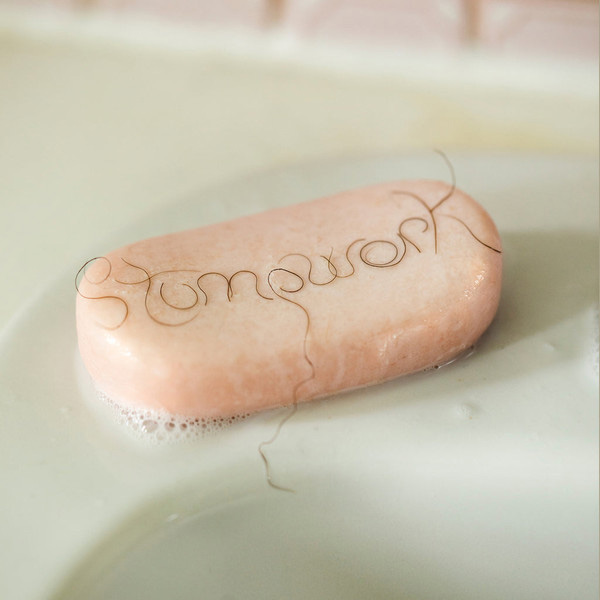
 『Stumpwork』というのはおかしな言葉だ。口にしてみてもおかしいし、その意味を紐解くのに分解してみると、さらに厄介になる。「Stump(=切り株)」とは、壊れたものや不完全なもの、つまり枯れた木の跡や、切断された枝があった場所を指す。そして、そこに労働力(= work)を加えるのは奇妙な感じがする。

 「Stumpwork」とは、糸や、さまざまな素材を重ねて、型押し模様を作り、立体的な奥行きを出す刺繍の一種で、もしかしたら、そこにドライ・クリーニングの濃密で複雑なテクスチャーの音楽とのつながりを見い出すことができるかもしれない。しかし、まず第一に、この言葉が感覚的に奇妙でおかしな言葉であることを忘れないでいよう。

 フローレンス・ショウは、いま、英語という言語を扱う作詞家のなかでもっとも興味深い人物の一人であり、面白くて示唆に富む表現に関しての傑出した直感の持ち主である。アルバム・タイトルでもそうだが、彼女は言葉の持つ本質的な響きというテクスチャーに一種の喜びを感じているようだ。“Kwenchy Kups”という曲では、歌詞の「otters(発音:オターズ)」という単語で、「t」を強調し、後に続く母音を引きずっているのが、音楽らしいとも言えるし、ひそかにコミカルとも言える。また、「dog sledge(*1)」、「shrunking(*2)」、「let's eat pancake(*3)」といった言葉や表現には、「あれ?」と思うくらいのズレがあるが、言語的な常識からすると、訳がわからないほど逸脱しているわけではなく、ちょっとした間違いや、型にとらわれない表現の違和感を常に楽しんでいることがうかがえる。このような遊び心あふれるテクスチャーは、「Leaping gazelles and a canister of butane (跳びはねるガゼルの群れと、ブタンガスのカセットボンベ)」のような、幻想的なものと俗なものを並列させる彼女の感性にも常に息づいている。ドライ・クリーニングの歌詞は、物語をつなぎとめる組織体が剥ぎ取られ、細部と色彩だけが残された話のように展開する。何十もの声のコラージュが、エモーショナルで印象主義的な絵画へと発展していくのだ。

*1: 正しくはdog sled(=犬ぞり)。「Sledge」はイギリス英語で「そり」なので、dogと合体してしまっているが、dog sledが正確には正しい。
*2: 正しくはshrinking(=収縮)。過去形はshrank、過去分詞はshrunk、現在進行形はshrinkingでshrunkingという言葉は存在しない。動詞の活用ミス。
*3: 正しくはLet’s eat a pancakeもしくはLet’s eat (some) pancakes。文法ミス。冠詞が入っていないだけだが、カタコト風な英語に聞こえる。

 音楽性において『Stumpwork』は、彼らの2021年のデビュー作『New Long Leg』(これも素晴らしい)よりも広範で豊かなパレットを露わにしている。ドライ・クリーニングのサウンドは、しばしばポスト・パンクという伸縮性のある言葉で特徴付けられ、トム・ダウズの表情豊かなギターワークからは、ワイヤーの尖った音や、フェルトやザ・ドゥルッティ・コラムの類音反復音を彷彿とさせるような要素を聴くことができるが、彼は今回それをさらに押し進めて、不気味で酔っ払ったようなディストーションやアンビエントの濁りへと歪ませている。ベーシストのルイス・メイナード、ドラマーのニック・バクストンは、パンクやインディの枠組みを超えたアイデアやダイナミクスを取り入れた、精妙かつ想像力豊かなリズムセクションを形成している。オープニング・トラックの“Anna Calls From The Arctic”では、まるでシティ・ポップのような心地よいシンセが出迎えてくれるし、アルバム全体を通して、予想外かつ斜め上のアレンジが我々を優しくリードしてくれる。このアルバムは、聴く人の注意を強烈に引きつけるようなものではなく、煌めくカラーパレットに溶け込んでいく方が近いと言えるだろう。

 だがこの作品は抽象的なものではない。現実は、タペストリーに縫い込まれたイメージの断片に常に存在するし、自然な会話の表現の癖を捉えるショウの耳にも、そして彼女の蛇行するナレーションとごく自然に会話を交わすようなバンドの音楽性とアレンジにも存在している。ある意味、このアルバムはより楽観的な感じがあって、人と人がつながる幸せな瞬間や、日常生活のささやかな喜びに焦点を当てているのだが、やはり、フローレンスの歌い方は相も変わらず、不満げで、擦れた感じがある。イギリスの混乱した政治状況は、曲のタイトル“Conservative Hell”に顕著に表れているのだが、私は、とりわけ混乱した状況の最中にトムとルイスと落ち合うことになった。イギリス女王は数週間前に埋葬されたばかりで、リズ・トラス首相の非現実的な残酷さが、ボリス・ジョンソンのぼろぼろな残酷さに取って代わったばかりで、リシ・スナックの空っぽで生気のない残酷さにはまだ至っていないという状況だった。

 3年ぶりにイギリスを訪れた私は、いきなりこんな質問で切り出した。

最近のイギリスでの暮らしはどのような感じですか?

トム:ニュースを見ていると、まるで悪夢だよ。しかも、すべてはいままでと同じような感じで進んでいる。新しい首相が誕生したことで、ひとつ言えることは、いまがまさにどん底だってことで、保守党政権の終焉を意味してるということ。12年間も緊縮財政を続けたのに、何の成長もなかったから、上層部の議員でさえ、もはや野党になる必要があるなんて言っているんだ。まあ、良い点としては、次の選挙で保守党が落選することだろう。デメリットは、保守党落選まで、俺たちは、彼らが掲げる馬鹿げた政策に付き合わなければならないってことだね。

ルイス:うちの妹みたいに政治に全く興味のない人でも、「ショックー! マジでクソ高い!」って言ってるんだ。 請求書や食料の買い出しなど、いまは本当にキツイ状況になってる。

トム:まさにその通りだね。もし次の選挙で負けたいなら、国民の住宅ローンをメチャクチャにしてやればいい!


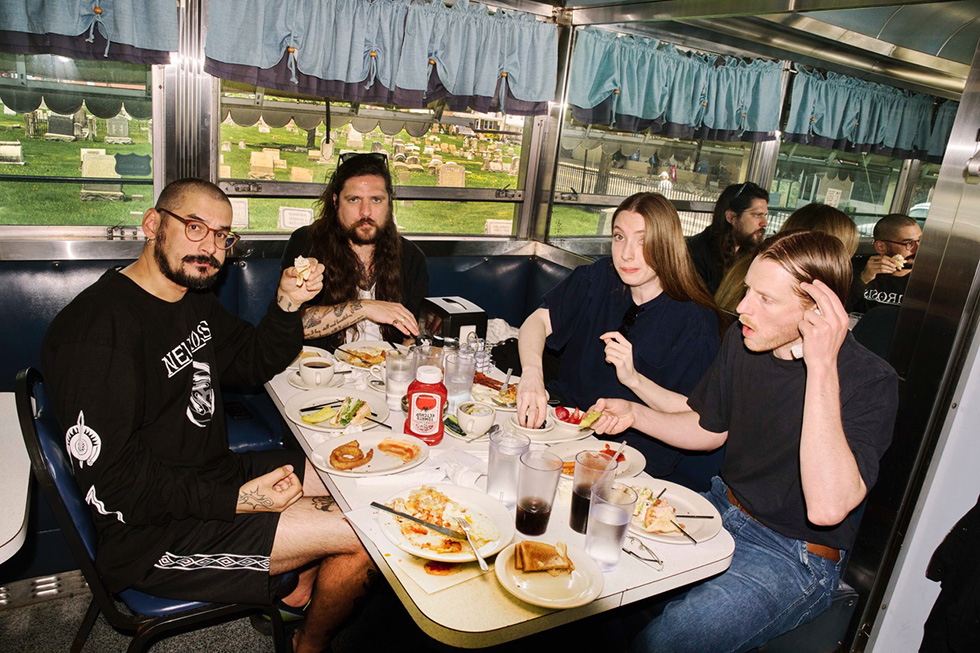
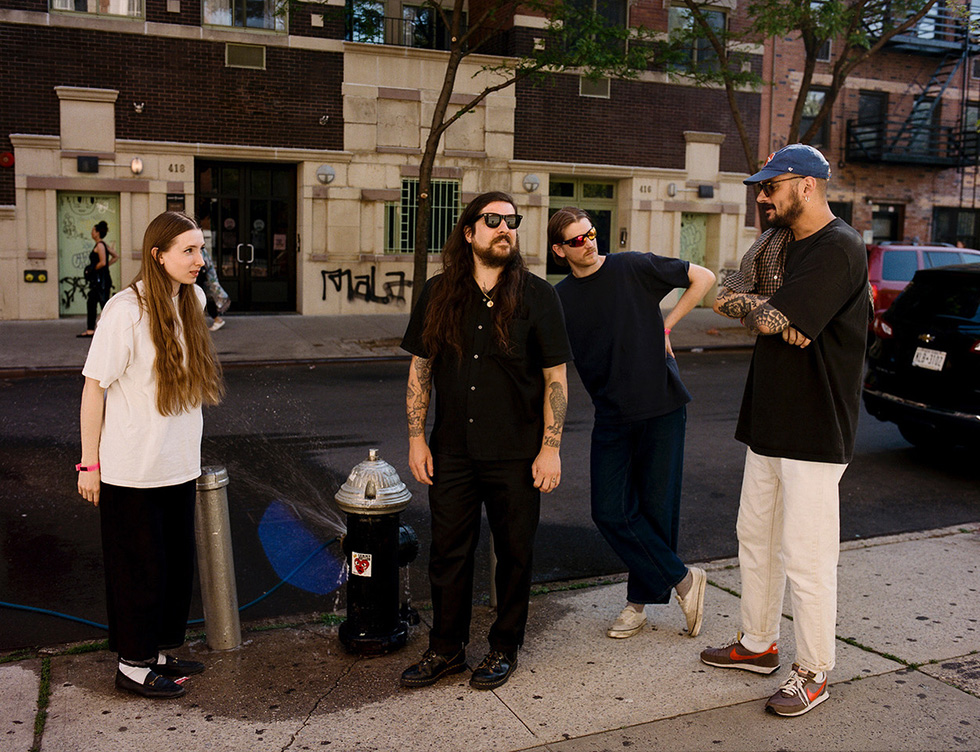
by Ben Rayner(左から取材に答えてくれたギターのトム、中央にベースのルイス、そしてヴォーカルのフローレンスにドラムのニック)

ニュースを見ていると、まるで悪夢だよ。しかも、すべてはいままでと同じような感じで進んでいる。新しい首相が誕生したことで、ひとつ言えることは、いまがまさにどん底だってことで、保守党政権の終焉を意味してるということ。12年間も緊縮財政を続けたのに、何の成長もなかったから、上層部の議員でさえ、もはや野党になる必要があるなんて言っているんだ。

私の家族も同じようなことを言っていますよ。さて、この話題をどうやって新しいアルバムにつなげようかな......(一同笑)。先ほど、普段通りの生活をしながらも、現在の状況が断片的に滲み出てきているとおっしゃっていましたね。もしイギリスの政治情勢がアルバムに影響を与えているとしたら、それは日常生活のなかに感じられる、そういったささやかな断片なのだと思います。例えば、ある曲でフローレンスは「Everything’s expensive…(何から何まで物価は高いし...)」と言っていますよね。

トム: 「Nothing works(何をやっても駄目)」そうなんだよ。俺たちがフローの歌詞についてコメントするのはなかなか難しいんだけど、彼女は、ひとつのテーマについて曲を書くということは絶対にしない人なんだ。彼女の曲を聴いていると、脳の働き方がイメージできる。俺は以前、自転車に乗っていて車に轢かれたことがあるんだが、気絶する直前、不思議なことがいろいろと頭に浮かんできたんだ。でも、さっき俺が言った「いままでと同じような感じで進んでいる」というのは、「いままでと同じような感じで進んでいるけど、すごく抑圧的な空気が影に潜んでいる」という意味なんだ。それでも仕事に行かないといけないし、請求書も払わないといけないし、日常のことはすべてやらないといけない。ただ、政治情勢がね……俺たちは12年間この状況にいたわけで、少しでも好奇心や観察力がある人なら、その影響を受けていると思うよ。

ルイス:俺たちはいつもひとつの場所に集まって、一緒に作曲をする。フローは、自分の書いた歌詞を紙に束ねて持って来るから、それを組み合わせたり、繋げたり、丸で囲んだり、位置を変えたりしている。そうやって、様々なアイデアが集まるコラージュのようなものを作っているんだ。

(ドライ・クリーニングの音楽を)聴いていると、何かの断片が自分を通り越していくような感じがするんです。

トム:でも、ランダムってわけじゃない。彼女は、歌詞を一行書くと、次は、逆の内容を書くという性分みたいなものがあると思う。響き的にも、テクスチャー的にも、コンセプト的にも、まったく違うものを書くんだよ。例えば、絵を描くときに、すべての要素がうまく調和するようにバランスをとっているような感じかもしれない。

ルイス:俺たちが自分たちのパートを演奏することで彼女の歌詞に反応するという、会話みたいなことをたくさんやっているんだ。

(アルバムには)日常生活の断片のような一面もあるので、自分たちでアルバムを聴いていて「あ、この会話覚えてる……」と思ったりすることはあるんですか?

トム:ああ、たしかに俺たちの言ったこととか、自分がいた場で友だちが言ったこととかが、歌詞に入ってるよ。

ルイス:俺たちの演奏と同じように、彼女も即興で歌詞を書くことが多いし、あらかじめ考えたアイディアも持っている。バンドで演奏しているときは、その場の音がかなりうるさいから、ヴォーカルだけ別録りして、フローが言ったことを自分で聴き返せるようにしたんだ。今回のアルバムでは、ファーストよりも、レコーディングのプロセスで歌詞を変えていたことが多かったみたいだけど、それほど大きな違いはなかったと思う。

トム:それは、スタジオでの即興をたくさんやったからということもある。でも、だいたいの場合、フローは俺たちが曲を作り始めるタイミングと同じ時に作詞をはじめるんだ。曲を書きはじめる時はみんなで集まって、ルイスが言っていたように、フローがやっている何かが、俺たちのやっていること、つまりサウンドに影響することがよくあるんだよ。“Gary Ashby”を作曲しているときは、フローが、行方不明になった亀について歌っていると知った時点で、こちらの演奏方法が変わった。フローが言っていることをうまく強調する方法を探したり、フローの歌詞をもっと魅力的にできるように、もっとメランコリックにできるように工夫する。以前なら使わなかったマイナーコードなどを使うかもしれない。音楽を全部作った後に、彼女が別の場所で歌詞を書くということはめったにないよ。もっとオーガニックな形でやってるんだ。

ルイス:俺たちは、他のメンバーへの反応と同じような方法で、フローにも反応する。俺がドラムに反応するのと同じように、彼女のヴォーカルにも反応するし、その逆もしかり。(フローの声は)同じ空間にある、別の楽器なんだ。

初期のEPや、特に前作と比べて、(作曲の)アプローチはどのように変化したのでしょうか?

トム:作曲のやり方はいまでも変わらないよ。基本的にみんなでジャムして作曲するんだ。

ルイス:携帯電話でデモを録ることが多いね。みんなでジャムしていて、「これはいい感じだな」と思ったら、誰かが携帯電話を使って録音しはじめる。そして、翌週にその音源で作業することもあれば、半年間放置されていて、誰かが「そういえば、半年前のジャムはなかなか良かったよな」って思い出すこともある。ほとんどの曲はそんな始まり方だよ。今回はスタジオにいる時間が長く取れたから、意図的に、曲が完成されていない状態でスタジオに入ったんだ。

トム:そう、アプローチの違いは、基本的に時間がもっと使えたということ。前回は2週間しかなくて、なるべく早く仕上げないといけなかった。

ルイス:それに、ファースト・アルバムのときは、事前にツアーをやっていたから、レコーディングする前にライヴで演奏していた曲もあったんだ。今回は、ツアーができなかったから、アルバムをレコーディングし終わって、いまはアルバムの曲を練習しているところなんだ。

なるほど。曲を作曲している段階で、観客の存在がなかったということが、この作品のプロセスにどのような影響を与えたのか気になっていました。

トム: 実際に曲をライヴで演奏して試してみないとわからないから、何とも言えないね。その状況を受け入れるしかなかったよ。ライヴで曲を演奏することができなかったから、自分たちがいいと思うようなアルバムを作ることにしたのさ。

ルイス:(自分たちの曲を)聴くってことが大事だと思う。スタジオでは、また違った感じで音が録音されるから。スタジオで実験できるのはとてもいいことだし、俺たちの曲作りのプロセスには聴き返すという部分が多く含まれている、ジャムを聴き返すとかね。もし俺たちがレコーディングして、それを聴き直して編集するという作業をしていなかったら、ほとんどの曲は、演奏していて一番楽しいものがベースになるだろうけど、実際はほとんどそうならない。聴き返すということをちゃんとしているから。ライヴで演奏できなかったけれど、結局、同じようなことが起こったと思う。つまり、何が演奏して楽しいかよりも、何が良い音として聴こえるか、ということに重きが置かれることになるんだ。

トム:それと、1枚目のアルバムで学んだのは、あるひとつの方法でレコーディングしたからといって、必ずしもそれがライヴで再現される必要はないということ。だから、今回のアルバムをいまになって、またおさらいしているんだ。アルバムには絶対に入れるべき要素もあるけれど、また作り直していいものもある。『New Long Leg』のツアーでは、“Her Hippo”と“More Big Birds”に、新しいパートを加えたり、尺を長くしたりしていたから、この2曲は(アルバムヴァージョンより)少し違う曲になったんだ。

ルイス:偶然にそうなるときもあるよね。ツアーを通して、曲が自然に進化していくこともある。

[[SplitPage]]

俺たちはいつもひとつの場所に集まって、一緒に作曲をする。フローは、自分の書いた歌詞を紙に束ねて持って来るから、それを組み合わせたり、繋げたり、丸で囲んだり、位置を変えたりしている。そうやって、様々なアイデアが集まるコラージュのようなものを作っているんだ。

今回のアルバムを聴いていてしばしば感じたことなのですが、曲が自然な形で完結し、これで終わりかなと思ったらまた戻ってきて、それが時にはそれまでとは全く違う感じになっているということがありました。それも、スタジオで色々と作業する時間が増えたからなのでしょうか?

トム:それにはいくつかの要因があると思う。まず、“Every Day Carry”を作ったときは、初めてスタジオで三つのパートを作って、そのなかでも即興演奏を加えたりした。“Conservative Hell”のときは、曲の最後の部分は、曲の最初の部分を完成させてから、何かが足りないと感じていたところに、ジョン(・パリッシュ、プロデューサー)が、何か作り上げようという気にさせてくれたから、出来たものなんだ。

ルイス:ファースト・アルバムでは、ジョンは曲を短くするのがとても上手だったけど、“Every Day Carry”では曲を伸ばそうという意図があった。ジョンにとっても、そのプロセスが実は楽しかったみたいだ。セカンド・アルバムのときも、ジョンはまた曲を短くするんだろうと覚悟していたんだけど、彼はもっと曲を伸ばそうとしていた。長くするのを楽しんでいたみたいだった。「曲は長い方がいいんだ!」とか言って。ジョンが曲を長くしてくれたことに、俺たちは驚きだったよ。

プロデューサーのジョン・パリッシュのことですね?

ルイス:そう。

ジョン・パリッシュは、私の地元ブリストル近辺の出身なんです。彼は、私が大好きなアルバム、ブリリアント・コーナーズの『Joy Ride』をプロデュースしたんですよ……(一同笑)。彼が他にも、さらに有名なアルバムを手がけているのは知っていますけど、私はとにかくブリリアント・コーナーズが大好きなんですよね。

トム:それがジョンのいいところだよね。自慢話をするような人ではないし、あまり有名人の名前を出したりしないんだけど、一緒に夕食をとっているときに、何か言ったりする。ジョンがトレイシー・チャップマンのレコードを手がけたって言うから、俺は「何だって!?」と思ったよ。彼にはそういうエピソードがあるんだけど、それは自然に彼から引き出さないといけないんだ。

ジョンとの制作は2回目ということで、親しみもあり、リラックスした雰囲気で仕事ができたのでしょうか?

トム:そうだね、それにはいくつかの理由があると思う。まず、自分たちの状態が安定していたということ。『New Long Leg』が好評だったことも自信につながったし、あの時点では、もっと大規模な公演にも出ていたから、とにかく気持ちが楽だったんだ。最初のアルバムでは、テイクを重ねながら、「これは絶対に素晴らしいものにしないといけないから、俺は全力を尽くさねば!」なんて思っていたんだけど、実際には、そんなこと思わなくていいんだと後で気づいた。アルバムを制作するということはとても複雑なことで、本当に数多くの段階があるから、ミキシングとマスタリングが終わる頃には、自分がそもそも何をしようとしていたのかさえ、すっかり忘れているんだ。だから、今回のアルバムでは、ある意味、ありのままを受け入れた。良いテイクを撮ろうとはするけれど、ジョンが満足すれば、次の作業に移るということをしていた。

ルイス:それにファースト・アルバムでは、ジョンと会った直後にレコーディングしたんだ。彼に会って、ほんの数時間で“Unsmart Lady”を録音して、次の曲に移って、また次の曲に移ってという感じ。バンドとして演奏する時間があまりなかったんだ。

トム:そうそう、それに前回は、彼が「それは嫌だから、変えて」とか言うもんだから、耐性のない俺たちにはショックだったよな(笑)。

ルイス:そうそう、で、トムは「え、今からですか?」ってなってたよね。前回は、日曜日に休みが1日だけあって、土曜日にジョンに「それは嫌だから、明日の休みの日の間に変えてくれ。では、月曜日に!」って言われたんだ。

トム:でも、前回のセッションが終わるころには、俺たちはすっかり溶け込んでいた。ジョンの仕事の仕方が気に入ったし、彼のコメントを個人的に受け止めなくていいってことが分かった。それに俺たちの自信もついたし、バンドとして少したくましくなったから、彼のコメントにもうまく対処できるようになった。だから、2枚目のアルバムでは、もしジョンが何かを違う風にやってみろと言ったら、俺たちは素直に違うやり方を模索した。

ルイス:それに、今回は音源に何か変更を加えるためにスタジオ入りしたという感じもある。最初のアルバムでは、多くの曲を既にライヴで演奏していたから、みんな自分のパートやアイデアに固執してしまっていて、それを変えるのは難しかった。でも今回は、もっとオープンな気持ちで臨んだんだ。

今回のアルバムは、ファースト・アルバムに比べて音の質感がかなり広がった感じがあります。それは自然にそうなったのでしょうか、それとも何か意識的に音を広げる要素があったのでしょうか?

トム:俺たちの音楽の好みが広いから、そうなることは自然だと思うんだよね。もし、もっと時間があれば、俺はアンビエント系のプロジェクトをやりたいと思うし、ルイスと一緒にメタル・バンドをやりたいとか、いつも思うんだよ。ニックはきっと何らかのダンス・ミュージックをやるだろうな。

ルイス:ドライ・クリーニングは、そうしたすべてのアイデアをさまざまな方向にうまく展開させた、素敵なコラボレーションなんだ。

トム:ルイスが1枚目のアルバムから今回のアルバムへの移行を説明したように、1枚目のアルバムでは、様々な方向に進むための余白がほとんど残っていなかった。2枚目のアルバムでは、そこから少し先に進めたという感じ。そして、もし次のアルバムを作る機会があれば、できれば3枚目のアルバムでは、さらにそれを発展させたいと考えているんだ。いろいろな道を模索していきたいと思っている。だから、もう少しアンビエントな方向に行きそうなときでも、「いや、こういう音楽は作りたくない」とはならずに、その流れに乗ることができるんだ。俺たちは、すでにそういう音楽が好きだからね。

ルイス:それに、スタジオで何ができるかということもいろいろと学んでいる。最初のEPはデモみたいなもので、2、3時間でレコーディングした。スタジオで演奏する時間があまりないから、リハーサルルームでいい感じに聴こえたものを、自分のパートとして書き留めていくような感じだった。2枚目のアルバムでは、スタジオ用に曲を書いていたという意識が強かった。曲を書いていて、トムが「この上に12弦ギターを乗せるべきだ!」などと言い出したりね。キーボードのパートがあったとしたら、ニックが静かに演奏しながら「アルバムではもっと大音量にするけど、こうやって弾くとすごくいい音になるんだよ」と言ったりね。そういう実験がもっとできるようになったんだ。

そのアンビエントな感じがもっとも顕著に表れているのが“Liberty Log”ではないかと思いますが、スポークン・ワードが大部分を占める曲のために作曲することというのは、従来のポップ・ソングのヴァース、コーラス、バースという構成に比べて、別のやり方で音楽を構成していくことになるのではないかと思うのですが。

ルイス:メンバーの誰かが「じゃあ、そろそろコーラスを演奏してみるか?」と言うんだけど、他のメンバーが「どれがコーラスなの?」って聞き返すことが何度もあったよ。

トム:そうそう、「どれがコーラス?」って。

ルイス:それで、どこがでコーラスなのか、みんなで決めるんだよ。

トム:それは実は良い傾向だと思うんだ。俺たちは皆、それぞれ別の考え方をしているけど、そんななかでも音楽は成立しているんだってこと。これは俺も同感なんだが、ルイスは過去のインタヴューで、俺たちのアイデンティティの強さのひとつは、すべての中心にフローがいることだと言っていて、彼女の声が俺たちをしっかりと固定して支えてくれることだと言っていた。たしかにミュージシャンとして、いろいろなものを取り入れる余地が与えられているように感じられるね。“Hot Penny Day”を書きはじめたとき、俺が最初にメイン・リフを書いたんだが、それは、『山羊の頭のスープ』時代のローリング・ストーンズみたいなサウンドに聴こえたんだけど...。

ルイス:誰かが、それをぶち壊したんだよ!

トム:それをルイスに聴かせて、一緒に演奏し始めたら、スリープみたいなストーナー・ロックみたいなものに変わり始めて、よりグルーヴィーになったんだ。

ルイス:そこにフローが加わると、一気にドライ・クリーニングのサウンドになるんだ。彼女の声や表現が、俺たちの音楽に幅を与えてくれていると思う。

トム:ミュージシャンとして、このメンバーと5年間一緒に仕事をしてきて、みんなそれぞれ、音のモチーフがあると思うんだ。ルイスだとわかる音があり、ニックだとわかる音があり、彼らにも俺だとわかる音がある。でもフローは間違いなくドライ・クリーニングという世界で、すべてを錨のように固定して、支えている存在なんだ。

by Ben Rayner

俺たちは皆、それぞれ別の考え方をしているけど、そんななかでも音楽は成立しているんだってこと。これは俺も同感なんだが、ルイスは過去のインタヴューで、俺たちのアイデンティティの強さのひとつは、すべての中心にフローがいることだと言っていて、彼女の声が俺たちをしっかりと固定して支えてくれることだと言っていた。

あなたがたが過去に活動していたバンド、サンパレイユとラ・シャークの作品を聴いていたのですが、例えばサンパレイユは一見パンク・バンドですが、わかりやすいパンク・バンドではないし、ラ・シャークは少しインディ・ポップ・バンドっぽいですが、これまたわかりやすいバンドではないように感じます。常に予期せぬ角度から攻めている気がするんです。

トム:俺たちが過去にいたバンドをチェックしてくれたのはすごく嬉しいよ! ドライ・クリーニングを理解するには、俺たちが過去にやってきたことがルーツになっていると思うからね。あなたが言う通り、俺たちは音楽の趣味が広い。俺が最初に経験した音楽はパンクやハードコアのバンドだったけど、スタイル的にかなり限界があると思っていたんだ。速い音楽のカタルシスも好きなんだけど、REMのメロディも好きなんだよ。ラ・シャーク(の演奏)は何度か見たことがあるけど、彼らは、明らかに歪んだ感じのポップ・バンドだったけど、後期の作品はインストゥルメンタルなファンカデリックのようなサウンドだったんだ。そんなわけだから、自分たちのいままでの影響をすべてひとつのバンドに集約するには時間が足りないんだよ。

ルイス:俺は運転中に、ふたつのバンドを組み合わせたらどうなるかっていう妄想をいろいろするんだけど、トムやニックやフローに会ったときに、そのアイデアを話すんだ。すると、彼らは「それ、やってみようよ!」と言ってくれる。で、やってみると、やっぱりドライ・クリーニングになるんだよね。ニュー・アルバムからフローのヴォーカルを抜いたら、いろんなジャンルに落とし込めそうな素材がたくさんあると思う。

フローレンスはすべての中心にいて、バンドのアイデンティティを束ねているとのことですが、同時に、彼女は少し離れているようなところもありますよね。新作では、ミックスの仕方だと思うのですが、以前よりもさらに、バンドがどこかひとつの場所で演奏しているように聴こえるのに、彼女のヴォーカルが入ってくると、まるで彼女が耳元で歌っているように聴こえるんです。まるで、自分がステージ上のバンドを観ているときに女性が耳元で囁いているような。

ルイス:それを聞いて、フローがバンドに入った経緯を思い出したよ。たしか、トムがバンド(の音楽)を演奏していたときに、フローがそれにかぶせるようにしゃべったのがはじまりだったね。

トム:俺たちは一緒にヴィジュアル・アートを学んでいて、当時は二人とも漫画の制作をしていて、その話をするために会ったんだ。彼女が「最近は他に何してるの?」と聞いてきたから、「ルイスとニックとジャムしはじめたよ」と答えた。そのときにちょうどデモがいくつかあったから、彼女に聴いてもらった。彼女はイヤホンを取り外して、「ふーん、面白いわね」と言って、喋りを再開したんだけど、まだイヤホンから音が出ていて、音楽が聴こえてきて、彼女の声がそれにかぶさっていた。ジョンが俺たちのバンドのことで一番興味があるのは、どうやってフローの声をミックスするかと言うことだと思うんだ。このアルバムでは、彼女の息づかいがかなり感じられるようになっている。フローはとても繊細なパフォーマーだから、彼女がするちょっとした仕草、例えば舌の動きとか、そういったごく小さな音も、ジョンは確実に取り込もうとする。このことについて、ジョンがインタヴューで語っているのを読んだことがあるけど、彼女がやっていることすべてを聴かなければならないと言っていた。それが第一で、それをベースにしてミックスを構築して、バンドの音を加えているんだ。

ルイス:レコーディングの時はいつも彼女も同席して、同時に彼女のトラックも撮る。スタジオには、隔離された部屋がいくつもあるから、俺のアンプは1つの部離すためにかなりの工夫がされているから、バンドの音の影響をあまり受けないようになっているんだ。トムが言ったように、ジョンはその点にかなり重点を置いている。

[[SplitPage]]

The texture of broken things

by Ian F. Martin

Stumpwork is a funny word. It feels funny in your mouth, and it only gets more awkward once you start breaking it down to untangle its meaning. A stump is a broken or incomplete thing — the remains of a dead tree or the place where an amputated limb used to attach — and it seems like a strange thing to dedicate one’s labour toward.

It refers to a form of embroidery where threads or other materials are layered to create an embossed, textured pattern, giving a feeling of three dimensional depth to the image, and perhaps in this we can reach out and contrive a connection with the increasingly rich and intricately textured music of Dry Cleaning. But we shouldn’t forget that it’s first and foremost a viscerally strange and funny word.

Florence Shaw is one of the most interesting lyricists in the English language right now, and she has a remarkable instinct for interesting and evocative phrasing. Just as with the title itself, she seems to take a sort of joy in the inherent sonic texture of a word — the way she hangs on the hard t and trailing vowels of the word “otters” in the song Kwenchy Kups is both musical and quietly comical. There’s a constant delight in the awkwardness of small errors and unconventional phrasings that reveals itself in words and expressions like “dog sledge”, “shrunking” and “let’s eat pancake” that deviate disconcertingly but never incomprehensibly from linguistic norms. This playful texture is also ever-present in her instinct for juxtaposing the magical and the mundane that results in lines like, “Leaping gazelles and a canister of butane”. Dry Cleaning’s lyrics play out like a story where the connecting tissue of narrative has been stripped out, leaving only the details and colour — a collage of dozens of voices that adds up to an impressionistic emotional tableau.

Musically, Stumpwork reveals a broader, richer palette than the band’s (also excellent) 2021 debut full-length New Long Leg. The band’s sound has often been characterised with the elastic term post-punk, and you can hear elements that recall the choppy angles of Wire or the chiming sounds of Felt and Durutti Column in Tom Dowse’s expressive guitar work, but he takes it further this time, twisting it into queasy, drunken distortions or ambient haze. Bassist Lewis Maynard and drummer Nick Buxton make for a subtle and imaginative rhythm section that brings in ideas and dynamics from beyond punk and indie tradition. Smooth washes of almost city pop synth welcome you into opening track Anna Calls From The Arctic, and unexpected and oblique arrangements pull you gently one way and another throughout the album. It’s not an album possessed of an urgent need to grab your attention so much as a shimmering palette of colours to melt into.

It’s not an as disaffected and worn as ever. Britain’s confused political situation filters through, most explicitly in the song title Conservative Hell, and I catch up with Tom and Lewis in the middle of a particularly chaotic moment. The Queen has just been buried a couple of weeks prior, and the delusional cruelty of prime minister Liz Truss has recently replaced the ramshackle cruelty of Boris Johnson, but not quite yet given way to the vacant, lifeless cruelty of Rishi Sunak.

It’s been three years since I last had a chance to visit the UK, so I open with a big question.

IAN: So what’s it like living in Britain these days?

TOM: If you look at the news, it’s a living nightmare. Beyond that, though, things just carry on kind of as they were before, really. One thing that I think has happened now with the new prime minister is that this is the nadir: this is the endgame of Conservative politics. We’ve had twelve years of austerity and no growth, and even high ranking MPs are sort of admitting that they need to be an opposition party now. So one good thing about that is that the Conservatives are going to get voted out in the next election. The downside is that until that happens, we have to live with the stupid policies they have.

LEWIS:Even someone like my sister, who totally ignores it, even she’s like, “It’s shocking; it’s really fucking expensive!” — the bills, the food shopping, it’s getting really tough now.

T:That’s a really good point. If you want to lose the next election, fuck with people’s mortgages!

I:I’m hearing similar things from my family too, yeah. So seeing if I can segue this into the new album… (everyone laughs) What you were saying earlier about life going on as normal but with little pieces of the situation coming through, it feels like if the political situation in the UK informs the album, it’s in these little fragments filtering through normal life, like at one point Florence just remarks, “Everything’s expensive…”

T:“Nothing works.” Yeah, it’s quite difficult for us to comment on Flo’s lyrics, but she’s definitely the kind of person who wouldn’t make a song about one subject. Her songs remind me of the way your brain works. I remember being hit by a car on my bike once, and on the edge of the void there’s all sorts of strange things that come to your mind. But I should clarify what I said earlier about how everyone’s just getting on with things: everyone’s just getting on with things but under a very oppressive shadow. You still have to go to work, you still have to pay your bills, you still have to do all the normal things, it’s just that the political climate — we’ve been under this for twelve years, and if you’re an even slightly curious or observant person, it’s going to affect you.

L:We write together in the room at the same time, and she’ll have a stack of papers which will have lyrics that she’s written and will sort of combine and join together, and there’s lots of circling that and dragging it to that, making almost a collage where lots of different ideas come together.

I:When I’m listening, it feels like fragments of something flowing past me.

T:It’s not random though. When she writes a line, she has the sort of temperament to write the opposite line next — something completely different tonally, texturally, conceptually. It’s almost like when you’re making a painting or something, you’re trying to balance all the elements so it works nicely.

L:There’s a lot of reacting to us in the room playing our parts and us reacting to her, like a conversation.

I:There’s such an aspect of fragments of daily life to it and I wonder if there’s ever a sense where you’ll be listening to it and think, “Oh, I remember that conversation…”

T:Oh, there’s definitely things that we’ve said or things that friends have said when I was there and they’re in the lyrics.

L:And like ourselves, she improvises a lot when writing her lyrics as well as having some pre-formed ideas. We’ve had to get better at finding ways to record because the room’s quite loud when we’re playing, so a lot of times we’ll separately record the vocals so she can hear back what she said. I think on this record the lyrics changed more when it came to recording than on the first record, but not a huge amount.

T:That was partly because we improvised quite a lot of stuff in the studio. But generally, Flo will start at the same time we start writing the song. We’re all there at the start of it, and like Lewis says, a lot of the time there’s something Flo is doing that informs how we’re doing our thing as well — tonally, if that makes sense. When we were writing Gary Ashby, when I found out she was singing a song about a tortoise that’s gone missing, it changes the way you play; you find ways of punctuating what she’s saying, making it more charming or melancholy, you might use a minor chord or something that you wouldn’t have done before. It’s rare that we’ll write a whole song and then she’ll go away and write all the lyrics — that never happens, and it’s a more organic thing.

L:We’ll react to her in the same way we react to each other. I’ll react to the drums in the same way I react to the drums and the guitar, and vice versa. It’s another instrument in the room.

I:How has the approach changed, since the early EPs and the last album in particular?

T:We still write in the same way. We write by basically just jamming together.

L:There’s a lot of phone demos. We’ll be having a jam, think “This sounds OK” and someone just clicks on their phone and starts recording, and then sometimes we’ll work on it the next week or sometimes it’ll get lost for six months and someone will be like, “Hey, that jam from six months ago was quite good.” That’s how almost everything starts. This time, because we had more time in the studio, we intentionally went in with ideas less finished.

T:Yeah, the change in approach was basically that we got more time. Before we had two weeks to get it down as quickly as possible.

L:Also, with the first record, we were doing some tours beforehand, so we were playing some of that record live before we recorded it. This time we didn’t get a chance to do that: we recorded it and now we’re in the process of learning it.

I:Right, and I was wondering how not having the constant physical presence of the audience while you were developing the songs affected the process on this one.

T: It’s hard to say really, because without actually road testing the song, you never know. We just embraced it really: we couldn’t play live, so we just write the album the way we wanted to.

L:It comes down to listening, because things get captured differently in the studio as well. It’s quite nice to be able to try something in the studio and a lot of our writing process comes down to listening — like listening back to jams. It’s a nice way of doing it, because if we weren’t recording and listening back and editing from there, a lot of our songs would be based on what was the most fun to play, but that rarely happens because it’s all about listening. And I think that happens as well with not being able to play it live: it’s less about what’s fun to play and more about what sounds good.

T:I think also we learned from the first record that just because you’ve recorded a song one way, that’s not necessarily how it has to be live again, so that’s why we’re sort of relearning the album now. There’s things on the album that definitely need to be on there, but there’s also things that we can just make up again.Touring New Long Leg, there’s Her Hippo and More Big Birds where they just changed and became slightly different songs — added a new part to them, made them longer.

L:Sometimes by accident as well. Sometimes they kind of naturally evolve through a tour.

I:One thing that happens a few times on the new album is that a song will work its way to a natural sounding conclusion, I’ll think it’s ended, but then it will come back and sometimes as something quite different from what it was before. Was that something that came out of having more time to play around in the studio?

T:I think there’s several factors there. First, when we did Every Day Carry, that was the first time we did that in the studio, literally making three parts and kind of improvising some of them. When we did Conservative Hell, that whole last section of that song really came from the first part of the song down and feeling like there was something missing, and John (Parish, producer) was very good at motivating us to just go and make something up.

L:On the first album, John was quite good at making songs snappy, but with Every Day Carry we sort of extended it — and I think he quite enjoyed that process. When it came to the second album, we were kind of prepared for him to make things shorter again, but he seemed to extend stuff more. i think he kind of enjoys it, like, “It’s good when it’s longer!” He surprised us quite a lot by extending songs.

I:That’s John Parish, your producer, right?

L:Yeah.

I:He’s from around my hometown in Bristol. He produced one of my favourite albums, Joy Ride by The Brilliant Corners… (everyone laughs) I know he’s done way more famous albums than that, but they’re one of my favourite bands!

T:That’s one of the great things about John: he’s not the kind of person to brag about things or he doesn’t namedrop much, but when you’re having dinner, he’ll say something — he told me he did a Tracy Chapman record, and I was like, “What!?” He’ll have these stories, but you have to get it out of him naturally.

I:Was it more relaxing working with him this second time, with the familiarity?

T:I think in several ways. Firstly, we were more comfortable, just in ourselves; we’d been doing it longer and had more confidence. The fact New Long Leg did well gave us confidence, we’d played bigger shows by that point, and we were just feeling comfortable. I remember doing takes on the first record and feeling, “This has to be amazing, I have to give this everything!” and then you realise you don’t. Making an album is so complicated, there’s so many layers to it that by the time it’s mixed and mastered, you’ve completely forgotten what it was you were trying to do. So definitely on this one we sort of accepted things the way they were; you try to get a good take, if John’s happy, you move on to the next thing.

L:With the first one as well, we recorded it so quickly with John. We met him and within a few hours, we’d tracked Unsmart Lady, then we moved on to the next one and moved on to the next one. We didn’t have time to play so much.

T:Yeah. And it was a bit of a shock to the system last time when he would say things like, “I don’t like that. Change it.” (laughs)

L:And you’d be like, “Uh… now?” We had one day off last time, on the Sunday, and on Saturday, he was like, “I don’t like that. Change that tomorrow on your day off. See you Monday!”

T:But by the time we got to the end of that session, we were really onboard with it. We liked the way he worked and you just don’t take it personally. Because you’re more confident, a bit more robust, you can deal with it a bit better — you expect it and you welcome it. So with the second record, if he says to go and do something differently, that’s what you’re looking for.

L:And we’d go into the studio looking for things to change. With the first record, we’d been playing a lot of those songs live, so maybe people were a bit more fixed on their parts and their ideas, so that’s harder to change. This one was a bit more open to change.

I:The sonic texture of this album feels a lot broader than the first one. Did that come naturally, or was there some sort of conscious element to expanding the sound?

T:I think it’s natural in the sense that our listening tastes are so broad. I often feel that if I had more time, I’d do some kind of ambient project, or me and Lewis could do a metal band together. For sure Nick would do some kind of dance music, wouldn’t he?

L:And Dry Cleaning’s a nice collaboration of all those ideas pulling nicely in different directions.

T:The way Lewis described the transition from the first record to this one, it’s like the first record left little markers down for different directions to go in and on the second record we take them all a little bit further. And then hopefully on the third one if we get the opportunity to do another one, we’ll take it even further. It’s all about exploring different avenues. So when things seem to go a little more ambient, we’re already into that kind of music and we’ll go with it as opposed to being sort of, “Oh, I don’t want to make that kind of music.”

L:We’re learning more about what we can do in the studio as well. The first EP was really like a demo, recorded in a couple of hours. You don’t get much time to play in the studio, so you sort of write your parts for what sounds good in the rehearsal room. Writing the second record, we were writing for the studio more. We’d be writing a song and Tom would go, “There should be a twelve string on top of this!” There’d be a keyboard part here, or Nick would be playing really quietly and saying “On the record it’s going to be really big but it just sounds good the way I’m hitting it like this.” You get to experiment more like that.

I:I suppose it’s on Liberty Log where that almost ambient feeling is most pronounced, and I was wondering if writing for what’s mostly spoken word lends itself to a different way of structuring music compared to the traditional pop song structure of verse-chorus-verse-chorus.

L:There were a lot of times where one of us would say, “Should we do the chorus now?” and then we’d be like, “Which one’s the chorus?”

T:Yeah, “What’s the chorus?”

L:And we’d all have to agree on what’s the chorus.

T:Which I think was a good sign, actually. It shows how we’re all thinking in different ways but music is getting done. I think I agree: Lewis has said before in other interviews that one of the strengths of our identity is you have Flo in the middle of everything, and her voice anchors you, and certainly as a musician it feels that you’re given a lot of room to chuck things in. When we first started writing Hot Penny Day, initially when I wrote the main riff it sounded like Goats Head Soup-era The Rolling Stones to me…

L:And then someone fucked it up!

T:And then when I showed it to Lewis and we started playing it together, it started turning into something more like Sleep or stoner rock — made it more groovy.

L:And then Flo gets involved and it instantly sounds like Dry Cleaning. I think her voice and her delivery gives us a lot of scope.

T:I mean, as musicians, having worked with these guys for five years, I think we all have our own sonic motifs — I can tell it’s Lewis, I can tell it’s Nick, they can tell it’s me — but Flo definitely anchors things in Dry Cleaning world.

I:I was angles.

T:I’m really glad you checked our previous bands! I think if you want to understand Dry Cleaning, it has roots in what we’ve done in the past. Like you say, because we’ve got broad music taste, my first experiences in music were in punk and hardcore bands but I did find them stylistically quite limiting. I like the catharsis of fast music, but I also like the melody of REM. I remember seeing La Shark a few times and it was clearly a sort of skewed pop band but their later stuff sounded like instrumental Funkadelic, so it’s almost like there isn’t enough time to put all your influences into one band.

L:I’ll be driving and have little fantasies about combining two bands, and then I’ll meet up with Tom or Nick or Flo and I’ll say that, and they’ll be like, “We should do that!” And once again, it’s still Dry Cleaning. If you took Flo’s vocals off the new album, there’s so many different genres you could put stuff into.

I:You say Florence is in the centre of it all, holding the identity of the band together, but at the same time, she’s also a little bit separate from it in some ways. On the new album, even more than before, the way it’s mixed you hear the band playing, who sound like they’re in a room somewhere, but then her vocals come in and it’s like she’s right up against your ear. Like you’re watching a band on the stage and there’s just this woman whispering in your ear!

L:That reminds me of Flo’s story about her joining the band started with you playing the band and her talking over the top of it.

T:We’d studied visual art together — we were both making comics at the time, and we met up to talk about that. She asked, “What else have you been up to?” and I said, “I’ve started jamming with Lewis and Nick.” I had some demos and she listened to it. Then she took her earphones out, said, “Oh, that’s interesting,” and started talking, and I could hear the music still with her voice over the sound out of the earphones in the background. I think John’s key interest in our band is how he mixes Flo. On this record to a much greater extent you can hear bits of her breath. Flo is a very nuanced performer: just the little things she does, like the click of her tongue or something — very small sonic things that he’s very keen to make sure are in there. I’ve seen him talking about this in an interview, about how you have to hear everything she’s doing: that’s the first thing, and then around that, he builds the mix and brings the band in.

L:She’s always in the room when we’re recording, and she’s tracking at the same time. We’re lucky enough to have isolated rooms, so my amps can be in one room, Tom’s amps can be in another room, Nick could be behind some glass, Flo’s in the room with us, and she keeps a lot of those vocals. There’s a lot of effort put into isolating her vocals so there’s not too much bleed from the band. I agree with what Tom said, John puts a lot of focus on that.

Moor Mother - ele-king

 1960年代後半から1970年代初頭にかけて、ドラマーのアーサー・テイラーは、当時を代表するジャズ・ミュージシャンたちにインタヴューを行い、後に著書『Notes and Tones』にまとめた。ジャズが商業的な影響力を失いはじめた時代を捉え、シーンにおける政治的な力学から、当時は「フリーダム・ミュージック」と呼ばれていた音楽の様式的な刷新に至るまでのさまざまな議論が交わされているわけだが、なかでももっとも論争を引き起こしたのは、ジャズという言葉そのもので、アート・ブレイキーがたいした問題ではないと主張した一方、マックス・ローチなどはニューオーリンズの売春宿を起源とし、文脈によっては“クソ”と同義的に使われることもある言葉を自分たちの音楽に押し付けられたことに不快感を示した。ニーナ・シモンはこの問いかけに異なる角度からアプローチし、テイラーに「ジャズはただ音楽であるというだけでなく、生き様であり、在り方であり、物の考え方。それは、アフロ・アメリカ系の黒人を定義するものだ」と語った。
 『Jazz Codes』を聴きながら、私はこのことを思い出した。ムーア・マザーの最新ソロ・アルバムは、亡き詩人アミリ・バラカの精神にのっとって、過去と現在(彼女の言うところの「パッド(メモ帳)とペンで瞑想する)」のジャズ・ミュージシャンたちのリズムをリフにすると同時に、音楽を埋め込まれた記憶や奥深い真実として、異界の領域への入り口のように扱っている。2020年の『Circuit City』では、「タイムトラベルや 内外の次元を追求することは不可能‏‏/フリー・ジャズなしには」と宣言している。また、アルバムと同じぐらいの長さのビリー・ウッズとのコラボレーション作「Brass」では、「ブルースは、国が忘れてしまった全てのことを覚えている」と注目曲のひとつで書いている。

 『Jazz Codes』では、ムーア・マザーの最近のソロ・ミュージックの瑞々しさというトレンドが引き継がれ、2020年のロックダウン時にリリースされた『Clepsydra』や『ANTHOLOGIA 01』、そして昨年の『Black Encyclopedia of the Air』で紡いだ糸を繋いでいる。彼女は再びスウェーデンのプロデューサーでインストゥルメンタリストのオロフ・メランダーと組み、ある種の明晰夢の状態にあるイリュージョン(幻影)と暗示の音楽を呼び起こしている。いくつかの曲は小品に過ぎないが、これらは人を酔わせる、宇宙的な作品だ。

 いちばん長く、人を惑わせるような“Meditation Rag”では、サン・ラからジェリー・ロール・モートン、フィスク・ジュビリー・シンガーズといったアーティストの名前を挙げながら、そのまわりをアリャ・アル=スルターニのソプラノのヴォーカルが分散する光のように浮遊し、まるで降霊術の会の様相を呈している。他では、ジェイソン・モラン、メアリー・ラティモアにアイワのインリヴァーシブル・エンタングルメンツのバンド仲間がインストゥルメンタルで貢献し、R&Bヴォーカルのフックやサイケデリックな煌めきや、不明瞭なトリップ・ホップのリズムを紡ぐ。コラボレーションの多いこのようなアルバム制作では、あえてフォアグラウンド(前景)とバックグラウンドを分けていない事が多く、重なり合うヴォイスのなかからリスナー自身が、どれに焦点を当てて聴くのかを選ぶことを任される。
 クロージング・トラック“Thomas Stanley Jazzcodes Outro”では、作家でアーティストのトマス・スタンリーがテイラーの著書のテーマを拾い上げている。

  多くの評者たちが
  ジャズはかつてセックスを意味したと言っている
  そしておそらく、
  ジャズはセックスを意味するものに
  戻る必要があるだろう
  性行為や交尾、
  ハイパー・クリエイティヴィティ、
  繁殖力、
  そして誕生と同一視されるように。

 『Jazz Codes』の気だるいグルーヴは、アイワがイリヴァーシブル・エンタングルメンツとともに披露する扇情的なフリー・ジャズとは別世界のように思えるが、どちらも音楽が解放の源となり得るという鋭い認識を共有している。

 それはまた、彼女と同じフィラデルフィア在住のDJハラムとのデュオ、700 Blissの『Nothing To Declare』でもときどき響いている。このアルバムは、ムーア・マザーの作品のなかでも、2016年の『Fetish Bones』に代表されるようなより挑戦的な側面が好きなファンには即座に魅力的に映るだろうが、ここではサウンドと怒りがある種の無頓着なユーモアのセンスによって抑制されている。
 とくにアルバムの前半は、〈Hyperdub〉レーベル・メイトのアヤ(ピッチシフトを好む傾向を含めて)と共通する何かがあり、後半ではクラブから遠くへ離れ、ときには毒気の少ないファルマコンにも似た趣となる。アイワの歌詞は徹底的にルーズで、歌うような韻と言葉のフィジカリティを楽しんでいるように聞こえる。“Bless Grips”で彼女がデス・グリップスのフロントマン、MCライドのリズムを真似る様子をチェックしてほしい。まるでコメディの寸劇のような“Easyjet”では、700 Blissをあきれ顔で批判する二人組をデュオが演じている(おいおい、これはそもそも音楽と言えるのか?)
 しかし、より深いところまで切り込んでいるのは、傑出した曲たちだ。“Capitol”でのアイワの冒頭のヴァースは、血で書かれた一般教書演説で(夢の成分をすすりたい/私たちを奴隷にした奴らの喉を切り裂きたい)、何時間でも没頭できる。ほぼインダストリアル・テクノのような“Anthology”では、20世紀半ばに人類学に基ずき振付を芸術に変えた〝ラック・ダンスの女家長〟として活躍したキャサリン・ダナムにオマージュを捧げている。
 さらに、数年前にリリースされた“Sixteen”は、このデュオのこれまでの最高傑作といえるかもしれない。アイワは、「もう戯言にはうんざりだ、世界はとても暴力的だ/自分だけの島が欲しい。でも奴らが気候を破壊した」と激しく非難し、ダンスフロアに自らを解き放つ前に「私はただ踊って汗をかきたい/踊って忘れてしまいたいだけ」と歌う。それは、世界がどれほどひどい場所かというのを無視することではなく、生き残るためのツールを見つけることだ。それは音楽であるというだけでなく、生き様や物の考え方のひとつなのだから。


by James Hadfield

In the late 1960s and early 1970s, the drummer Arthur Taylor conducted a series of interviews with some of the day’s leading jazz musicians, later collected in his book “Notes and Tones.” It captured a period when jazz was losing its commercial clout, while debates raged over topics from scene politics to the stylistic innovations of what was then still called “freedom music.” But one of the most contentious issues was the word itself: jazz. While Art Blakey insisted it was no big deal, others, such as Max Roach, were upset that their music had been lumbered with a term that originated in the brothels of New Orleans, and in some contexts could be used interchangeably with “shit.”

Nina Simone approached the question from a different angle. “Jazz is not just music, it’s a way of life, it’s a way of being, a way of thinking,” she told Taylor. “It’s the definition of the Afro-American black.”
I was reminded of this while listening to “Jazz Codes.” Moor Mother’s latest solo album finds her working in the spirit of the late poet Amiri Baraka, riffing on the rhythms of jazz musicians past and present (“meditatin′ with the pad and the pen,” as she puts it), but also treating the music as a source of embedded memories and deeper truths—a portal to other realms. As she declared on 2020’s “Circuit City”: “You can’t time travel / Seek inner and outer dimensions / Without free jazz.” Or, in the words of one of the standout tracks from “BRASS,” her album-length collaboration with billy woods: “The blues remembers everything the country forgot.”

“Jazz Codes” continues the recent trend in Moor Mother’s solo music towards lushness, picking up the thread from her 2020 lockdown releases “Clepsydra” and “ANTHOLOGIA 01,” and last year’s “Black Encyclopedia of the Air.” Once again, she works with Swedish producer and instrumentalist Olof Melander to conjure a sort of lucid-dream state: a music of illusions and allusions. Even though some of the tracks are barely more than vignettes, this is heady, cosmic stuff.
On “Meditation Rag,” one of the longest and most transporting songs, she seems to be staging a seance, name-checking artists from Sun Ra to Jelly Roll Morton to the Fisk Jubilee Singers as the soprano vocals of Alya Al-Sultani float spectrally around her. Elsewhere, instrumental contributions—including by Jason Moran, Mary Lattimore and Ayewa’s bandmates from Irreversible Entanglements—weave together with R&B vocal hooks, psychedelic shimmer and slurred trip-hop rhythms. In an album heavy on collaborations, the production often doesn’t distinguish between foreground and background, leaving listeners to decide which of the overlapping voices to focus on.
On the closing track, “Thomas Stanley Jazzcodes Outro,” author and artist Thomas Stanley picks up on a theme from Taylor’s book:

“Many observers have told us that jazz used to mean sex
And maybe it needs to go back to meaning sex:
To being identified with coitus and copulation,
Hyper-creativity, fecundity and birth.”

Although the languid grooves of “Jazz Codes” may seem a world apart from the incendiary free-jazz that Ayewa serves up with Irreversible Entanglements, both share a keen awareness of how music can be a source of liberation.
That’s echoed occasionally on “Nothing to Declare” by 700 Bliss, her duo with fellow Philadelphia resident DJ Haram. It’s an album that will instantly appeal to fans of the more confrontational side of Moor Mother’s work, typified by 2016’s “Fetish Bones,” though here the sound and fury is tempered by an insouciant sense of humour.

Especially during its first half, the album has something in common with Hyperdub label-mate Aya (including a penchant for pitch-shifted vocals); later on, it drifts further from the club, at times resembling a slightly less bilious Pharmakon. On many of the tracks, Ayewa’s lyrics sound downright loose, happy to delight in sing-song rhymes and the physicality of words; check the way she seems to mimic the cadences of Death Grips frontman MC Ride on “Bless Grips.” There’s even a comedy skit, “Easyjet,” in which the duo play a pair of eye-rolling naysayers talking smack about 700 Bliss (“I mean, come on, is this even music?”).
However, the standout tracks are the ones that cut a little deeper. You could spend hours picking apart Ayewa’s opening verse in “Capitol,” a state-of-the-nation address written in blood (“I wanna sip what dreams are made of / I wanna slice the throat of those who enslaved us”). On “Anthology”—over a track that’s practically industrial techno—she pays tribute to Katherine Dunham, the “matriarch of Black dance,” whose pioneering anthropology transformed artistic choreography during the mid-20th century.

Then there’s “Sixteen,” first released a couple of years ago, which may just be the best thing the duo has done so far. “I'm tired of the bullshit, the world's so violеnt / I just want my own island, but they destroyed thе climate,” Ayewa declaims, before finding her release on the dancefloor: “I just wanna dance and sweat / I just wanna dance and forget.” It’s not about ignoring what a fucked-up place the world is, but finding the tools to survive. It’s not just about the music: it’s a way of being, a way of thinking.

ISSUGI - ele-king

 復活した MONJU としての活躍も記憶に新しい ISSUGI がニュー・アルバム『366247』を完成させた。ソロとしては2019年の『GEMZ』以来、およそ2年半ぶりとなる。バンド・サウンドに挑戦した前作から打って変わり、今回は DJ SCRATCH NICE がメインのプロデュースを担当。本日先行公開された “April” からして抜群にカッコいいです。発売はCDとデジタルが7月20日、LPが11月16日。

MONJUとしての新作リリースも記憶に新しいISSUGIの約2年ぶりとなる9thアルバム『366247』のリリースが決定! NYから帰国したDJ SCRATCH NICEがメインでプロデュースを担当しており、KID FRESINO、BES、Eujin KAWIが参加した先行シングル"April"が本日より配信開始!

◆DOGEAR RECORDSの中心的存在であるMONJU、そしてBudamunk、5lackと共にSICK TEAMのメンバーであり、BES & ISSUGIやISSUGI & DJ SHOEとしての作品リリースなどソロでの活動だけに留まらず様々な形で作品をリリースし続け、またビートメーカー/DJ名義である16FLIPとしての活動も高く評価されているラッパー、ISSUGI。

◆仙人掌、Mr.PUGとのユニットであるMONJUとしての待望の新作リリースも記憶に新しい中、ISSUGI名義でのオリジナル・アルバムのリリースが決定。ISSUGI名義としては2019年の『GEMZ』以来、約2年ぶり9作目となる今作にはその仙人掌、Mr.PUG、さらにKID FRESINOや弗猫建物のEujin KAWIとVANY、『VIRIDIAN SHOOT』と『PURPLE ABILITY』の2作をこれまでにジョイント・リリースしているBESといった馴染の面々の他、ISSUGI楽曲では初共演となるSPARTAや東京のヒップホップ・クルーであるonenessのstzが参加。

◆2015年にリリースしたジョイント・アルバム『UrbanBowl Mixcity』を筆頭にこれまでに幾度もコラボしてきた盟友とも言えるプロデューサー、DJ SCRATCH NICEがメインでプロデュースを担当。16FLIPのプロデュース曲も収録。またDJ Shoe、DJ K-Flashがスクラッチで参加。

◆KID FRESINO、BES、Eujin KAWI(弗猫建物)が参加した先行シングル"April"(prod DJ SCRATCH NICE)が本日より配信開始!

*ISSUGI "April" feat. Eujin KAWI, KID FRESINO & BES
Stream/Download/Purchase:
https://p-vine.lnk.to/pL0Pi3

アーティスト:ISSUGI
タイトル:366247
レーベル:P-VINE, Inc. / Dogear Records
仕様:CD / LP(完全限定生産) / デジタル
発売日:
CD・デジタル / 2022年7月20日(水)
LP / 2022年11月16日(水)
品番:
CD / PCD- 25347
LP / PLP-7876
定価:
CD / 2.750円(税抜2.500円)
LP / 4.378円(税抜3.980円)

[TRACKLIST]
01. Dime
 prod DJ SCRATCH NICE
 Scratch by DJ SCRATCH NICE
02. G.U.R.U. ft Mr.PUG
 prod DJ SCRATCH NICE
 Scratch by DJ SHOE
03. April ft Eujin KAWI, KID FRESINO, BES
 prod DJ SCRATCH NICE
04. from Scratch
 prod DJ SCRATCH NICE
05. Game Changer
 prod DJ SCRATCH NICE
06. Rare ft VANY
 prod DJ SCRATCH NICE
 Scratch by DJ SCRATCH NICE, DJ K-FLASH
07. Real ft SPARTA
 prod DJ SCRATCH NICE
08. Perfect blunts
 prod 16FLIP
09. Ethology ft stz, 仙人掌
 prod DJ SCRATCH NICE
10. 366247 
 prod DJ SCRATCH NICE
11. End roll
 prod Daworld

[PROFILE]
東京都練馬区出身のラッパー / ビートメーカー。
中学の頃に出会ったスケートボードの影響からヒップホップを聴き始め、自身もリリックを書き、曲を作り始める。MONJU、SICK TEAM、BES & ISSUGI等としても作品を出し続け 16FLIP名義では、ビートメイクやDJもこなす。ソロを含めこれまでに多数のアルバムやミックス作品をリリース。2022年7月にソロ9thアルバム「366247」をリリース。東京Dogear RecordsをRepresent。

  1 2 3 4 5 6 7 8 9